
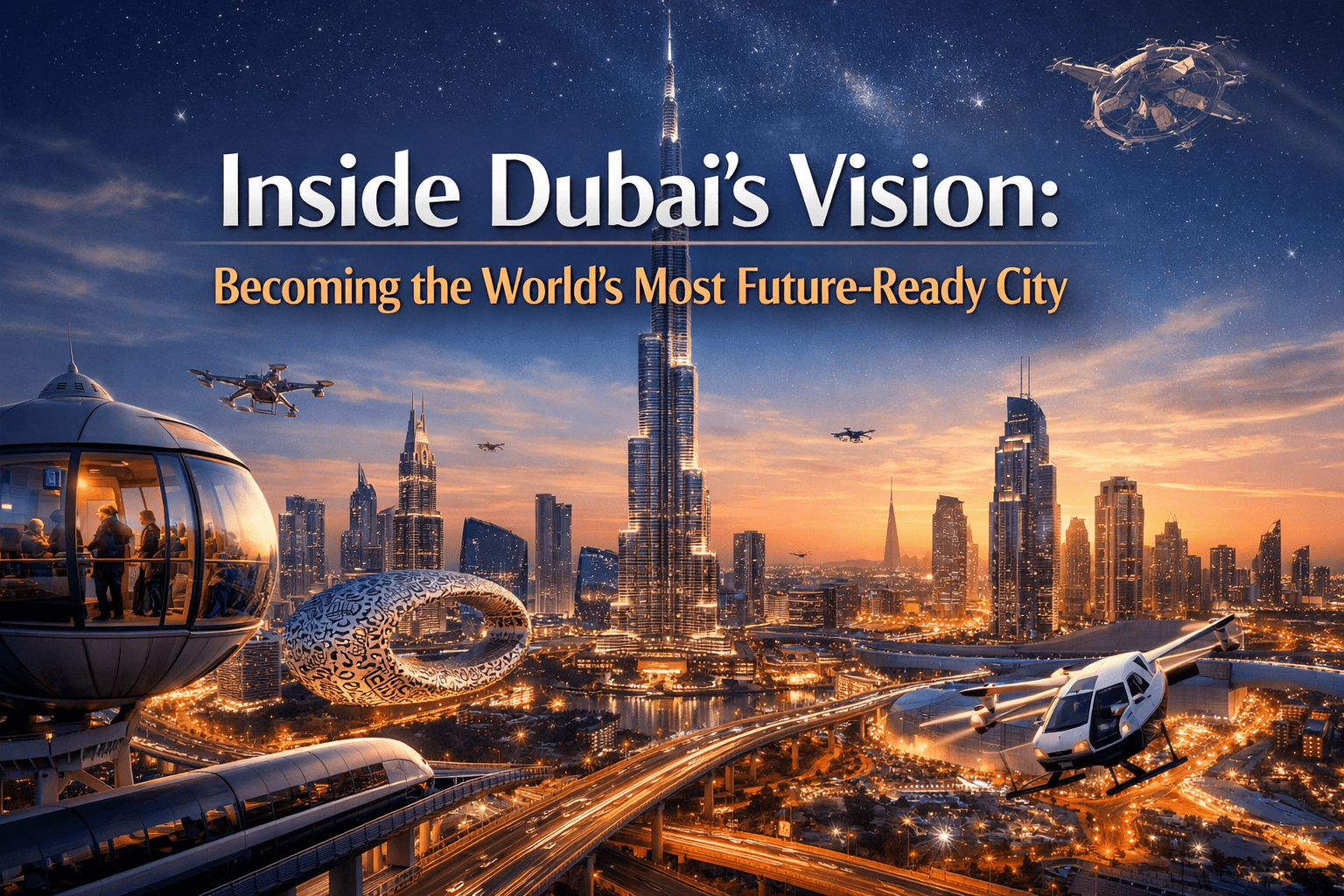
With Dubai 2040 Urban Master Plan, Green Development, Air Taxis, AI integration, Expo city, and world-class infrastructure Dubai seems ready for the future!
From a busy trading hub of the world to one of the most advanced and strategically planned cities, Dubai has transformed itself in the past few decades. Today, Dubai is attracting investors from around the world not just with its iconic skyscrapers and luxury real estate, but is also impressing the world with its visionary governance and urban planning. For global investors, entrepreneurs and residents, Dubai offers a rare blend of opportunity and execution ability.
Recently, Dubai has become the first Gulf city to join the Global Resilient Cities Network, reflecting the emirate’s determination to proactively prepare for future challenges. Additionally, Dubai has moved eight places to rank 4th in the world in the IMD Smart City Index 2025, issued by the IMD World Competitiveness Centre. This achievement has highlighted Dubai’s position as the highest-ranked city in the GCC, the Arab world and Asia. Dubai is emerging as a global leader in smart city development and urban modernisation.
This article explores how Dubai is becoming a future-ready city through the Dubai 2040 Urban Master Plan, green city expansion, air taxis, road network modernisation, tourism leadership, Expo City transformation, and advanced infrastructure systems.
What makes Dubai future-ready
- Dubai 2040 Urban Master Plan
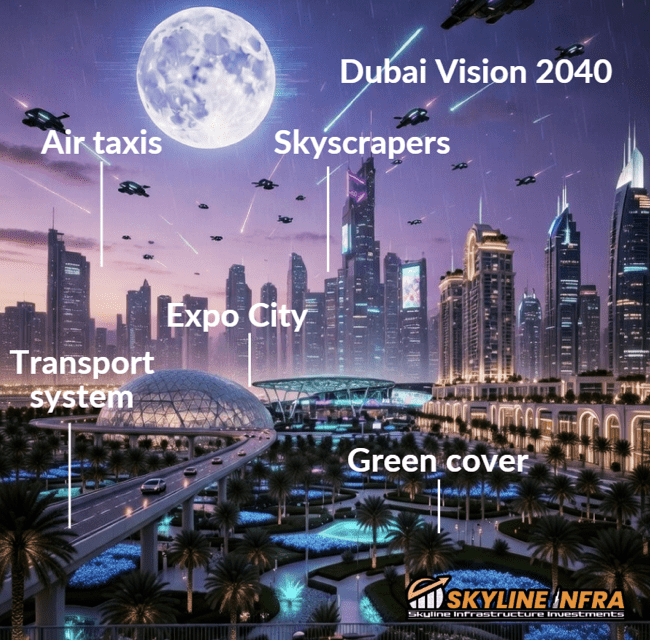
The forward-thinking Dubai government has been working constantly to introduce new policies and roadmaps to ensure the continued growth in the emirate. Dubai 2040 Urban Master Plan is one of the most ambitious plans to transform it into a sustainable and people-oriented city. To further improve the quality of life, this visionary plan for Dubai creates a strategy for the future development of Dubai. The key focus areas are green development, improved infrastructure, affordable housing, mixed-use urban spaces and creating cultural innovation hubs. The plan works to develop green spaces by about 55% and increase the beach area by 400%. With sustainability and smart city technology, Dubai is well-positioned to emerge as a global model for urban innovation and liveability. The Master Plan will work to encourage the use of mass transit, cycling, walking and the flexible modes of transportation, increase area for hotels and tourist activities. Additionally Dubai is investing heavily in Artificial Intelligence, paperless governance, blockchain systems and digital economy, which make it ready for a smarter today and tomorrow.
2. World’s biggest airport
Dubai has started the construction of ‘world’s largest’ airport at a cost of $35 billion that will have 400 gates and five parallel runways. The airport will have the capacity to annually handle about 150 million passengers. The airport is expected to be operational in 10 years. According to sources, Dubai officials claim to make the Dubai airport ‘the world’s airport’. Called the Al Maktoum International Airport, it will be about five times bigger than the current Dubai airport.
3. Air taxi
Dubai is expected to launch the world’s first urban aerial taxi network in 2026. The four key vertiport locations have been identified, which are DXB, Downtown Dubai, Dubai Marina and Palm Jumeirah. Dubai is all set to experience the future where electric air taxis will offer fast and sustainable travel, by significantly bringing down the commute time across the city. Spearheaded by the Roads and Transport Authority (RTA), these sites were selected to connect the major transport hubs and tourist spots for quick travel from point to point.
4. Road network
Dubai’s Roads and Transport Authority has been working to improve road connectivity to ease congestion. For example, a recent upgrade has increased the traffic-handling capacity on Sheikh Zayed bin Hamdan Al Nahyan Street by up to 40%, and reduced travel time to Sheikh Mohammed bin Zayed Road to just 4 minutes, a 60% reduction. Similar upgrades are planned to benefit more than 80,000 residents by 2030. Dubai is not shying away from using technology to ease up traffic congestion. The city has successfully implemented a transformative smart traffic system that integrates AI and V2X technology. With this upgrade, traffic signals get directly connected to vehicles and provide real time data, such as optimal speed advice and countdown timers. Additionally, the RTA has added two kilometres of cycling tracks to promote healthy living and sustainable mobility.
5. Focus on tourism
Dubai’s tourism sector is one of the significant drivers of economic diversification and sustainable growth, aligned with the goals of the Dubai Economic Agenda D33. As per the data published by the Dubai Department of Economy and Tourism, Dubai welcomed about 20 million international overnight visitors in 2025, which was a 5% increase in comparison to 2024. Dubai has also secured a spot among the top three global travel destinations, alongside Tokyo and London. The growing popularity of Dubai can be understood from the fact that the city welcomed more than 2 million visitors in December 2025.
Three Dubai properties have made it to the World’s 50 Best Hotels 2025 list, as announced in October 2025, which are Atlantis The Royal, Jumeirah Marsa Al Arab and The Lana Dubai. In 2025, the city welcomed new property openings, including Ciel Dubai Marina, Vignette Collection by IHG, Jumeirah Marsa Al Arab, Mandarin Oriental Downtown, Cheval Maison in Expo City and Vida Dubai Mall. Dubai has won several accolades in 2025, which highlight Dubai’s commitment to accessible travel, sustainable future and safety. These global accolades include being the first Certified Autism Destination in the Eastern Hemisphere, one of the world’s ten safest cities in Numbeo’s Safety Index, and the world’s best city for solo female travellers by InsureMyTrip.
6. Expo city
Dubai is building a huge exhibition centre with an investment of AED10 billion. Under the Dubai 2040 Urban Master Plan, the expansion of Expo Centre is key to Dubai’s vision to emerge as a dynamic economic hub, hosting global exhibitions and events. The goal here is to build an iconic venue that will become the largest indoor events and exhibition destination in the area. The Dubai management has reaffirmed their commitment to consolidate the status of Dubai as a top global destination for mega events.
Wrapping up
Dubai has strategically planned to achieve the visionary goal of becoming the world’s most futuristic city by building Expo City Dubai, Dubai 2040 Urban Master Plan and expanding Al Maktoum International Airport, which will become the world’s largest airport once fully operational. The well-synchronised development plan is set to push forward this unique urban hub, highlighting Dubai’s approach in launching a blueprint for a future city. The infrastructure developments, cultural authenticity, sustainable urban planning and other strategic initiatives will reinforce Dubai’s tourism ecosystem. Indeed, Dubai is shaping a future-forward metropolis that sets new standards for excellence in the world.



Join The Discussion