


Over the years, Dubai has emerged as one of the promising real estate markets that has attracted the interests of investors from all around the world. With tax-free environment, world-class infrastructure, regulated realty market, structured payment plans, the opportunities are indeed compelling. However, for many prospective Indian investors, one question still remains – How do I invest in Dubai securely and systematically in Dubai real estate while sitting in India? This is exactly where Skyline Infrastructure investments steps in.
Though Dubai real estate market is structured and regulated, still it might feel overwhelming for the investors to navigate it remotely. The challenges faced by them may be around understanding Dubai Real Estate Regulatory Authority or RERA, identifying high yield locations, understanding developer’s background or credibility, selecting from under-construction versus off-plan projects and more. For Indian investors looking for transparency and systematic advisory, Skyline Infrastructure investments stands as a reliable partner.
Step-by-step Investment Journey
We recommend a five-steps approach for your investment journey in Dubai –
1. Understand where you can buy in Dubai
Indian property buyers can only purchase property in freehold zones, which allow complete ownership of the property. The top freehold areas for Indian buyers are Downtown Dubai, Dubai Marina, Business Bay, Jumeirah Village Circle Arjan and Dubailand. Dubai South is one of the emerging markets of Dubai where there is a lot of government focus these days. While selecting a property, have a clear goal – whether you want the property for capital gain, rental return or lifestyle upgrade?
2. Keep a budget a side
Set a realistic budget for your investment. Property prices in Dubai can vary as per location, amenities and the status of the project – whether it is off-plan (interest-free plan) or ready-to-move-in. The off-plan units are offered by the developers at launch prices and therefore, they are usually lower than the completed projects. As there is progress in project construction, demand increases and property values move forward. They hold an advantage for the investors as it gives them a window where entry price is lower, market exposure begins and value appreciates over time.
A general cost breakdown for properties –
Fluctuations in currency exchange – INR to AED
Property price – Rs 1.50 crore and up for decent options
Fee for Dubai Land Department – 4% of property value
3. Choose the Right Property
The choice of property type is important for long-term returns. We advise our customers to select apartments when they are looking for rental returns; go for villas as they are luxurious choice for families; buy off-plan properties as they are under construction and cheaper. The off-plan properties are ideal when you are looking for long-term investment for capital appreciation, while ready-to-move-in properties are often selected for immediate rental income. We provide you property options from reputed developers, such as Emaar, DAMAC, Sobha, Danube so that you get best quality and credible choices.
4. Legal Process
After finalising a property, you need to —
- i) Sign the Sales Purchase Agreement that outlines property details and payment terms
- ii) Pay 5–10% of the total property value as booking amount
- iii) Register the property with Dubai Land Department and pay 4% transfer fee
- iv) Get NOC from developer and transfer ownership.
- v) Keep the necessary KYC documents ready along with proof of funds or mortgage approval.
For the Indian investors, it is important to understand the concept of TCS on foreign remittance. When one sends money outside India, they may have to pay foreign remittance tax in India, which is also known as Tax Collected at Source or TCS on foreign remittance. Under Section 206C (1G) of the Income Tax Act, TCS is collected by banks and authorised dealers when funds are transferred overseas. It is important to note that one can adjust the total TCS amount as per their tax liability. For investment and property purchase, TCS is nil up to Rs 10 lakh and 20% for the mount more than Rs 10 lakh.
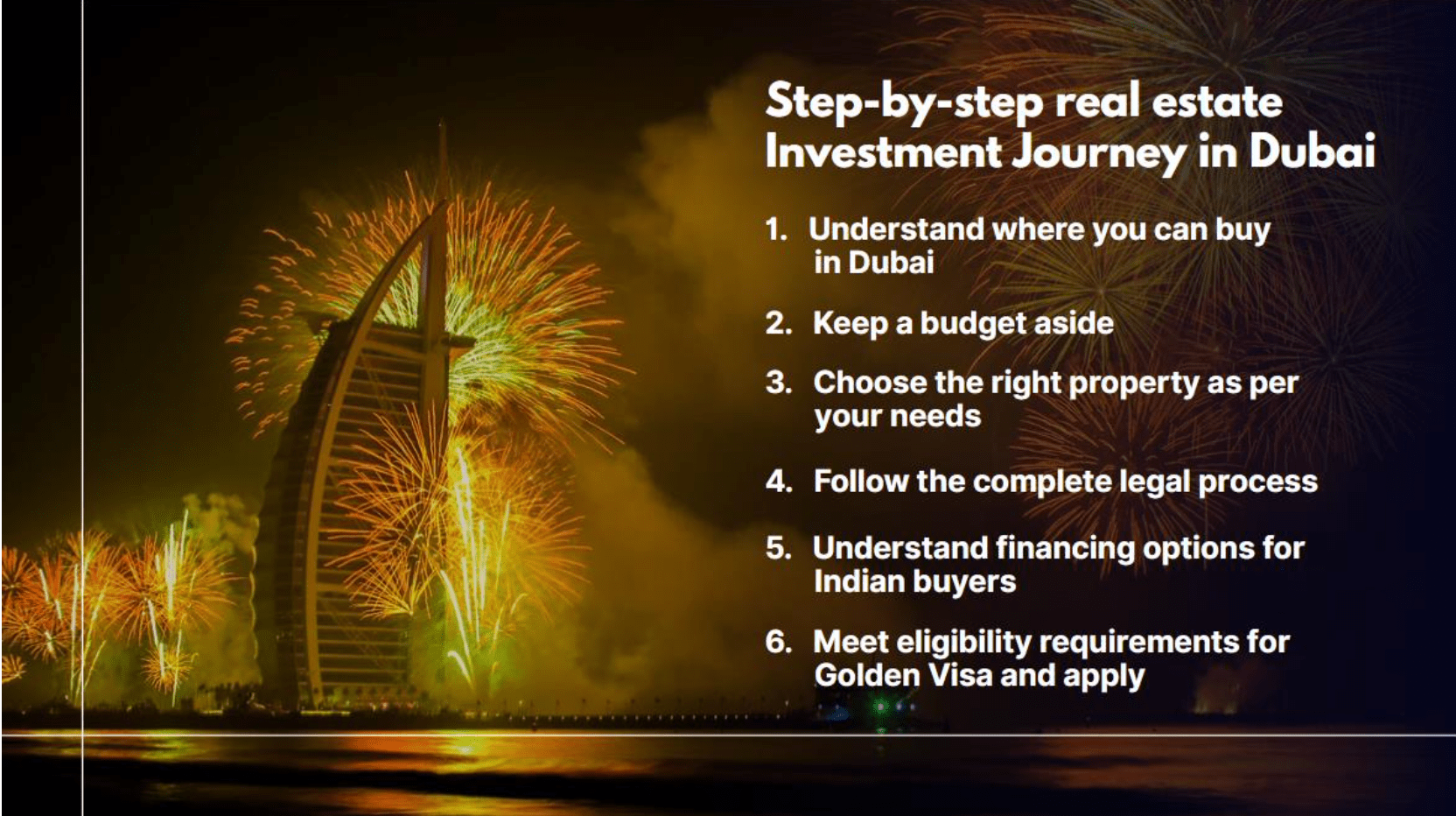
5. UnderstandfinancingoptionsforIndianbuyers
If you are not planning to make an upfront payment for your Dubai property, you can opt for developer payment plans or apply for a home loan from a UAE or certain selected Indian banks. Most of the banks in Dubai grant loans to foreign buyers, as long as they meet the required eligibility guidelines around income, residency, and at times, employment in approved companies. Usually, banks finance up to 50% of the property value for people outside their country.
6. Apply for a Golden Visa
Golden Visa is a long-term residence visa that enables eligible persons to live or study or work in the UAE and enjoy exclusive benefits. Business persons with a project worth 500,000 and more dirhams, specialised talent like doctor, scientists, artists, humanitarian workers, real estate investors, students etc are eligible to apply for Golden Visa. It is generally valid for 5 to 10 years on case- to-case basis. Here are the key features and benefits of Golden visa –
• It is basically the United Arab Emirates residence by investment program that provides long-term residency to foreign business persons, investors and talented persons. By obtaining the UAE Golden Visa, applicants get access to world-class infrastructure, a favourable tax regime and a secure lifestyle for their families.
- A minimum investment of AED 1 million, about USD 280,000, is required for 5-year visa, for investors aged 55 and over, or AED 2 million, about USD 550,000 for 10-year visa for investors of any age.
- The applicant can add spouse and unmarried children of any age at no additional cost.
- With the Golden Visa, you can live, work and study in UAE without any need for local sponsor.
- Golden visa holders can easily travel in and out of the UAE, as it is a multiple-entry visa.
- You get complete ownership of your business and are free to engage in business deals not just in Dubai, but throughout the country.
- You get access to UE’s world-class heath facilities and significant discounts with certain healthcare providers.
- In many cases, you may not need to pay the complete price of the property upfront.
- One gets the right to live in one of the seven Emirates.
Frequently Asked Questions :-
Q1. Can I buy property in Dubai if I am not a resident?
Absolutely. The non-residents can buy a property in Dubai, given that their purchase is within the designated freehold areas. The Freehold areas, such as Business Bay, Downtown Dubai, Discovery Gardens, Dubai Marina, Jumeirah Lake Towers, etc are open to all nationalities and do not require UAE residency to buy a property.
Q2. What is the process of buying property in Dubai?
The Dubai real estate market is one of the most regulated and transparent property markets is in the world. The process is well-defined and straightforward. This is the reason why there is growing interest of international investors in Dubai, as they can purchase off-plan or ready-to- move-in properties remotely with the help of a registered broker and Power of Attorney, as required.
Q3. What are the key factors that make Dubai a real estate hotspot?
Dubai has become one of the attractive real estate destinations in the world, not only for Indian, but global investors. With tax-free environment, regulated market with the Dubai RERA, attractive rental income, high yield, structured payment plans, financing options, etc, Dubai offers several attractive investment opportunities.
Q4. What is the initial payment required to secure a property that I want to buy in Dubai?
Once you finalise the property you want to buy, in most cases, you will be required to pay a ‘Expression of Interest (EOI)’ so that the seller can hold the unit for you. The token amount may start from as low as AED 25,000-4000. After the token amount is paid, the next payment can be about 5% of the total unit purchase price.
Q5. What are the key differences between India and Dubai real estate market.
Dubai and Indian real estate markets are fundamentally different. Dubai offers high rental yield, tax-free and freehold properties for foreigners, whereas Indian market focuses on long-term capital appreciation. Dubai real estate market offers luxury, themed villas and serviced apartments, while India is driven by domestic and location-oriented demand. Dubai realty market is strictly regulated where investments are secured via Escrow accounts and projects are not delayed, unlike Indian real estate market.
















Join The Discussion