
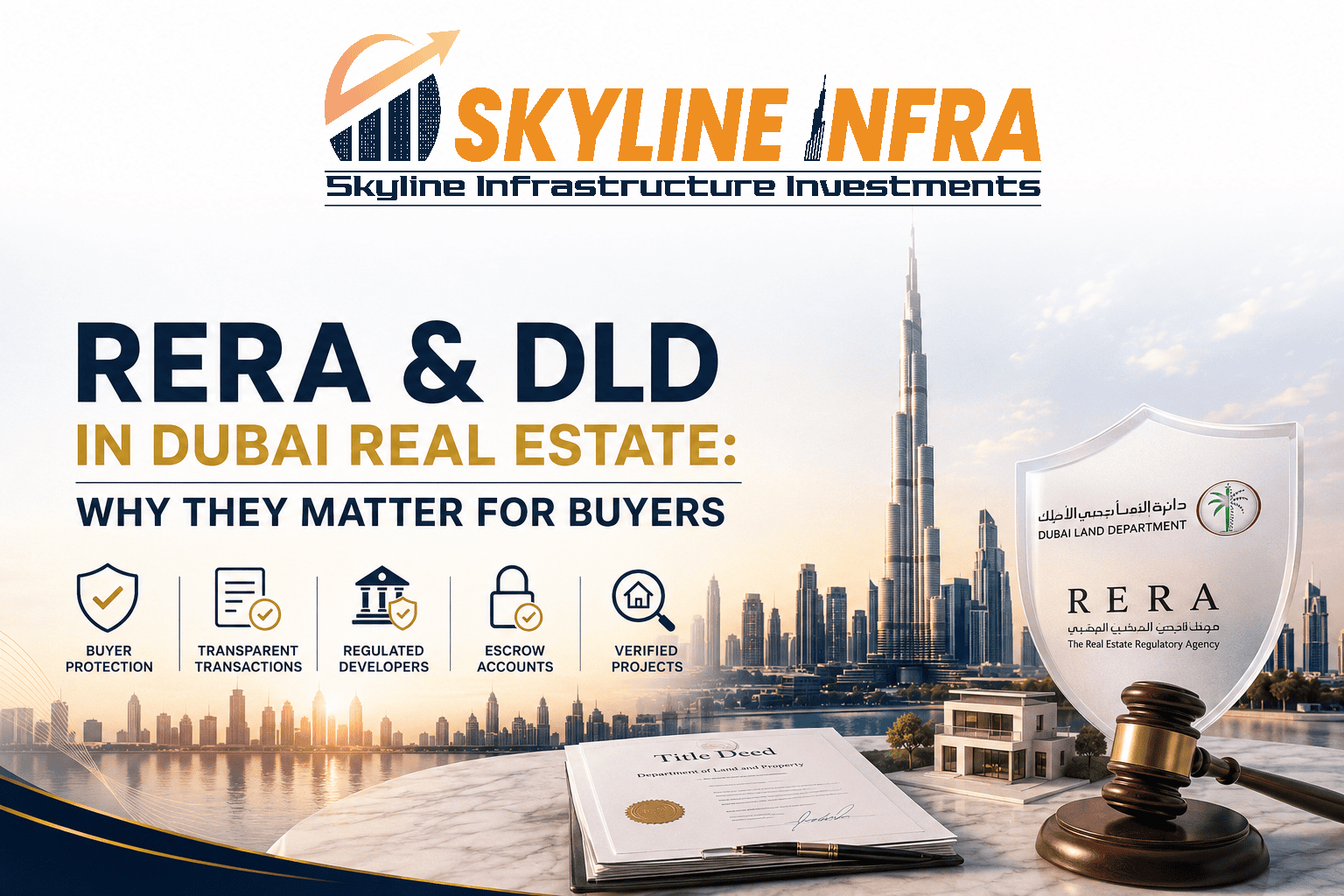
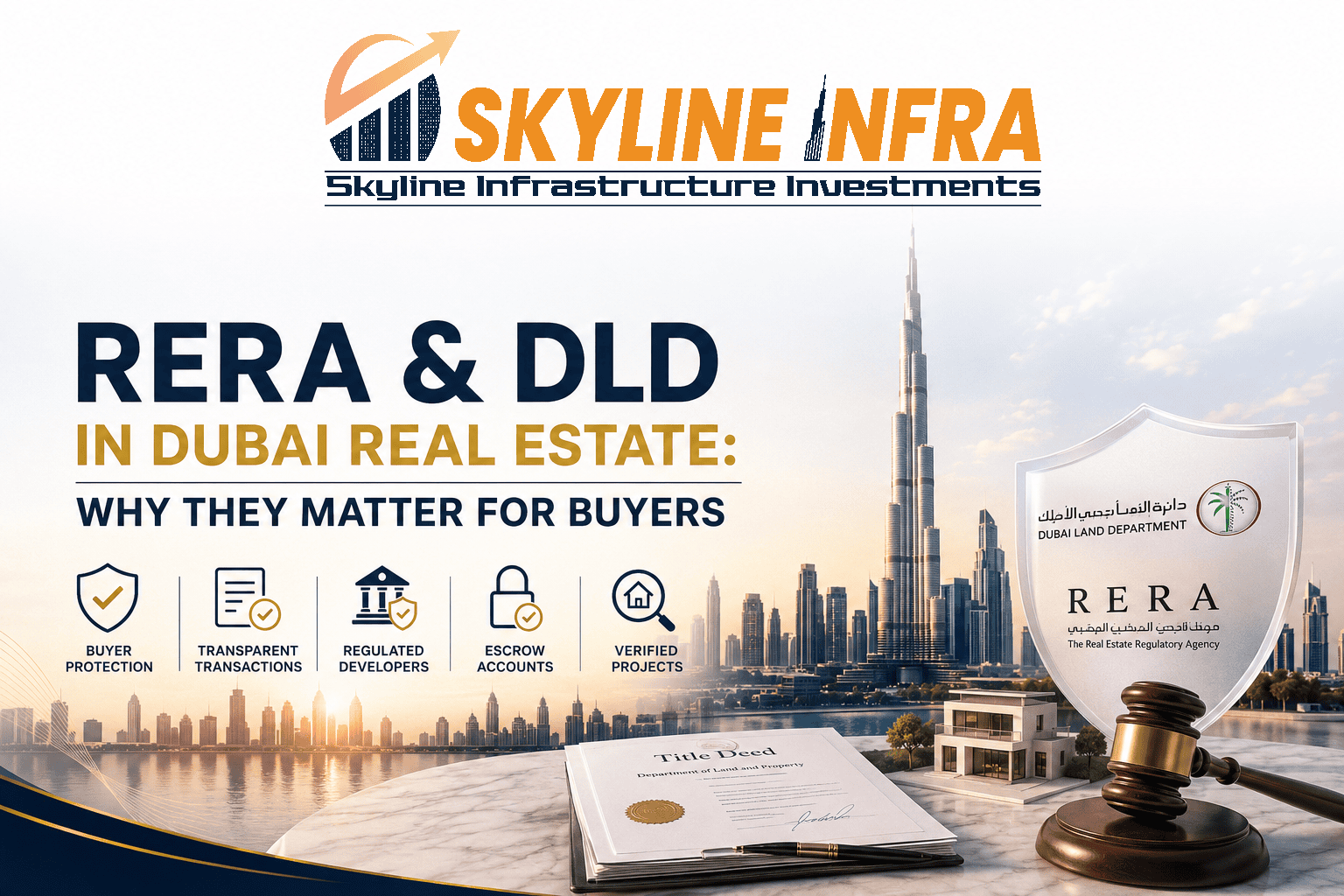
Dubai has transformed into one of the world’s most trusted real estate investment destinations. Investors from more than 200 RERA and DLD in Dubai Real Estate are the foundation of one of the world’s most transparent and investor-friendly property markets. Whether you’re buying an off-plan apartment, a luxury villa, or your first investment property, understanding how the Dubai Land Department (DLD) and the Real Estate Regulatory Agency (RERA) work can help you make informed decisions and protect your investment.
Dubai has transformed into one of the world’s most trusted real estate investment destinations. Investors from more than 200 nationalities purchase residential and commercial properties across the emirate every year, attracted by tax-efficient ownership, premium infrastructure, strong rental demand, and a transparent legal framework.
Unlike many international property markets, Dubai’s success isn’t driven only by iconic skyscrapers or luxury developments. Behind every successful property transaction is a robust regulatory system designed to protect buyers, maintain market confidence, and ensure transparency.
At the heart of this system are two key government authorities:
- Dubai Land Department (DLD) – Responsible for property registration, title deeds, and official ownership records.
- Real Estate Regulatory Agency (RERA) – Regulates developers, brokers, escrow accounts, and market practices to safeguard buyers.
Whether you’re purchasing your first apartment, investing in an off-plan project, or building an international real estate portfolio, understanding how DLD and RERA operate can help you avoid costly mistakes and invest with confidence.
In this comprehensive guide, you’ll learn how these authorities work, why they matter, how they protect investors, what Oqood registration is, how escrow accounts function, and the essential checks every buyer should complete before paying a booking amount.
Why RERA and DLD in Dubai Real Estate Are More Important Than Ever
Buying property is one of the largest financial decisions most people will ever make. Understanding RERA and DLD in Dubai Real Estate is essential because these two authorities help create a transparent, well-regulated, and investor-friendly property market. Whether you’re purchasing a ready home or an off-plan property, knowing how DLD and RERA work can significantly reduce investment risks.
While buyers often focus on location, developer reputation, and expected rental income, experienced investors know that strong regulation is just as important as return on investment (ROI).
Without a well-regulated market, buyers may face risks such as:
- Misleading advertisements
- Unlicensed brokers
- Delayed project handovers
- Ownership disputes
- Poor documentation
- Misuse of buyer funds
- Lack of legal transparency
Dubai has spent decades strengthening its real estate regulations through the Dubai Land Department (DLD) and the Real Estate Regulatory Agency (RERA). These institutions have introduced stricter licensing requirements, escrow account regulations, digital property services, and buyer protection measures that have helped make Dubai one of the world’s most transparent real estate markets.
Today, investors benefit from:
- Digital property services through Dubai REST
- Licensed and regulated real estate brokers
- Government-verified project information
- Escrow account protection for eligible off-plan developments
- Electronic property registration and title deeds
- Transparent ownership records
- Improved market confidence through regulatory oversight
This robust regulatory ecosystem is one of the biggest reasons why RERA and DLD in Dubai Real Estate continue to strengthen investor confidence and attract buyers from more than 200 nationalities every year.
Quick Overview: What Is the Difference Between DLD and RERA?
Although the two names are often mentioned together, they perform different functions.
| Authority | Main Responsibility | Why Buyers Should Care |
| Dubai Land Department (DLD) | Registers property ownership, title deeds, mortgages, property transfers and official records. | Confirms legal ownership and maintains transparent property records. |
| RERA (Real Estate Regulatory Agency) | Regulates developers, brokers, escrow accounts, advertisements and property management companies. | Protects buyers by regulating the real estate industry. |
A simple way to remember it is:
DLD manages the property.
RERA regulates the property market.
Together, they create one of the strongest regulatory systems in global real estate.
What Is Dubai Land Department (DLD)?
Established in 1960, the Dubai Land Department (DLD) is the government authority responsible for managing and documenting all real estate transactions within Dubai.
Its mission is to create a transparent, efficient, and investor-friendly property market while protecting the rights of buyers, sellers, developers, and financial institutions.
Whenever a property changes ownership, DLD records the transaction and maintains the official legal records.
Without DLD registration, ownership cannot be legally recognized.
Key Responsibilities of Dubai Land Department
1. Property Registration
Every completed property sale must be officially registered.
This creates a permanent legal ownership record and protects buyers from ownership disputes.
2. Title Deed Issuance
Once ownership has been successfully transferred, DLD issues the property’s official Title Deed.
This document confirms who legally owns the property and is one of the most important records every property owner should keep safely.
3. Mortgage Registration
When buyers finance a property through a bank, DLD records the mortgage against the property.
This creates transparency for both lenders and property owners.
4. Property Valuation Services
DLD also provides official valuation services for legal, banking, and government-related purposes.
5. Market Transparency
Dubai is known for publishing reliable real estate transaction data.
This enables investors to analyse:
- Market trends
- Community performance
- Average selling prices
- Transaction volumes
- Investment opportunities
Instead of relying only on marketing brochures, investors can study actual market performance.
DLD Registration Fees Every Buyer Should Know
Many first-time buyers focus only on the property’s purchase price and overlook government registration costs.
One of the most important costs is the Dubai Land Department registration fee, which is generally 4% of the property’s purchase price, plus applicable administrative charges.
In many transactions, this fee is typically paid by the buyer, although the exact arrangement can vary depending on the Sales and Purchase Agreement (SPA) or special developer offers.
Understanding these costs early helps buyers budget more accurately and avoid unexpected expenses during the purchase process.
What Is RERA?
The Real Estate Regulatory Agency (RERA) was established in 2007 as the regulatory arm of the Dubai Land Department.
Rather than registering ownership, RERA oversees the people and companies involved in the property market.
Its primary objective is to improve professionalism, transparency, and investor confidence across Dubai’s real estate sector.
Today, RERA regulates:
- Property developers
- Real estate brokers
- Escrow accounts
- Property advertisements
- Community management companies
- Training and licensing standards
As Dubai’s property market expanded rapidly, RERA introduced stronger regulations that continue to support one of the world’s most trusted investment environments.
How RERA Protects Property Buyers
Regulating Real Estate Developers
Developers must comply with regulatory requirements before launching eligible real estate projects.
This helps improve accountability throughout the development process.
Licensing Property Brokers
Only licensed brokers are legally permitted to conduct property transactions.
Before working with an agent, buyers should always verify the broker’s registration.
Choosing a licensed broker significantly reduces the risk of misinformation and unethical practices.
Monitoring Escrow Accounts
One of RERA’s most important responsibilities is supervising development escrow accounts.
Instead of allowing developers unrestricted access to buyer payments, funds collected for eligible off-plan developments are deposited into regulated project-specific escrow accounts.
Escrow funds are generally released in stages after construction milestones are verified through the applicable regulatory and engineering review process, helping ensure that payments are aligned with project progress.
This structured system has become one of the strongest safeguards for off-plan buyers in Dubai.
Regulating Property Advertisements
Dubai has strengthened regulations around real estate advertising to improve transparency.
Developers and brokers are expected to comply with applicable advertising rules, helping buyers distinguish between verified project information and misleading promotions.
Community Governance
RERA also establishes standards for jointly owned properties, including aspects of community management and service charge governance.
This contributes to better-maintained residential communities and supports long-term property values.
Why These Authorities Matter for Off-Plan Buyers
Off-plan properties have become one of Dubai’s fastest-growing investment segments.
They often appeal to investors because they offer:
- Lower entry prices
- Flexible payment plans
- Brand-new developments
- Modern amenities
- Potential long-term capital appreciation
However, because construction is still in progress, buyers should complete additional due diligence before investing.
Before paying a booking amount, investors should confirm:
- Is the project officially registered?
- Is the developer operating within Dubai’s regulatory framework?
- Will payments be processed through approved channels where applicable?
- Can construction progress be monitored through official services?
- How will ownership be recorded during construction?
Understanding these points can significantly improve buyer confidence.
Dubai’s Digital Transformation Has Changed Property Buying
Dubai continues to lead the region in digital government services.
One of the biggest innovations is Dubai REST, an official platform that allows buyers and owners to access a range of property-related services digitally.
Depending on the service, users can access:
- Property information
- Ownership services
- Transaction updates
- Project status enquiries
- Registration services
- Digital documentation
For overseas investors, this reduces paperwork and makes managing property transactions more convenient.
New Initiative: Madmoun QR Code for Property Advertisements
To further improve transparency, Dubai introduced the Madmoun QR Code system.
Participating property advertisements include a QR code that buyers can scan to verify that the listing is linked to official approval.
This initiative helps buyers:
- Verify property advertisements
- Reduce the risk of misleading listings
- Confirm that project information matches official records
For international investors, this provides another valuable layer of confidence before making enquiries or payments.
Did You Know?
Dubai is one of the few international property markets where buyers can verify project details, transaction information, and selected property services through official digital platforms such as Dubai REST, reflecting the emirate’s ongoing focus on transparency and investor protection.
What Is Oqood Registration?
One of the most common questions first-time investors ask is:
“If I’ve signed the Sales and Purchase Agreement (SPA), do I already own the property?”
The answer is not yet.
For off-plan properties, ownership begins with Oqood Registration, which is a provisional registration system maintained by the Dubai Land Department.
Oqood records your contractual rights to an off-plan property while construction is still underway. Once the project is completed and all legal requirements are fulfilled, the Oqood registration is replaced by the property’s final Title Deed.
Think of the process like this:
Reservation → SPA Signed → Oqood Registration → Construction → Handover → Title Deed Issued
Why Oqood Registration Is Important
Buying an off-plan property means purchasing a home before construction is complete.
Without an official government record, buyers would have limited legal documentation proving their ownership interest during construction.
Oqood registration provides several important benefits:
- Officially records the off-plan sale
- Helps protect buyer rights during construction
- Reduces ownership disputes
- Creates a government-recognized transaction record
- Improves transparency throughout the development process
For overseas investors who may not visit Dubai regularly, Oqood provides additional peace of mind by ensuring the transaction is formally documented.
What Does Oqood Registration Cost?
One of the most common misunderstandings among first-time buyers is assuming that Oqood registration is a free administrative process.
In reality, off-plan property registration generally involves the Dubai Land Department’s 4% registration fee (calculated on the property purchase price), along with applicable administrative charges.
Depending on the developer and the terms of the Sales and Purchase Agreement (SPA), these costs may be:
- Paid by the buyer
- Shared between the buyer and developer
- Covered under special promotional offers
Always review your SPA carefully to understand who is responsible for these fees before making your booking payment.
Oqood vs Title Deed
Many investors confuse these two documents.
Although both relate to ownership, they serve different purposes.
| Oqood Registration | Title Deed |
| Applies to off-plan properties | Issued for completed properties |
| Records provisional ownership rights | Confirms final legal ownership |
| Issued during construction | Issued after project completion and transfer |
| Protects buyer during development | Confirms permanent ownership |
A simple way to remember it:
Oqood protects your investment during construction.
The Title Deed confirms your ownership after completion.
Understanding Escrow Accounts
One of the strongest protections available to off-plan buyers in Dubai is the escrow account system.
When purchasing a property that is still under construction, buyers naturally want reassurance that their money will be used for the project they invested in.
This is where escrow accounts become extremely important.
What Is an Escrow Account?
An escrow account is a regulated bank account opened specifically for an eligible real estate development project.
Instead of developers receiving buyer payments directly into their operating accounts, funds are deposited into the project’s escrow account.
This system helps ensure that money collected from buyers is linked to the registered development and used in accordance with the applicable regulatory framework.
How Does the Escrow System Protect Buyers?
One of the biggest strengths of Dubai’s off-plan market is that developers cannot simply withdraw buyer funds whenever they choose.
Escrow fund releases are generally linked to verified construction progress and regulatory requirements.
As construction advances, engineering inspections and regulatory reviews help confirm that project milestones have been achieved before eligible funds are released from the escrow account.
This structured process promotes financial discipline and helps ensure that buyer payments support the project’s actual construction progress.
Why This Matters for Investors
Imagine purchasing an apartment that will be completed in three years.
Without an escrow system:
- Buyer funds could potentially be redirected to unrelated activities.
- Construction delays might become harder to monitor.
- Financial oversight would be weaker.
With escrow protection:
- Payments remain linked to the registered project.
- Construction milestones are monitored within the regulatory framework.
- Buyers gain additional confidence that the development is progressing through an established process.
This is one of the key reasons why Dubai’s off-plan market has earned strong international investor confidence.
Dubai REST: Digital Property Services
Dubai has embraced technology to make property transactions simpler and more transparent.
One of its flagship digital platforms is Dubai REST.
The platform allows buyers, owners, and investors to access a wide range of government property services digitally.
Available services include:
- Property ownership information
- Project status enquiries
- Registration services
- Property transaction updates
- Digital title-related services
- Mortgage-related services (where applicable)
For international investors, Dubai REST reduces paperwork and allows many property-related activities to be completed remotely.
Madmoun QR Code: A New Layer of Buyer Protection
To combat misleading property advertisements, Dubai introduced the Madmoun QR Code initiative.
Under this system, participating real estate advertisements include a QR code that buyers can scan to verify whether the advertisement has been officially approved.
Before contacting a broker or making a payment, investors can use this system to:
- Verify the property’s marketing details
- Confirm that the advertisement is linked to official records
- Reduce the risk of fake or misleading listings
This initiative reflects Dubai’s continued investment in digital transparency and consumer protection.
Buyer Checklist Before Paying a Booking Amount
Buying a property is exciting, but it’s important not to rush the process.
Before paying a booking amount or signing any documents, complete the following checks:
| Checklist | Why It Matters |
| Verify the developer’s reputation | Review past projects and delivery history. |
| Check project registration | Confirm the project is officially registered. |
| Understand the payment plan | Ensure the schedule matches your financial goals. |
| Review the Sales & Purchase Agreement (SPA) | Understand all terms, conditions, and obligations. |
| Confirm Oqood registration | Important for off-plan purchases. |
| Verify the broker’s licence | Work only with licensed real estate professionals. |
| Understand service charges | Factor ongoing maintenance costs into your investment. |
| Keep all receipts and agreements | Maintain records for future reference. |
| Ask about handover timelines | Understand expected completion and possession dates. |
Documents Required to Buy Property in Dubai
Although requirements may vary depending on the transaction, buyers typically need:
- Valid Passport
- Emirates ID (if applicable)
- UAE Visa (if applicable)
- Reservation Form
- Sales & Purchase Agreement (SPA)
- Proof of Payment
- Mortgage Approval (if financing through a bank)
Keeping these documents organized can make the purchasing process smoother.
Common Mistakes First-Time Buyers Make
Many investment mistakes can be avoided through proper planning.
Some of the most common include:
1. Buying Only Based on Price
A lower purchase price doesn’t always mean better value.
Evaluate the location, developer, rental demand, and future growth potential.
2. Ignoring Government Fees
Many buyers budget only for the property’s price and forget additional costs such as:
- DLD Registration Fees
- Administrative Charges
- Service Charges
- Mortgage Fees (if applicable)
Always prepare a complete cost estimate before investing.
3. Not Researching the Developer
Every developer has a different track record.
Review:
- Previous projects
- Construction quality
- Delivery timelines
- Customer reviews
- Market reputation
4. Working With Unlicensed Brokers
Always verify that your broker is licensed.
Professional guidance reduces the likelihood of misinformation and protects your interests throughout the transaction.
5. Skipping Due Diligence
Never rely solely on brochures or advertisements.
Verify project information through official sources whenever possible.
Expert Tips from Skyline Infrastructure Investments
At Skyline Infrastructure Investments, we recommend every buyer follow these simple principles:
✔ Invest based on long-term goals—not emotions.
✔ Compare multiple developers before making a decision.
✔ Understand every stage of the payment plan.
✔ Budget for all government fees and ownership costs.
✔ Verify official project information before paying a booking amount.
✔ Work with experienced, licensed real estate professionals.
✔ Keep copies of all signed agreements and receipts.
These steps can significantly reduce risk and improve your investment experience.
Final Thoughts
Dubai’s reputation as a global real estate destination is built not only on luxury developments but also on a regulatory framework designed to protect buyers.
The Dubai Land Department (DLD) provides the legal foundation for property ownership, while RERA ensures that developers, brokers, escrow accounts, and market practices operate within established regulations.
For anyone investing in Dubai—especially in off-plan projects—understanding Oqood registration, escrow accounts, title deeds, and official verification tools is essential.
An informed buyer is far more likely to make a successful long-term investment.















Join The Discussion