

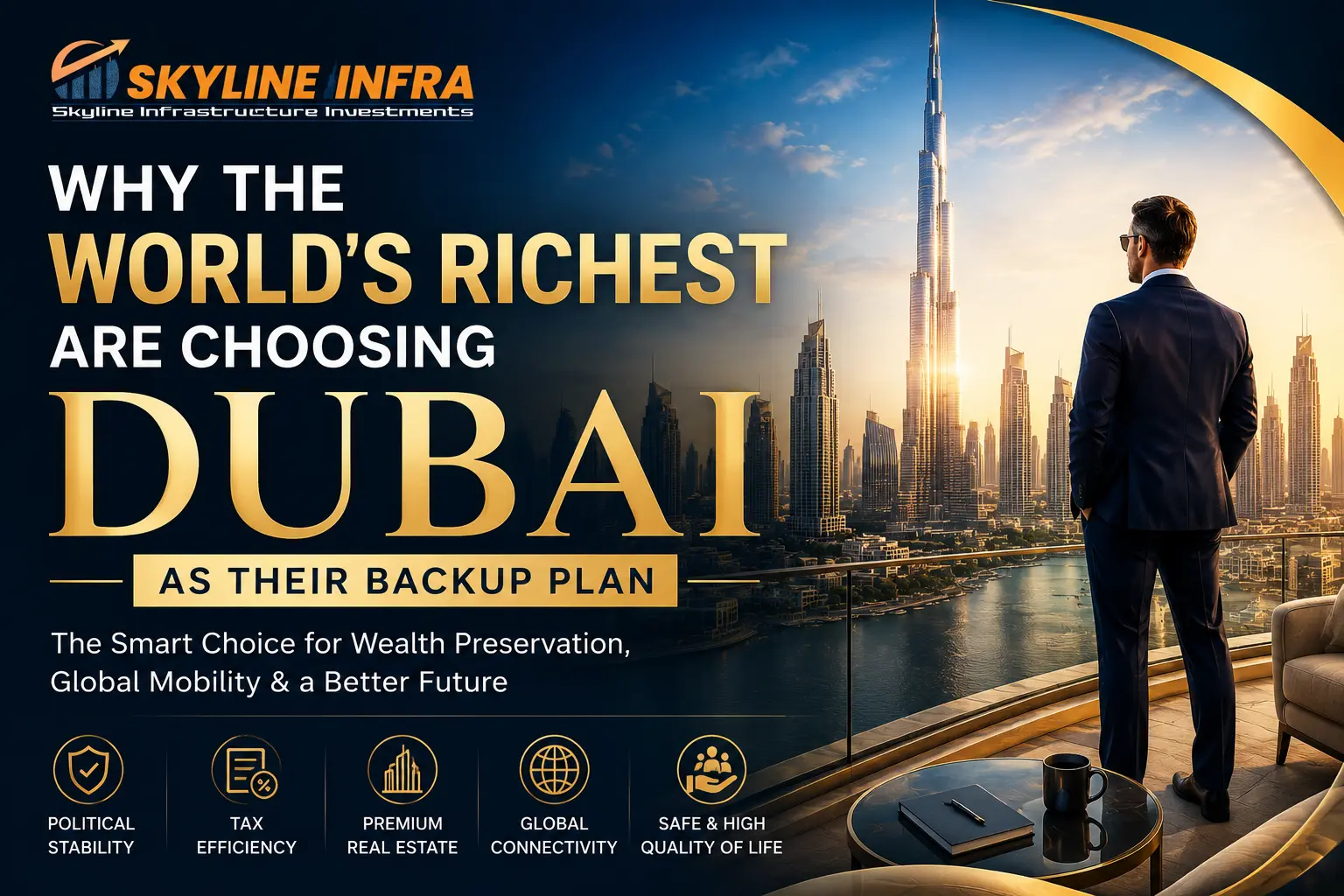
In today’s global economy, wealth is no longer measured solely by financial success. Increasingly, it is defined by resilience—the ability to protect assets, diversify investments, and create opportunities across multiple jurisdictions.
This shift has fundamentally changed the behaviour of high-net-worth individuals (HNWIs), entrepreneurs, and family offices. Instead of concentrating their wealth in one country, they are establishing a “Plan B”: a second home, a second business hub, and a second investment destination that can provide economic stability, legal certainty, and global access during uncertain times.
Few cities have benefited from this trend as much as Dubai.
Over the past decade, Dubai has evolved from a regional commercial hub into one of the world’s most competitive destinations for international wealth. Today, it competes directly with London, Singapore, New York, and Zurich—not only as a place to do business but also as a city where global investors choose to live, invest, and preserve wealth.
Unlike previous investment cycles driven mainly by speculative buying, the current demand is increasingly supported by long-term structural factors such as economic diversification, business migration, infrastructure investment, and sustained population growth.
The numbers support this transformation.
According to the Dubai Land Department (DLD), Dubai’s real estate market recorded AED 252 billion in transactions during Q1 2026, representing a 31% increase in transaction value and a 6% increase in transaction volume compared with the same period a year earlier. During the quarter, the emirate recorded 60,303 property transactions, while real estate investments reached AED 173 billion across 57,744 investment transactions, reflecting strong domestic and international investor confidence.
Dubai continued delivering strong real estate performance despite ongoing geopolitical uncertainty across global markets.
Global Wealth Is Moving—And Dubai Is One of the Biggest Winners
One of the clearest indicators of investor confidence is where wealthy individuals choose to relocate.
Every year, Henley & Partners publishes its Private Wealth Migration Report, widely regarded as one of the most authoritative studies tracking millionaire migration around the world.
Its findings reveal an important trend.
Rather than moving purely for tax reasons, wealthy families increasingly relocate based on a combination of political stability, business opportunities, quality of life, education, healthcare, and long-term economic security.
The report also highlights that globally mobile entrepreneurs are increasingly seeking jurisdictions that provide flexibility rather than dependence on a single country.
According to the Henley Private Wealth Migration Report 2026, the UAE remains one of the world’s strongest wealth magnets. Despite regional geopolitical tensions, the country achieved one of the highest Wealth Mobility Competitiveness Scores globally, reflecting its strengths in taxation, investor access, safety, global connectivity, and long-term residency pathways. Henley notes that demand is driven more by diversification and optionality than by people leaving the UAE, reinforcing Dubai’s role as a long-term base for internationally mobile families.
This distinction is important.
The world’s richest are not abandoning their home countries; instead, they are expanding their footprint. Dubai has become one of the preferred locations for that expansion.
Dubai’s Transformation Into a Global Investment Hub
Only twenty years ago, Dubai was primarily recognised for tourism, aviation, and trade.
Today, its economy is significantly more diversified.
Financial services, logistics, technology, healthcare, hospitality, manufacturing, renewable energy, and real estate have all become major contributors to economic growth.
Government initiatives such as the Dubai Economic Agenda D33 aim to double the size of Dubai’s economy over the next decade while strengthening its position as one of the world’s leading financial centres. This long-term planning has provided investors with a level of policy consistency that many mature economies currently struggle to offer.
Infrastructure investment has also played a critical role.
Dubai International Airport remains one of the busiest international airports globally, while Jebel Ali Port continues to rank among the world’s leading logistics hubs. Combined with advanced digital infrastructure and business-friendly regulations, these advantages have helped multinational companies establish regional headquarters across the emirate.
As businesses expand, demand for residential property naturally follows.
Why Real Estate Has Become the Preferred Asset
Real estate has always been an essential component of wealth preservation.
Unlike financial assets, property combines tangible ownership with the potential for recurring rental income and long-term capital appreciation.
Dubai has strengthened this proposition through transparent property regulations, internationally recognised developers, and a continuously expanding portfolio of master-planned communities.
Areas such as Palm Jumeirah, Downtown Dubai, Dubai Hills Estate, Business Bay, Dubai Marina, and Dubai Creek Harbour continue attracting international investors because they combine lifestyle appeal with strong investment fundamentals.
The luxury segment has been particularly impressive.
According to Knight Frank, Dubai recorded a record 296 residential property sales above US$10 million during the first half of 2026, with total luxury sales reaching US$5.1 billion, representing a 14% increase compared with the same period in 2025. The report also notes that 26 homes sold for more than US$25 million, highlighting sustained demand from ultra-high-net-worth buyers despite global economic uncertainty.
These figures reinforce Dubai’s position as one of the world’s leading destinations for luxury real estate investment.
Wealth Migration Creates a Positive Economic Cycle
When wealthy investors relocate, their impact extends well beyond property purchases.
- Establishing regional headquarters and new businesses.
- Creating employment across multiple sectors.
- Setting up family offices and wealth management operations.
- Investing in financial markets and private enterprises.
- Increasing demand for tourism, retail, healthcare, education, and professional services.
This creates a multiplier effect across the wider economy.
International property consultancies such as Knight Frank, CBRE, JLL, and Savills consistently identify this combination of population growth, business expansion, and infrastructure investment as one of Dubai’s greatest competitive strengths. Their research suggests that the emirate’s property market is increasingly supported by genuine economic activity rather than short-term speculation.
For long-term investors, this distinction matters.
Markets driven by real demand tend to be more resilient than those driven primarily by speculative capital.
Why Indian Investors Are Following the World’s Richest
The growing interest in Dubai is no longer limited to billionaires or multinational corporations. Indian investors—ranging from entrepreneurs and business owners to NRIs and professionals—are increasingly viewing Dubai as a strategic destination for international diversification.
Several factors explain this trend. India and the UAE share deep trade, business, and cultural ties, with direct connectivity between major Indian cities and Dubai. English is widely spoken, the legal framework for property ownership is transparent, and investors can choose from a broad range of residential and commercial developments across different budget segments.
For investors who have traditionally concentrated wealth in Indian equities, domestic real estate, or gold, Dubai offers exposure to an international market that is driven by a different set of economic fundamentals.
Unlike speculative investment cycles, today’s demand is increasingly supported by business migration, tourism, population growth, and long-term government planning.
Dubai’s Real Estate Market by the Numbers
The latest market data demonstrates why Dubai continues attracting international capital.
| Market Indicator | Latest Figure (2025–2026) |
|---|---|
| Q1 2026 Total Real Estate Transactions | AED 252 Billion |
| Year-on-Year Growth in Transaction Value | 31% |
| Total Property Transactions | 60,303 |
| Real Estate Investments | AED 173 Billion |
| Investment Transactions | 57,744 |
| UAE Millionaire Inflow (Henley 2025) | 9,800 HNWIs |
| Estimated Wealth Migrating to UAE | US$63 Billion |
| Luxury Homes Sold Above US$10 Million (H1 2026) | 296 |
| Value of US$10M+ Home Sales | US$5.1 Billion |
The combination of rising investment values and strong participation from international buyers reflects Dubai’s ability to attract capital even during periods of global uncertainty.
Luxury Real Estate Continues to Set New Benchmarks
The luxury segment remains one of Dubai’s strongest performing sectors.
According to Knight Frank’s H1 2026 analysis, Dubai recorded 296 residential transactions above US$10 million, representing a 14% increase in transaction value compared with H1 2025. The total value of these transactions reached US$5.1 billion, while 26 homes sold for more than US$25 million. These figures reinforce Dubai’s position as one of the world’s leading destinations for ultra-high-net-worth property investment.
Communities attracting the highest levels of international demand include:
- Palm Jumeirah
- Emirates Hills
- Dubai Hills Estate
- Downtown Dubai
- Jumeirah Bay Island
- Dubai Marina
Demand is increasingly driven by end-users and long-term investors rather than short-term speculative buyers, contributing to a more mature market.
What Do CBRE and Other Global Consultants Say?
Independent research from CBRE, Knight Frank, JLL, and Savills paints a balanced picture of the market.
CBRE’s Q1 2026 UAE Real Estate Market Review notes that Dubai’s residential sector remained resilient despite regional geopolitical disruptions. The report highlights:
- More than 45,000 residential sales in Q1 2026.
- Residential sales value exceeding AED 137 billion.
- Off-plan transactions accounting for over 32,600 deals, worth approximately AED 103 billion.
- Continued strength in the ultra-luxury segment, with more than 800 sales above US$5 million during the quarter.
This suggests that while some buyers adopted a more cautious approach later in the quarter, demand for high-quality properties remained healthy.
Recent Market Developments
Dubai’s property market has not been immune to global events.
During the first half of 2026, geopolitical tensions in the Middle East affected investor sentiment, leading to slower transaction activity in certain months. Some reports recorded a decline in residential sales volumes and moderate price corrections in parts of the market.
However, market analysts also observed that Dubai’s real estate sector remained comparatively resilient. ANAROCK reported AED 225.7 billion in residential transactions during H1 2026, emphasizing that buyer confidence has historically recovered quickly following periods of regional uncertainty.
For long-term investors, these developments reinforce an important principle: real estate markets move in cycles. Temporary slowdowns are a normal part of any mature market, and investment decisions should be based on long-term fundamentals rather than short-term headlines.
Opportunities and Risks Every Investor Should Understand
Like every international real estate market, Dubai presents both opportunities and risks.
Opportunities
- Strong international demand.
- Government-backed infrastructure projects.
- Transparent property registration.
- High-quality developers.
- Diverse investment options across different budgets.
- Continued population growth and business expansion.
Risks
- Short-term geopolitical uncertainty can affect investor sentiment.
- Rising supply in some communities may moderate future price growth.
- Currency movements can influence returns for overseas investors.
- Returns vary significantly depending on location, developer quality, and holding period.
A successful investment strategy depends on thorough due diligence rather than following market trends alone.
Outlook: Why Dubai Is Expected to Remain a Global Wealth Hub
Despite temporary market fluctuations, the long-term outlook remains positive.
Government initiatives such as the Dubai Economic Agenda D33, continued investment in infrastructure, expanding tourism, and a growing international business community continue to support demand across the real estate sector.
The city’s ability to attract entrepreneurs, multinational companies, family offices, and globally mobile professionals provides a structural advantage that extends beyond short-term market cycles.
For Indian investors seeking international diversification, Dubai offers a combination of accessibility, transparency, and global connectivity that few markets can currently match.
Final Thoughts
The world’s richest individuals are not choosing Dubai solely because of tax efficiency or luxury lifestyles.
They are investing because Dubai has successfully built an ecosystem that combines economic opportunity, political stability, world-class infrastructure, transparent regulation, and global connectivity.
The latest research from the Dubai Land Department, Henley & Partners, Knight Frank, and CBRE suggests that while short-term market conditions may fluctuate, the long-term drivers supporting Dubai’s real estate market remain firmly in place.
For Indian investors, this presents an opportunity to diversify internationally while participating in one of the world’s most dynamic property markets. As with any investment, success depends on careful research, realistic expectations, and guidance from experienced professionals.






Join The Discussion