

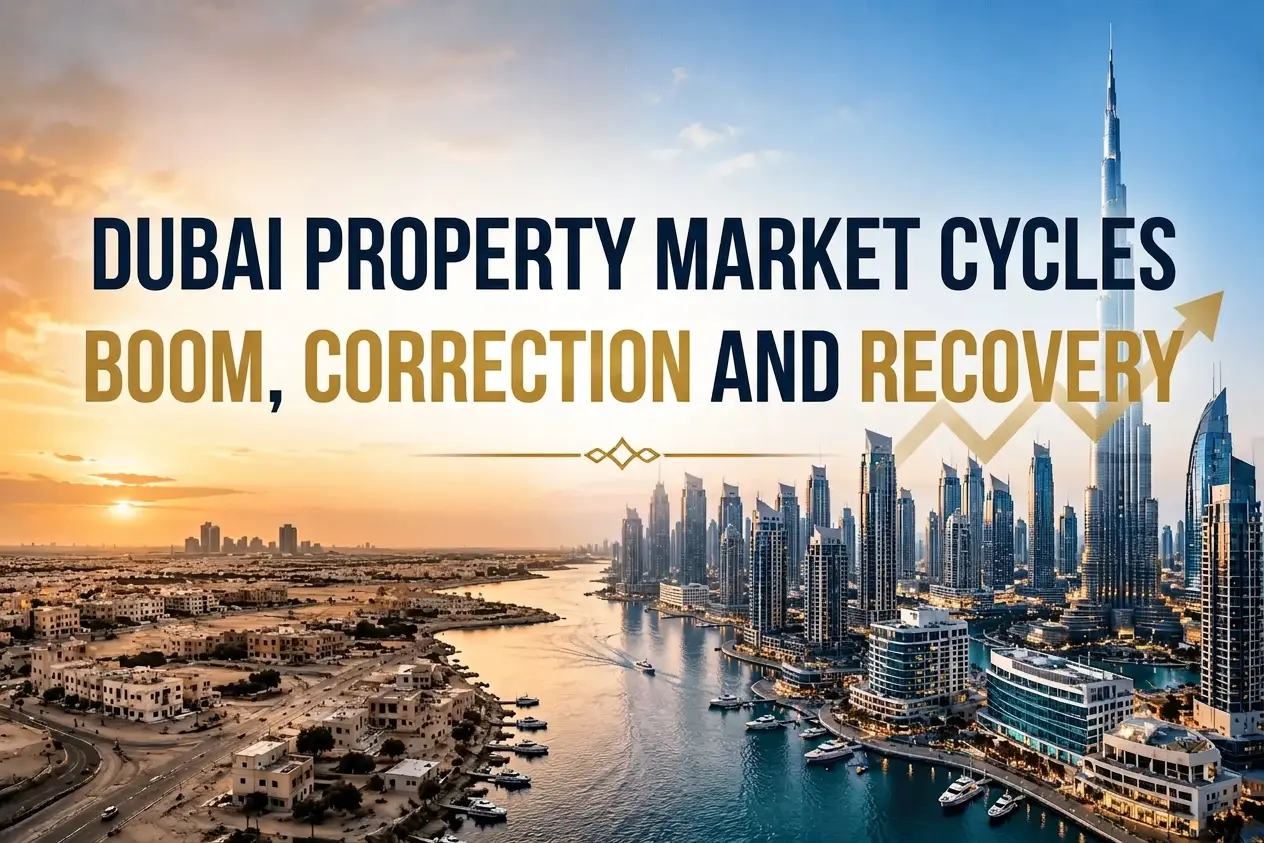
Dubai’s real estate market has never moved in a perfectly straight line. Like most major property markets, it passes through periods of boom, moderation, correction and recovery. Understanding these stages can help investors interpret price movements more rationally instead of making decisions based only on short-term headlines.
The concept of Dubai Property Market Cycles is particularly important for investors considering apartments, villas, townhouses or off-plan developments. A property purchased during rapid price growth may behave differently from one purchased during a correction or early recovery.
Dubai’s recent market performance demonstrates why investors should study both growth and normalization. According to the Dubai Land Department (DLD), total real estate transactions reached AED 252 billion in Q1 2026, up 31% year-on-year in value, while the number of transactions increased 6%. DLD also reported AED 173 billion of real estate investment during the quarter. [Source: Dubai Land Department]
At the same time, market research in 2026 has pointed toward a more measured phase. Cushman & Wakefield Core reported that Dubai’s residential market had begun showing signs of price correction after several years of exceptional growth, while additional supply was expected to enter the market.
This combination is exactly why understanding Dubai Property Market Cycles matters.
Rather than asking whether prices will simply go up or down, investors should ask:
- Which phase of the cycle is the market in?
- What is driving demand?
- How much new supply is coming?
- Are rents supporting property values?
- Are transaction volumes rising or falling?
- Are buyers becoming more selective?
- Does the individual property have strong fundamentals?
This guide explains the major stages of Dubai Property Market Cycles and the indicators investors can monitor.
What Are Dubai Property Market Cycles?
Dubai Property Market Cycles describe the recurring pattern through which real estate markets move as demand, supply, prices, rents, financing conditions and investor sentiment change.
A simplified property cycle normally includes four stages:
- Boom
- Correction or slowdown
- Stabilization
- Recovery
These stages do not always happen at exactly the same speed. Different communities and property segments can also experience different cycles at the same time.
For example, luxury villas, affordable apartments, prime waterfront property and emerging communities may not respond equally to changes in market conditions.
This is one of the most important lessons from Dubai Property Market Cycles: the Dubai market should not be treated as one single property market.
1. The Boom Phase
The boom phase is characterized by strong demand, rising transaction activity, increasing prices and growing investor confidence.
During a boom, buyers may become more comfortable paying higher prices because they expect continued appreciation. Developers may launch more projects because sales velocity is strong.
Dubai has experienced several periods of rapid real estate expansion.
The post-pandemic recovery became a particularly important phase. Strong population growth, international migration, tourism, business activity, regulatory developments and investor demand supported substantial market activity.
CBRE reported that Dubai’s residential market ended 2025 with sales prices approximately 13% higher year-on-year, while more than 206,000 residential transactions were recorded during the year. Off-plan transactions represented nearly three-quarters of activity, according to CBRE.
These figures illustrate how quickly market momentum can build.
However, a boom does not automatically mean every property is a good investment.
During the boom phase of Dubai Property Market Cycles, investors should pay attention to:
- Price growth versus rental growth
- Developer pricing
- Construction pipeline
- Off-plan premiums
- Payment plans
- Rental yields
- Population and employment growth
- Transaction volumes
- Resale liquidity
A rising market can hide weaknesses because increasing prices may temporarily compensate for an overpriced purchase.
2. The Correction Phase
A correction occurs when the pace of growth slows or property prices begin declining in selected segments.
Correction does not necessarily mean a market crash.
A correction can be relatively normal and may occur after a period of unusually rapid appreciation.
This distinction is important when studying Dubai Property Market Cycles.
A market can move from rapid growth to moderate growth without entering a severe downturn. Similarly, one community can experience a price decline while another remains stable.
In 2026, market research began identifying signs of moderation in Dubai’s residential sector.
Cushman & Wakefield Core reported that after five years of exceptional growth, Dubai’s residential market had entered a more measured phase, with price corrections becoming increasingly visible across many apartment and villa submarkets.
CBRE’s Q1 2026 review also noted that price and rental growth were moderating and that anticipated new deliveries were encouraging a more cautious approach among some investors.
This is an important stage of Dubai Property Market Cycles because supply becomes increasingly important.
When many new properties enter the market simultaneously, buyers may have more choices.
That can increase competition between:
- Developers
- Existing property owners
- Landlords
- Resellers
- Off-plan projects
Investors therefore need to compare not just the purchase price but the competing properties entering the same location.
3. The Stabilization Phase
After a correction, the market may enter a period of stabilization.
Prices may move sideways rather than rising rapidly. Transaction volumes can become more balanced. Buyers often become more analytical.
This phase can be particularly useful for understanding the fundamentals behind Dubai Property Market Cycles.
Instead of asking:
“How quickly can this property appreciate?”
an investor may start asking:
“What makes this property valuable over the long term?”
Important indicators during stabilization include:
Rental demand
A property generating sustainable rental income may have stronger support than a property relying entirely on future appreciation.
Dubai’s rental market remained active in 2025. DLD reported 1.38 million registered tenancy contracts, with a total value of AED 126.4 billion, representing increases in both contract volume and value compared with 2024.
Occupancy
High occupancy can indicate strong end-user demand, although investors should examine individual buildings and communities rather than relying solely on city-wide figures.
Resale liquidity
A property with consistent transaction activity may be easier to exit than an unusual property with a very limited buyer pool.
New supply
Investors should examine how many competing units are scheduled for completion.
Developer quality
During a strong market, many projects can attract attention. During a slower market, delivery record, construction quality, service charges and community execution can become more important.
4. The Recovery Phase
Recovery begins when market activity improves after a period of weakness or stabilization.
Transaction volumes may increase before prices fully recover.
This is one reason transaction data is so important when analyzing Dubai Property Market Cycles.
An improvement in transactions can indicate that buyers are returning, although it does not guarantee future price appreciation.
Recovery can be supported by factors such as:
- Population growth
- Employment growth
- New infrastructure
- Tourism
- Business expansion
- Improved financing conditions
- International capital
- Limited supply in specific locations
- Strong rental demand
Dubai’s international nature means that global capital flows can also influence its property market.
Foreign investors are an important part of the ecosystem, meaning global economic conditions, currency movements and investor sentiment can affect demand.
For an investor, the recovery phase should therefore be studied through multiple indicators rather than a single price chart.
Dubai Property Market Cycles and the Role of Supply
Supply is one of the most important variables in Dubai Property Market Cycles.
When demand grows faster than available housing, rents and prices can come under upward pressure.
When supply grows faster than demand, landlords and sellers may face greater competition.
Dubai has a substantial development pipeline, making supply analysis especially important.
Cushman & Wakefield Core reported that more than 13,200 residential units were delivered in Q2 2026, with approximately 32,000 additional units expected in H2 2026.
This does not mean all locations will experience the same impact.
An investor should ask:
- How many units are being delivered?
- Where are they located?
- What unit types are being delivered?
- Are they comparable to the property being considered?
- What are the expected service charges?
- Who are the target tenants?
- Is the area already established?
- What infrastructure will be available?
This approach makes the analysis of Dubai Property Market Cycles more property-specific.
Dubai Property Market Cycles and Rental Income
Rental performance can provide another perspective on market conditions.
Capital appreciation is only one part of a real estate investment.
Rental income can provide ongoing cash flow while the investor holds the asset.
In 2025, DLD reported strong rental activity, with registered tenancy contracts increasing in both volume and value.
However, investors should not assume that city-wide rental growth will automatically translate into the same result for every property.
Rental performance depends on:
- Location
- Unit size
- Property condition
- Building quality
- Furnishing
- Amenities
- Parking
- Public transport
- Nearby employment centers
- Tenant profile
- Competition from new developments
Therefore, when studying Dubai Property Market Cycles, rental data should be analyzed at the community and property level wherever possible.
How Investors Can Identify the Current Market Phase
There is no single indicator that can perfectly identify the current stage of Dubai Property Market Cycles.
Instead, investors can monitor a combination of indicators.
1. Transaction volume
Increasing transactions can indicate stronger market activity.
Falling transactions can indicate caution or reduced liquidity.
2. Price growth
Rapid price increases may indicate strong demand, while flat or declining prices may indicate moderation or correction.
3. Rental growth
Rental trends can help determine whether property values are supported by actual occupancy demand.
4. New supply
A large number of upcoming handovers can increase competition.
5. Off-plan versus ready property activity
A major increase in off-plan activity may indicate strong investor participation, but investors should still examine project quality, delivery schedules and resale conditions.
6. Mortgage and financing conditions
Borrowing costs can influence affordability and investor demand.
7. Time on market
If properties remain listed longer, sellers may have less pricing power.
8. Discounts and incentives
Developers offering larger incentives may indicate increasing competition.
9. Rental yields
Gross rental yield can help compare property income against purchase price, although net yield should account for service charges, vacancy, maintenance, management and other costs.
What Past Dubai Property Market Cycles Teach Investors
Historical market cycles demonstrate that real estate markets can change direction.
Dubai’s property market experienced a major correction following the global financial crisis in 2008–09. The experience led to significant changes in the regulatory and institutional environment.
The Dubai Land Department now provides extensive real estate transaction and price data, including transaction, rental, project and valuation information.
For investors, the lesson is not to attempt to predict every market movement.
Instead, the lesson from Dubai Property Market Cycles is to build a decision-making framework that can survive different market conditions.
A property should ideally make sense not only when prices are rising but also when growth slows.
Boom vs Correction: What Changes for Investors?
| Factor | Boom Phase | Correction / Slowdown |
|---|---|---|
| Buyer sentiment | Strong | More cautious |
| Price growth | Rapid | Slower or negative in some areas |
| Negotiation | Often limited | Can improve |
| Supply | Increasing | More important |
| Investor focus | Appreciation | Value + fundamentals |
| Rental analysis | Important | Extremely important |
| Developer incentives | May be limited | Can increase |
| Due diligence | Important | Critical |
| Resale liquidity | Often strong | More selective |
The table shows why investment strategies need to adapt to Dubai Property Market Cycles.
How Indian Investors Can Approach Dubai Property Market Cycles
For Indian investors, Dubai property can provide international diversification, but currency movement, taxes, financing, ownership costs and local regulations should all be considered.
Before purchasing, investors should evaluate:
Total acquisition cost
Do not look only at the advertised property price.
Consider applicable registration charges, agency costs where relevant, financing expenses and other transaction costs.
Holding costs
Service charges, maintenance, property management, insurance and vacancy can affect net returns.
Rental strategy
Determine whether the property is intended for long-term rental, short-term rental where permitted, personal use or a combination.
Exit strategy
An investor should understand who the likely future buyer will be.
Developer and project
Review the developer’s delivery record, project documentation, escrow arrangements and relevant regulatory information.
Location fundamentals
Study connectivity, employment, schools, retail, public transport, infrastructure and future development.
Market cycle
Finally, understand where the property sits within the broader Dubai Property Market Cycles framework.
Why Data Matters More Than Headlines
Real estate markets generate constant headlines.
One week may bring reports of record transactions. Another may bring stories about price corrections or increasing supply.
Neither headline alone explains the complete market.
The Dubai Land Department provides official transaction and rental datasets that investors can use to investigate market activity.
DLD’s residential price index also provides a framework for monitoring price movements.
For current research, investors can review official DLD data rather than relying solely on social media posts or promotional claims.
This is especially important during changing Dubai Property Market Cycles, when market narratives can shift quickly.
A Practical Framework for Investing Through Different Market Cycles
A disciplined investor can use a simple five-step process.
Step 1: Identify the cycle
Determine whether the broader market is experiencing expansion, moderation, correction, stabilization or recovery.
Step 2: Study the community
Do not stop at Dubai-wide statistics. Analyze the specific community.
Step 3: Compare supply
Check existing inventory and future handovers.
Step 4: Calculate real returns
Consider rental income, vacancy, service charges, financing and transaction costs.
Step 5: Stress-test the investment
Ask what happens if:
- Prices remain flat for several years.
- Rent growth slows.
- The property takes longer to sell.
- New competing projects launch.
- Service charges increase.
This process can make investment decisions more resilient across different Dubai Property Market Cycles.
Dubai Property Market Cycles: The Bigger Picture
The history of Dubai real estate shows that markets move through different stages.
A boom can create strong appreciation and high investor confidence.
A correction can bring greater selectivity and more price sensitivity.
Stabilization can shift attention toward rental income and fundamentals.
Recovery can gradually restore transaction activity and investor confidence.
The key lesson from Dubai Property Market Cycles is that market timing is difficult to execute perfectly.
Instead of trying to identify the exact top or bottom, investors can focus on property quality, entry price, rental economics, supply, location fundamentals and long-term demand.
As of 2026, Dubai’s market combines strong transaction activity with signs of moderation and significant future supply. DLD reported AED 252 billion of real estate transactions in Q1 2026, while market researchers have identified increasing price and rental moderation during 2026.
That combination makes property-level due diligence particularly important.
For investors, the objective should not simply be to buy during a boom or wait for a correction.
The objective is to understand Dubai Property Market Cycles well enough to evaluate whether a specific property remains financially sensible under different market conditions.
Final Takeaway
Dubai Property Market Cycles are a normal part of real estate investing.
Booms create opportunities but can also increase prices and competition.
Corrections can create greater negotiation opportunities but may also expose properties with weak fundamentals.
Recovery can create new momentum, but investors should still validate the underlying demand.
For a long-term investor, the most important questions are:
What am I buying?
At what price?
What rental income can it realistically generate?
How much competing supply is coming?
Who will buy it from me later?
Would the investment still make sense if prices stayed flat?
Understanding these questions can be more valuable than attempting to predict the next market headline.
At Skyline Infrastructure Investments, our approach is research-driven and focused on helping Indian investors understand Dubai real estate through market data, property fundamentals, due diligence and long-term investment considerations.
If you are evaluating a Dubai property, understanding the market cycle is only the beginning. The next step is evaluating the specific project, developer, location, price, rental potential, costs and exit strategy.













Join The Discussion