

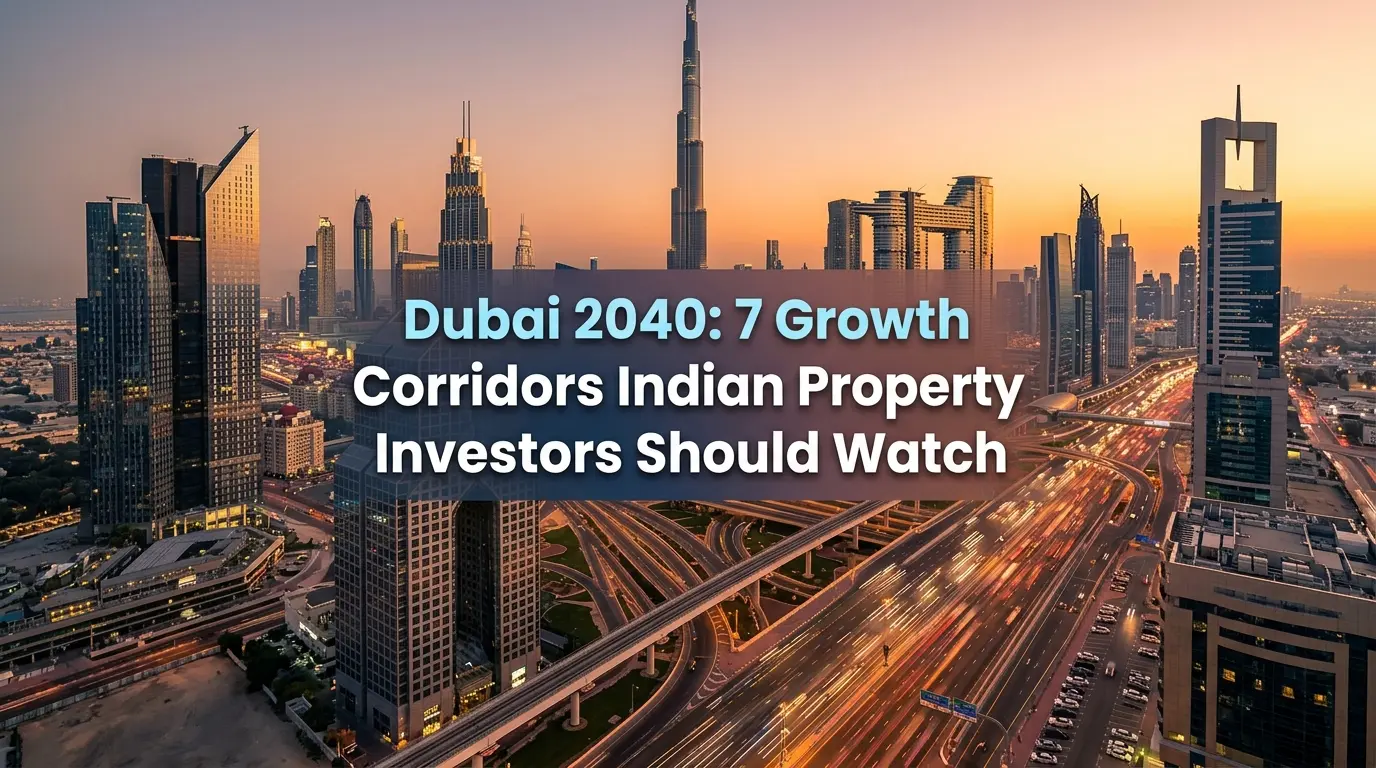
Dubai’s next real estate story may not be limited to Downtown Dubai, Dubai Marina or Business Bay. As the emirate plans its urban expansion toward 2040, new infrastructure, transport connections, economic centres, residential communities and logistics hubs are creating a much broader map of potential property demand.
For Indian investors looking to buy property in Dubai, this creates an important question:
Where could Dubai’s next major growth corridors emerge?
The Dubai 2040 Urban Master Plan provides a long-term framework for sustainable urban development, infrastructure, housing and new urban centres. Its objectives include strengthening urban centres, developing a 20-minute city concept, improving mobility and coordinating future urban growth.
This is where understanding Dubai 2040 Growth Corridors becomes important for anyone researching Dubai real estate.
As a Noida-based Dubai real estate consultant, Skyline Infrastructure Investments focuses on helping Indian investors understand Dubai property opportunities through location research, project comparison, developer evaluation, payment-plan analysis and investment due diligence.
The objective is not simply to find a Dubai property offer.
It is to understand why a particular location, why a particular project and whether the price makes sense for the investor’s strategy.
In this article, we examine seven Dubai 2040 Growth Corridors that Indian investors can research while evaluating 1BHK, 2BHK, townhouses, villas and off-plan property in Dubai.
What Are Dubai 2040 Growth Corridors?
A Dubai 2040 Growth Corridor is not an official investment category. It is a useful way of describing areas where several long-term development drivers are coming together.
These drivers may include:
- Metro and public transportation
- Major road infrastructure
- Airports
- Logistics hubs
- Business districts
- Universities
- Tourism
- Retail
- New residential communities
- Population growth
- Government-backed master planning
The Dubai 2040 Urban Master Plan includes initiatives focused on urban centres, real estate strategy, the 20-minute city and pedestrian connectivity.
Therefore, when researching Dubai 2040 Growth Corridors, investors should not look only at today’s property price.
They should also ask:
Who will live here?
Where will those residents work?
How will they travel?
What infrastructure is planned?
How much new property is being supplied?
What is the current rental demand?
These questions can be more useful than simply calling an area an “upcoming location.”
1. Dubai South – Expo City – Al Maktoum Airport Corridor
One of the most important areas to research within the Dubai 2040 Growth Corridors framework is the Dubai South–Expo City–Al Maktoum International Airport corridor.
Expo City Dubai has been identified as one of the five key urban centres under Dubai’s 2040 plan. Its master plan connects the area with trade, logistics, technology, innovation, tourism, business and events. The Dubai Government also highlights its proximity to Al Maktoum International Airport, Jebel Ali Port and Dubai Exhibition Centre.
This makes the corridor different from a purely residential development.
It combines:
Airport + logistics + business + tourism + exhibitions + residential development.
For an Indian investor researching Dubai property investment, this combination can be worth monitoring.
Potential property categories include:
- 1BHK apartments
- 2BHK apartments
- Townhouses
- Family communities
- Mid-market apartments
- Off-plan property Dubai
However, investors should not assume that every property in Dubai South will automatically benefit equally from future infrastructure.
The exact project location, entry price, developer, supply and rental market remain important.
2. Expo City Dubai Growth Corridor
Expo City deserves separate attention because its future development is directly connected with the broader Dubai 2040 Growth Corridors story.
The Dubai Government’s 2024 master plan positions Expo City as a future hub for entrepreneurs, businesses, innovators, educators, students, residents and visitors. The plan also identifies the area as one of Dubai’s five urban centres under the 2040 framework.
The location already benefits from major transport infrastructure, including Dubai Metro’s Route 2020 connection.
The wider corridor also connects toward Dubai South and the future expansion of Al Maktoum International Airport.
For investors considering off-plan property in Dubai, Expo City and surrounding communities may therefore appear in property research.
But an attractive launch price or Dubai property offer should never be the only reason to purchase.
Before considering an off-plan project, compare:
- Developer track record
- Escrow arrangements
- Construction progress
- Payment plan
- Handover timeline
- Service charges
- Nearby completed properties
- Expected rental demand
- Future competing supply
This is particularly important when comparing projects from developers such as Emaar, Sobha, Danube and DAMAC.
3. Dubai Creek Harbour – Ras Al Khor – International City Corridor
The Dubai Creek Harbour–Ras Al Khor–International City corridor is another major part of the Dubai 2040 Growth Corridors discussion.
The biggest infrastructure driver here is the Dubai Metro Blue Line.
According to Dubai’s Roads and Transport Authority, the Blue Line is a 30-kilometre route with 14 stations. It will connect areas including Dubai Creek Harbour, Ras Al Khor, International City, Dubai Silicon Oasis, Academic City, Mirdif, Al Warqa and Dubai Festival City.
The Blue Line is targeted to open on 9 September 2029. RTA says daily users are expected to reach approximately 200,000 by 2030 and 320,000 by 2040.
This creates an interesting infrastructure-led property story.
Dubai Creek Harbour is associated with waterfront residential development, retail and lifestyle.
Ras Al Khor provides a connection between established and developing areas.
International City already has a large residential population.
The Blue Line potentially brings these locations into a more integrated transport network.
For investors researching Dubai property for sale, the corridor can therefore be compared across different price points and property types.
4. Dubai Silicon Oasis – Academic City Corridor
Dubai Silicon Oasis is particularly relevant to Dubai 2040 Growth Corridors because it has been identified as one of Dubai’s strategic urban centres.
The area combines technology, business, education and residential development.
The Dubai Metro Blue Line will connect Dubai Silicon Oasis with several other important areas, including Academic City. RTA expects the Blue Line’s surrounding districts to accommodate around one million residents by 2040.
Academic City is another important demand driver.
RTA has stated that Dubai Academic City is anticipated to host more than 50,000 university students by 2029.
This creates several potential rental-demand segments:
- Students
- University staff
- Technology professionals
- Young professionals
- Families
- Business employees
For an Indian investor considering a 1BHK in Dubai, Dubai Silicon Oasis can therefore be evaluated from both current rental fundamentals and future connectivity.
A 2BHK in Dubai Silicon Oasis may also appeal to families or tenants looking for additional living space.
The key is to compare the individual building rather than assuming that every property in the community will perform identically.
5. Mirdif – Al Warqa – International City Corridor
The Mirdif–Al Warqa–International City connection is another area to monitor within the Dubai 2040 Growth Corridors landscape.
These are not entirely new residential districts. Instead, they represent established communities that could benefit from improved transportation connectivity.
The Dubai Metro Blue Line will connect Mirdif and Al Warqa with International City and other parts of the network. RTA says the Blue Line will also provide integration with Dubai’s existing Red and Green Metro lines.
This distinction is important.
An investor does not always need to look for a completely new neighbourhood.
Sometimes an established community with existing residents, schools, retail and services can become more attractive when connectivity improves.
For Indian investors, this can make these areas worth comparing when looking for:
- Affordable apartments
- 1BHK
- 2BHK
- Family apartments
- Rental properties
The important metrics remain purchase price, rent, service charges, building quality and future competing supply.
6. Al Maktoum Airport – Dubai South – Jebel Ali Logistics Corridor
The next corridor within the Dubai 2040 Growth Corridors framework is driven by aviation, logistics and trade.
Dubai’s long-term development is increasingly connected with the expansion of the southern part of the emirate.
The Dubai Government’s Expo City master plan specifically highlights the area’s proximity to Al Maktoum International Airport and Jebel Ali Port, with trade, logistics, technology and tourism identified as important sectors.
For real estate investors, the important question is not simply:
“How close is the property to the airport?”
The better question is:
“What economic activity will the airport and logistics infrastructure generate around the wider region?”
Economic activity can create employment.
Employment can create housing demand.
Housing demand can support residential real estate.
But this process takes time.
For that reason, investors considering Dubai investment property in emerging areas should carefully match their investment horizon with the infrastructure timeline.
Potential property categories include:
- 1BHK apartments
- 2BHK apartments
- Townhouses
- Family communities
- Mid-market residential property
7. Dubai Creek Harbour – Dubai’s Future Waterfront Connectivity
Dubai Creek Harbour is another location that deserves attention when studying Dubai 2040 Growth Corridors.
The Blue Line includes an iconic station at Dubai Creek Harbour. RTA says the station is designed to accommodate up to 160,000 passengers daily, with projected daily usage of around 70,000 by 2040.
The significance goes beyond a single metro station.
Dubai Creek Harbour combines:
- Waterfront residential property
- Retail
- Hospitality
- Leisure
- Commercial activity
- Public spaces
- Future metro connectivity
For investors researching premium Dubai apartments, the area can be compared with other established waterfront and central communities.
A buyer considering a premium 1BHK or 2BHK in Dubai should compare not only the view and amenities but also:
- Price per square foot
- Service charges
- Rental rates
- Available inventory
- Developer
- Building quality
- Resale market
- Future competing projects
This is where professional property research can become valuable.
Why Infrastructure Matters to Dubai Real Estate Investors
The connection between infrastructure and real estate is one of the most important concepts behind Dubai 2040 Growth Corridors.
The Dubai Metro Blue Line is expected to serve nine key districts with a combined projected population of around one million residents by 2040. RTA estimates that the project will generate more than AED 56.5 billion in economic benefits by 2040.
However, infrastructure should be viewed as a potential demand catalyst, not as a guarantee of property appreciation.
A metro station can improve accessibility.
An airport can support employment.
A business district can attract professionals.
A university can support rental demand.
But property performance still depends on supply, price and demand.
Therefore, the right question is not:
“Is there infrastructure?”
It is:
“Is the infrastructure likely to create sustainable demand for this particular property?”
1BHK vs 2BHK in Dubai: What Should Indian Investors Consider?
The Dubai 2040 Growth Corridors story is not limited to luxury villas.
Apartments remain important because Dubai needs housing for professionals, families, students and employees across different income groups.
1BHK in Dubai
A 1BHK can potentially appeal to:
- Young professionals
- Couples
- Single professionals
- Smaller households
- Long-term tenants
For an investor, the key questions include purchase price, rent, service charges, building quality and resale demand.
2BHK in Dubai
A 2BHK may appeal to:
- Families
- Professional couples
- Room-sharing tenants
- Tenants needing home-office space
But a larger property also requires a higher investment amount.
Therefore, investors should not ask whether 1BHK or 2BHK is universally better.
They should ask which property matches their:
budget + location + rental strategy + holding period + exit strategy.
Sobha, Danube, Emaar and DAMAC: How Should Investors Compare Developers?
Developer names are important when researching Dubai property for sale, but the developer should not be the only factor.
Indian investors may come across projects from:
- Emaar
- Sobha
- Danube Properties
- DAMAC
- Binghatti
- Azizi
- Other Dubai developers
A Sobha property, Danube property, Emaar property or DAMAC property should be evaluated on its specific project characteristics.
Compare:
| Factor | What to Check |
|---|---|
| Location | Current and future connectivity |
| Developer | Track record and delivery history |
| Price | Price per sq. ft. |
| Unit | 1BHK, 2BHK, 3BHK, townhouse or villa |
| Payment Plan | Construction and post-handover obligations |
| Service Charges | Impact on net rental income |
| Supply | Competing properties nearby |
| Rental | Comparable achieved rents |
| Handover | Expected completion |
| Exit | Potential resale market |
This approach is more useful than choosing a project simply because its marketing campaign offers a large discount or promotional Dubai property offer.
How a Dubai Property Consultant in Noida Can Help
For Indian investors, buying property overseas involves more than selecting an apartment.
A Dubai property consultant in Noida can help an investor understand the market from the perspective of an Indian buyer.
At Skyline Infrastructure Investments, the research process can include:
Location Research
Understanding the existing infrastructure and future development around a property.
Project Comparison
Comparing multiple Dubai properties instead of evaluating a single project in isolation.
Developer Due Diligence
Reviewing developer background, project status and delivery-related information.
Property Type Analysis
Comparing a 1BHK in Dubai, 2BHK in Dubai, townhouse or villa based on the investor’s objective.
Payment Plan Analysis
Understanding the full payment obligation rather than focusing only on the initial booking amount.
Rental Research
Studying comparable properties and potential tenant demand.
Investment Risk Review
Identifying supply, pricing, service-charge and liquidity risks.
This is the role of a Dubai real estate consultant in Noida: helping the investor understand the property before making a decision.
How Indians Can Buy Property in Dubai
Indian investors searching for Dubai property investment for Indians should approach the process systematically.
Start with the investment objective.
Are you looking for:
- Rental income?
- Long-term capital appreciation?
- A second home?
- Diversification?
- A property for family use?
- An off-plan opportunity?
Then establish a realistic budget.
After that, compare locations and projects.
A typical research process can include:
Budget → Location → Developer → Property Type → Price → Payment Plan → Rental Demand → Service Charges → Due Diligence → Purchase
This process can help prevent investors from becoming overly focused on marketing offers.
The same approach should be followed whether you are considering Dubai South investment, Dubai Silicon Oasis investment, Dubai Creek Harbour, Expo City or another Dubai community.
Risks Indian Investors Should Consider
Even the most attractive Dubai 2040 Growth Corridors come with investment risks.
1. Future Infrastructure Risk
Completion dates and project scope can change.
2. Supply Risk
Large numbers of new apartments can affect rental and resale competition.
3. Price Risk
A future-growth story may already be reflected in today’s property price.
4. Rental Risk
Advertised rental yields may not equal actual net income after costs.
5. Service Charges
Building and community service charges can affect net returns.
6. Developer Risk
Project-specific delivery and construction performance matter.
7. Liquidity Risk
Not every property is equally easy to resell.
8. Currency Considerations
Indian investors should also consider AED-INR exchange-rate movements when evaluating their overall investment.
Therefore, Dubai 2040 Growth Corridors should be used as a research framework, not as a promise of returns.
Dubai 2040 Growth Corridors: Quick Comparison
| Corridor | Main Growth Driver | Property Types to Research |
|---|---|---|
| Dubai South | Airport, logistics, business | 1BHK, 2BHK, townhouse |
| Expo City | Business, tourism, events | Apartments, townhouse |
| Dubai Creek Harbour | Waterfront + Metro | Premium apartments |
| Ras Al Khor | Connectivity + development | Apartments |
| Dubai Silicon Oasis | Technology + Metro | 1BHK, 2BHK |
| Academic City | Education + connectivity | Rental apartments |
| Mirdif / Al Warqa | Metro connectivity | Family apartments |
These Dubai 2040 Growth Corridors should not be interpreted as a ranking. Each has a different economic profile and investment proposition.
What Should Indian Investors Watch Between Now and 2040?
The most useful way to follow Dubai 2040 Growth Corridors is to track actual milestones rather than marketing claims.
Watch:
Metro construction progress
Airport development
New employment centres
Population growth
Rental transactions
Property supply
Developer launches
Infrastructure completion
Commercial development
Actual transaction prices
The Dubai Metro Blue Line is already under construction. RTA reported in November 2025 that 10% of construction had been completed, with 30% targeted by the end of 2026 and opening targeted for September 2029. In May 2026, RTA also announced the launch of primary tunnelling works.
This illustrates why investors should regularly update their research rather than relying on an old property presentation.
Final Thoughts on Dubai 2040 Growth Corridors
Dubai’s future development is increasingly being shaped by interconnected urban centres rather than a single property district.
The Dubai 2040 Growth Corridors around Dubai South, Expo City, Al Maktoum International Airport, Dubai Creek Harbour, Ras Al Khor, Dubai Silicon Oasis, Academic City, Mirdif and Al Warqa each have different infrastructure and economic drivers.
For Indian investors, the opportunity is not simply to find the cheapest property.
It is to understand the relationship between:
Infrastructure + Employment + Population + Connectivity + Supply + Property Price + Rental Demand.
Whether you are looking for a 1BHK in Dubai, 2BHK in Dubai, townhouse, villa, ready property or off-plan property Dubai, these factors should form part of the research process.
Similarly, whether you are considering a Sobha, Danube, Emaar, DAMAC or another developer, the individual project should be evaluated rather than relying only on the brand name.
As a Noida-based Dubai real estate consultant, Skyline Infrastructure Investments focuses on helping Indian investors research Dubai property opportunities with a location-first and due-diligence-focused approach.
The purpose is simple:
Don’t just ask what property is available. Ask why that property, why that location and why that price.
That is the approach Indian investors can use when researching Dubai 2040 Growth Corridors and the next phase of Dubai real estate.










Join The Discussion