

Dubai has emerged as one of the most attractive global real estate destinations for Indian investors—offering higher rental yields, transparent regulations, and strong long-term growth. There has been a lot of interest to explore and buy property in Dubai from India for many years now. To complement this interest, the recent data coming from Dubai real estate market is very encouraging. Knight Frank, a leading International Property Consultant, says in their quarterly Dubai Residential Market Review, “Dubai’s residential market hit new records in 2025, driven by substantial growth in both overall sales volumes and values. Total sales value surged to AED 544.2bn, marking 25% year-on-year increase.”
However, despite the market’s maturity and potential, first-time Indian property buyers in Dubai often make avoidable mistakes that can impact their property return, timelines, and peace of mind. At Skyline Infrastructure Investments, we believe, “Assets appreciate, Excuses depreciate.” We regularly interact with Indian investors exploring Dubai property for the first time. Here are the most common mistakes we see—and how you can avoid them.
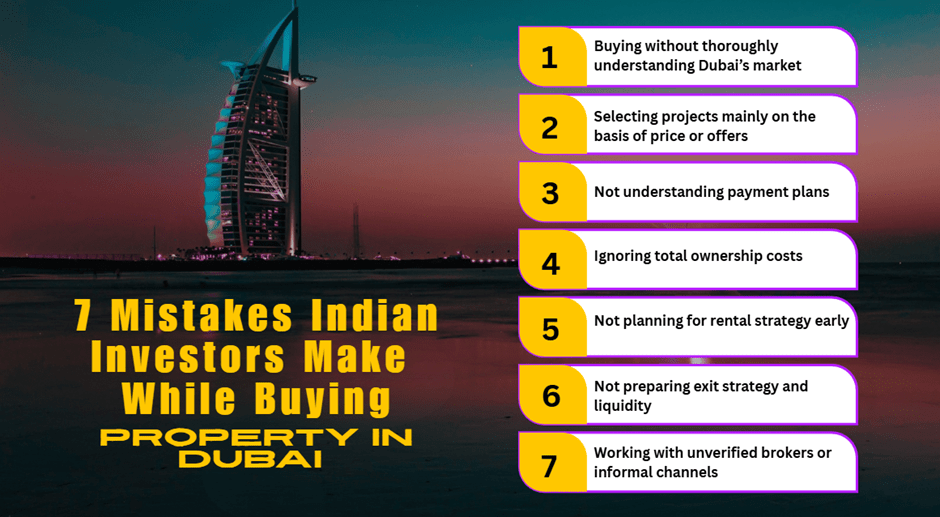
1. Buying without thoroughly understanding Dubai’s market
It has been seen many times that Indian investors approach Dubai real estate with certain assumptions shaped by their past experiences. They feel worried about long possession timelines, complex pricing or sudden changes or pause in construction. It is important for the property investors to understand the reality of the market before they make Dubai property investment.
Realty reality in Dubai:
- Projects are regulated by Dubai RERA
- Strict Dubai RERA rules for investors are in place
- Project funds are secured in escrow accounts, which ensures that payments are released strictly in line with construction progress, minimising the risk of misuse or diverting funds.
- Dubai has a regulated real estate system that puts buyer interests foremost. There are clear legal safeguards in place, developer responsibilities and obligations are defined and documentation processes are transparent.
- Payment plans are structured and often developer backed.
- There is no worry about timelines and penalties as they are defined contractually
Mistake: Assuming Dubai behaves as an extension of the Indian real estate market
Solution: While investing in Dubai real estate market, one should partner only with advisors who understand the property laws, regulations, and rights of overseas property buyers in Dubai. At Skyline Infrastructure Investments, we bridge the knowledge gap by offering structured, compliant and transparent guidance, especially focused towards Indian
investors. We strongly believe that the right real estate advisor should not just focus on closing the sale, but on building a transparent and clear relationship that grows with time.
2. Selecting projects mainly on the basis of price or offers
Attractive location or prices of property, high investment returns along with flexible and easy payment plans can be quite appealing, but they should certainly not be the only drivers of your decision.
Common oversight by overseas buyers:
- Ignoring developer track record
- Not checking RERA project registration
- Overlooking location demand and rental absorption
Solution: It is important to look beyond the headline price. Evaluate all the aspects of the property and the developer, such as its background, delivery record, construction quality, and resale demand of the location. One of the most important things for buyers is to ensure that the project is RERA-registered and that funds are safely kept in an escrow account. This safeguards your investment throughout the construction process, which mostly does not get stretched for a long period of time.
3. Not understanding payment plans
One of the major advantages that Dubai real estate market offers to the buyers is the choice of developer-backed payment plans, which are not seen as loans. However, you need to understand how the developer-backed payment plans work.
Mistake:
- Not understanding all the aspects of the payment plan
- Assuming that the instalment plans work like loans
- Not reviewing the payment schedules linked with milestones
- Ignoring structured post-handover payments
Solution: Understand whether the plan is:
- Completely approved and RERA-compliant
- Payments are interest free and not overly complicated
- Linked to construction milestonesof the project
Dubai property market offers payment plan that allow flexible and developer-driven payment plans. They mainly target off-plan projects and there are certain options to choose from, such as 1% monthly instalments, 10:90 plans and payments post-handover. Home loans in Dubai are usually available for up to 50% of the property value for non-resident investors, with competitive interest rates, as compared to many global markets. At Skyline Infrastructure Investments, we offer one-to-one consultation session with our experts that will guide you to choose the right structure that is aligned with your financial comfort. This approach mitigates your risk of buying property in Dubai.
4. Ignoring total ownership costs
One of the main drivers that makes Dubai real estate market so popular with investors is that Dubai charges zero annual property taxes. It is also popular for its investor-friendly rules and regulations and good quality of life. However, there are still costs that investors must factor in:
- DLD (Dubai Land Department) registration fee – Fixed at 4% (as on February 2026)
- Service charges
- Property management fees
- Broker commissions
Mistake: Comparing Dubai prices with India without accounting for all costs—or worse, assuming there are hidden costs of buying property in Dubai later.
Solution: Ask for a clear, all-in cost breakdown upfront so your return calculations remain accurate.
5. Not planning for rental strategy early
Many Indian investors buy with the intention of renting—but don’t decide how until after possession.
Missed Opportunities:
- Leasing for short term against long term
- Furnished versus unfurnished homes
- Having expertise services for property management
Solution: Think about your rental strategy and define your expectations before actually buying the property. It is important to take in account the location, unit type and target tenant profile. A successful strategy for the rental property market in Dubai can be around targeting 8% to 12% ROI through high-demand areas, aiming for capital appreciation in the long term.
6. Not preparing exit strategy and liquidity
Dubai real estate is liquid—but only if you buy the right asset. Liquidity in Dubai property market depends on factors such as location, builder’s reputation, quality of construction, pricing strategy and kind of demand in the area. One of the biggest mistakes that investors make is buying property due to FOMO (Fear of Missing Out). When you are chasing the hype around the project, social media influencer promotions, or ‘limited-time offers’, you are exposing your investment to a lot of vulnerabilities. Hype may create excitement for a short time, but your exit strategy depends on real demand and drivers that affect liquidity.
Mistake:
- Buying without understanding locations that may face good demand in near future
- Ignoring the prevalent trends in Dubai’s resale market
Solution: Since Dubai real estate market is fast evolving, it gets very difficult to ensure liquidity when you don’t have a clear exit strategy in place. Choose real estate projects that face strong demand from both investors and end users. At Skyline Infrastructure Investments, we help our clients identify high-potential Dubai projects backed by strong fundamentals, proven developers, and real market demand—maximising ROI while minimising risk.
7. Working with unverified brokers or informal channels
This is one of the biggest risks that Indian investors face—especially when buying remotely.
The red flags you should watch out for:
- Builder’s project does not have RERA registration
- Promises are mostly verbal without proper documentation
- The sales tactics are largely pressure driven
Solution: Established in July 2007, Dubai RERA operates under the Dubai Land Department and has done a commendable job by defining RERA rules, policies, and procedures that govern real estate transactions in the region. Always engage with RERA-licensed brokers and transparent advisors. Skyline Infrastructure Investments joins hands directly with RERA-registered brokerage firms in Dubai, providing our clients access to verified real estate projects from renowned builders in Dubai.
Final Thoughts: Dubai Rewards Informed Investors
There is no doubt about the fact that Dubai real estate is one of the most transparent and regulated property markets in the world. However, just like any investment, its success is directly dependent on making an informed decision as a property buyer. The property market of Dubai is expected to keep on appreciating over the next 5 years, driven by a diversified economy, continuous infrastructure growth, a clear regulatory framework and a growing interest of global investors. For Indian investors, the key is not just having an access to Dubai real estate projects, but taking expert guidance that bridges local understanding with global best practices.
The right advisor doesn’t sell you a property.
They help you make the right investment decision.
If you’re considering buying property in Dubai market and want clarity, compliance, and confidence at every step, professional advisory from Skyline Infrastructure Investments makes all the difference.
Written by Skyline Infrastructure Investments Research Team














Join The Discussion