

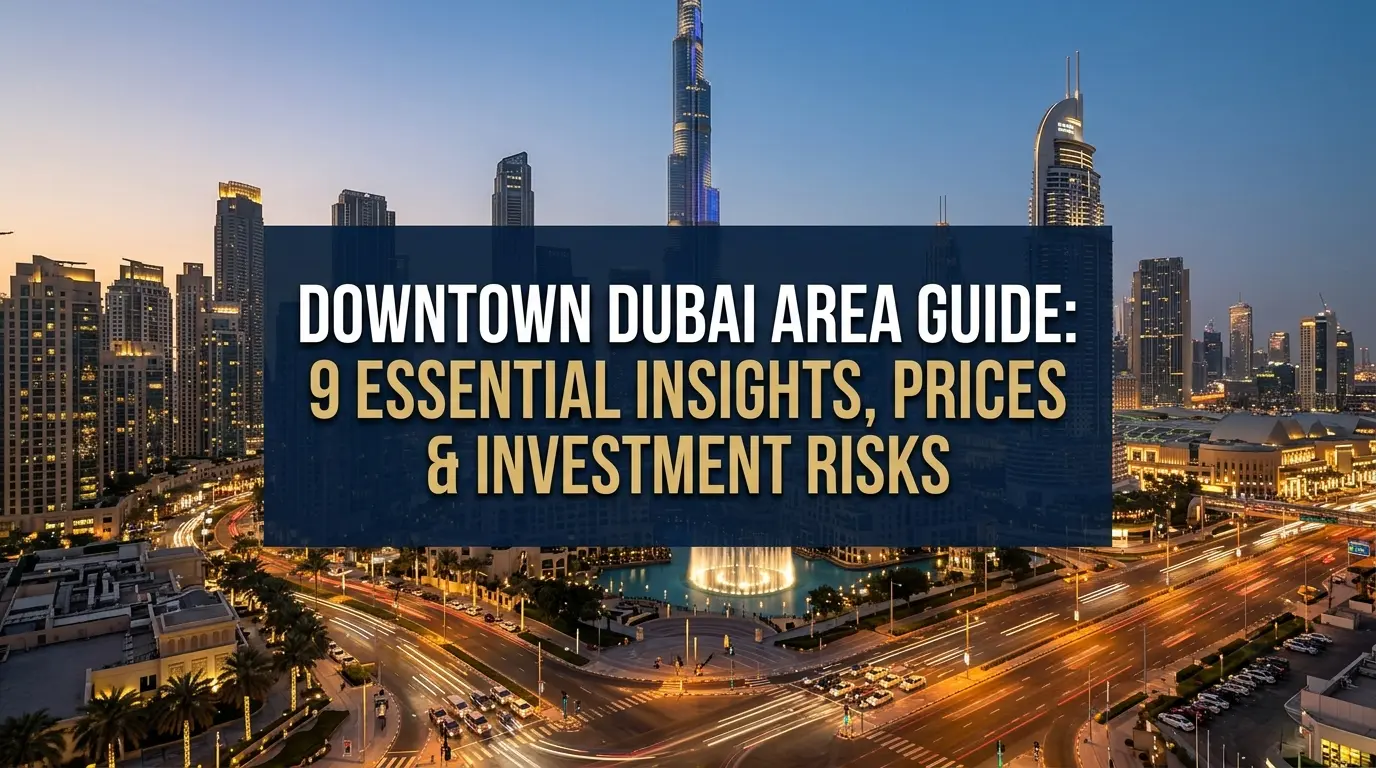
If you are researching Dubai’s most established luxury communities, this Downtown Dubai Area Guide is a useful starting point before making a property decision. Downtown Dubai is one of the city’s best-known destinations, combining luxury residences, offices, hotels, retail, entertainment and some of Dubai’s most recognisable landmarks.
Located between Sheikh Zayed Road and Financial Centre Road, Downtown Dubai is Emaar’s flagship master development and covers approximately two square kilometres. The district is centred around landmarks including Burj Khalifa, Dubai Mall, Dubai Opera, Burj Park and the Dubai Fountain.
For Indian investors, the appeal of a Downtown Dubai Area Guide is not simply about looking at luxury apartments. The important questions are: What makes the location different? What type of property is available? How much does property cost? What rental evidence exists? How accessible is the area? And what risks should investors consider?
This Downtown Dubai Area Guide answers those questions using current market information and practical investment considerations.
1. What Is Downtown Dubai?
Downtown Dubai is a purpose-built mixed-use community developed around some of Dubai’s most important attractions. Visit Dubai describes the area as a prestigious residential and commercial district, approximately 8 km from Dubai Creek.
The Downtown Dubai Area Guide is important for investors because this is not simply a residential neighbourhood. It functions as a destination for residents, tourists, businesses and luxury hospitality.
The area includes:
- Burj Khalifa
- Dubai Mall
- Dubai Opera
- Burj Park
- Souk Al Bahar
- Sheikh Mohammed bin Rashid Boulevard
- Burj Khalifa Lake
- Luxury hotels
- High-rise residential buildings
- Restaurants and cafés
- Retail and entertainment destinations
Emaar describes Downtown Dubai as its flagship mega-development and highlights its position between Sheikh Zayed Road and Financial Centre Road.
This combination makes the Downtown Dubai Area Guide especially useful for investors evaluating lifestyle, location and property demand together.
2. Why Is Downtown Dubai So Famous?
A major reason Downtown Dubai has become internationally recognised is the concentration of major landmarks within a relatively compact area.
Burj Khalifa rises 828 metres above the district and remains one of Dubai’s defining landmarks. Dubai Mall is directly adjacent to Burj Khalifa and forms another major part of the Downtown experience.
The Downtown Dubai Area Guide would not be complete without mentioning the area’s tourism ecosystem.
A visitor can move between Burj Khalifa, Dubai Mall, Souk Al Bahar, Burj Park and Dubai Opera without travelling across different parts of Dubai. This walkability is one of the district’s distinctive characteristics.
Emaar states that Dubai Mall covers approximately 1,124,000 square metres and has announced an expansion involving 240 additional luxury stores and food-and-beverage outlets.
For property owners, this concentration of attractions can be relevant because location is one component that influences tenant and visitor demand.
However, investors should not automatically assume that proximity to a landmark guarantees a specific rental yield or capital gain. Individual building quality, purchase price, service charges, views, layout, condition and market timing also matter.
3. Downtown Dubai Property Market
One of the most important sections of any Downtown Dubai Area Guide is the property market.
Downtown Dubai contains a wide range of apartments, from studios and one-bedroom homes to large multi-bedroom residences and luxury penthouses.
Current market data varies considerably by building and unit type.
Bayut’s August 2026 index reported an average Downtown Dubai sale price of approximately AED 3,330 per sq ft across the properties included in its index. Its breakdown showed approximately AED 2,737 per sq ft for studios, AED 2,730 for one-bedroom apartments, AED 3,187 for two-bedroom apartments, AED 4,283 for three-bedroom apartments and AED 5,635 for four-bedroom apartments.
These figures should be treated as market indicators rather than guaranteed purchase prices.
Actual transaction prices can differ significantly depending on:
- Building
- Floor
- View
- Size
- Property condition
- Furnishing
- Parking
- Service charges
- Payment terms
- Developer
- Seller expectations
- Market timing
For example, Property Finder’s transaction records show recent Downtown Dubai sales ranging from around AED 2 million for some one-bedroom transactions to more than AED 4 million for selected two-bedroom and hotel-apartment transactions.
Therefore, a serious Downtown Dubai Area Guide should never present one average price as the price of every property.
4. What Types of Properties Are Available?
The residential inventory in Downtown Dubai is predominantly apartment-based, making the area particularly relevant for buyers seeking an urban lifestyle.
Depending on the building and development, buyers may find:
Studios
Studios can provide a lower entry point compared with larger Downtown properties. They may appeal to investors targeting singles, young professionals or short-term accommodation markets, subject to applicable regulations.
One-Bedroom Apartments
One-bedroom apartments are common throughout Downtown Dubai and can appeal to both owner-occupiers and investors.
Two-Bedroom Apartments
Two-bedroom homes generally offer more living space and may appeal to families, professionals sharing accommodation or tenants seeking premium residences.
Three-Bedroom and Larger Homes
Larger residences occupy a more premium segment. Their pricing can vary substantially based on floor level, views, building reputation and internal area.
Penthouses and Ultra-Luxury Residences
At the upper end of the market, Downtown Dubai contains luxury residences with expansive terraces, Burj Khalifa views and high-end amenities.
Emaar’s current Downtown portfolio includes developments such as Forte, Burj Crown, Downtown Views II, Grande Signature Residences and other residential projects.
5. Rental Market in Downtown Dubai
Rental demand is another major consideration in this Downtown Dubai Area Guide.
Downtown Dubai attracts tenants who value centrality, luxury amenities, proximity to workplaces and access to entertainment and retail.
Recent Property Finder transaction records demonstrate a broad rental range.
For example, September 2026 records include one-bedroom rentals around AED 110,000 in Bellevue Tower 1 and AED 85,000 in Burj Views C, while a three-bedroom Forte transaction was recorded at AED 225,000.
Other transactions in The Residences show one-bedroom rents around AED 115,000–125,000 and larger residences reaching substantially higher levels.
These are individual recorded transactions, not guaranteed market rents.
Investors using this Downtown Dubai Area Guide should calculate rental returns using the actual purchase price of the specific property.
A simple gross rental yield calculation is:
Gross Rental Yield = Annual Rent ÷ Property Purchase Price × 100
For example, if an apartment costs AED 2,500,000 and generates AED 125,000 annual rent:
AED 125,000 ÷ AED 2,500,000 × 100 = 5% gross rental yield
This is before service charges, maintenance, management costs, vacancy and other expenses.
6. Connectivity and Transportation
Connectivity is another important part of a Downtown Dubai Area Guide.
Downtown Dubai sits close to Sheikh Zayed Road and Financial Centre Road, giving residents access to major routes through Dubai.
The Burj Khalifa/Dubai Mall Metro Station also provides metro access to the district. Emaar notes that Downtown Dubai can be accessed by car and metro and highlights the connection provided by the Burj Khalifa/Dubai Mall station.
This connectivity can be useful for residents working in areas such as:
- Downtown Dubai
- DIFC
- Business Bay
- Sheikh Zayed Road
- Dubai International Airport
- Jumeirah
- Dubai Marina
For investors, accessibility can be one of the factors supporting tenant demand, although it should be evaluated alongside the specific building’s walking distance, road access and parking availability.
7. Lifestyle in Downtown Dubai
The lifestyle component is central to any Downtown Dubai Area Guide.
Residents have access to shopping, restaurants, entertainment and public spaces within the district.
Dubai Mall alone includes extensive retail, dining and entertainment facilities. Emaar describes the mall as a major retail and leisure destination within Downtown Dubai.
Other lifestyle attractions include:
- Dubai Opera
- Burj Park
- Souk Al Bahar
- Dubai Fountain area
- Restaurants and cafés
- Luxury hotels
- Fitness facilities
- High-end retail
- Pedestrian promenades
The district therefore appeals to people who prefer a central, high-rise and activity-oriented lifestyle rather than a suburban villa environment.
Families should also evaluate school locations, traffic conditions, apartment size and daily commuting requirements before choosing Downtown Dubai as a primary residence.
8. Investment Advantages to Consider
A balanced Downtown Dubai Area Guide should identify potential advantages without presenting them as guaranteed returns.
Strong Brand Recognition
Downtown Dubai is internationally recognised because of Burj Khalifa, Dubai Mall and other landmarks.
Central Location
The district’s location provides access to important roads, business areas and transport infrastructure.
Diverse Tenant Profile
Potential tenants can include professionals, executives, families, international residents and corporate tenants, depending on the property.
Established Community
Unlike some emerging areas, Downtown Dubai is an established master development with completed residential, hospitality, retail and entertainment infrastructure.
Luxury Positioning
The district operates within Dubai’s premium residential segment, with a large selection of branded and luxury developments.
These characteristics can contribute to the area’s property appeal, but they do not eliminate investment risk.
Investors should compare the property with alternatives such as Business Bay, Dubai Marina, JBR and emerging districts before making a decision.
For a comparison with another established lifestyle destination, readers can also explore the Dubai Marina vs JBR investment guide.
9. Risks Investors Should Consider
A professional Downtown Dubai Area Guide should discuss risks as clearly as it discusses opportunities.
High Entry Prices
Prime-location properties can require significantly more capital than apartments in emerging Dubai communities.
Service Charges
Luxury buildings can have substantial annual service charges. These should be included when calculating net returns.
Property-Specific Performance
Two apartments in the same neighbourhood can produce very different rental returns because of building quality, layout, view, floor and furnishing.
Competition
Downtown Dubai has a substantial amount of residential inventory. Investors should compare competing properties available for sale and rent.
Market Cycles
Property values and rents can move through different phases. A buyer should avoid assuming that recent performance will continue indefinitely.
Off-Plan Considerations
New projects may offer payment plans and future-development potential, but they also introduce construction and completion considerations.
The correct approach is to analyse the specific property rather than relying only on the reputation of Downtown Dubai.
Downtown Dubai vs Business Bay
Another useful comparison in this Downtown Dubai Area Guide is Business Bay.
The two districts are geographically close but offer somewhat different property profiles.
Downtown Dubai is strongly associated with Burj Khalifa, Dubai Mall, luxury residences and tourism.
Business Bay is a mixed-use business and residential district with a larger variety of commercial buildings and residential developments.
For investors, the comparison should include:
| Factor | Downtown Dubai | Business Bay |
|---|---|---|
| Positioning | Prime luxury destination | Business & mixed-use hub |
| Landmark appeal | Very high | Moderate to high |
| Property type | Primarily apartments | Apartments + commercial |
| Lifestyle | Luxury, tourism, retail | Business, residential, lifestyle |
| Entry pricing | Generally premium | Wider range |
| Investment approach | Prime-location strategy | Broader market strategy |
There is no universal answer for every investor. Budget, investment horizon, desired rental profile and property characteristics should determine the comparison.
Is Downtown Dubai Suitable for Indian Investors?
For Indian investors researching Dubai property, this Downtown Dubai Area Guide highlights several practical considerations.
The area offers an internationally recognised location, established infrastructure, premium residential stock and access to major attractions.
However, Indian investors should also consider:
- AED-to-INR exchange-rate movement
- Dubai property registration costs
- Service charges
- Mortgage availability
- Financing costs
- Rental management
- Vacancy assumptions
- Developer and building reputation
- Exit strategy
- Property ownership structure
- Tax implications in both relevant jurisdictions
The purchase price should not be the only number in an investment analysis.
A property costing AED 2.5 million with a lower net return could have a different investment profile from a property costing AED 3 million with stronger rental income and better resale liquidity. These calculations need to be performed using actual property-level data.
How to Evaluate a Downtown Dubai Property
Before buying, use this Downtown Dubai Area Guide as a checklist and analyse the individual property.
Step 1: Check the Building
Research developer history, completion status, maintenance standards, amenities and service charges.
Step 2: Compare Recent Transactions
Look at recent completed sales rather than relying only on asking prices.
Step 3: Analyse Rental Evidence
Review actual rental transactions for comparable apartments.
Step 4: Calculate Net Yield
Deduct service charges, management, maintenance, vacancy and other relevant expenses.
Step 5: Compare Alternatives
Compare the same budget with Business Bay, Dubai Marina, JBR and emerging locations.
Step 6: Check Exit Potential
Consider the property’s likely buyer and tenant pool, layout, size, view and building reputation.
Step 7: Review Documentation
Before transferring funds, verify ownership, payment terms, registration requirements and contractual documentation through the appropriate authorities and professionals.
Frequently Asked Questions
Is Downtown Dubai a good area for property investment?
Downtown Dubai is one of Dubai’s established premium property districts. Its landmark attractions, central location and established infrastructure make it an important market to research. However, investment performance depends on the specific property, purchase price, rental income, costs and market conditions.
How much does property cost in Downtown Dubai?
Prices vary considerably by building and apartment type. Bayut’s August 2026 index reported approximately AED 3,330 per sq ft across its Downtown Dubai index, while individual transactions can be substantially above or below that figure.
Is Downtown Dubai good for rental income?
Downtown Dubai has an active rental market, with recent transactions covering studios, one-bedroom, two-bedroom and larger apartments. Actual rental yield depends on the property’s purchase price and all ownership costs.
Is Downtown Dubai close to the Metro?
Yes. The Burj Khalifa/Dubai Mall Metro Station serves the area and connects Downtown Dubai with Dubai’s wider metro network.
What are the main attractions in Downtown Dubai?
Major attractions include Burj Khalifa, Dubai Mall, Dubai Opera, Burj Park, Souk Al Bahar and the Dubai Fountain area.
Is Downtown Dubai only for luxury buyers?
The area is predominantly positioned toward the premium end of Dubai’s residential market, but property sizes, buildings and prices vary. Buyers should compare individual units rather than assuming every Downtown property falls into the same price bracket.
Final Takeaway
This Downtown Dubai Area Guide shows why the district remains one of Dubai’s most recognisable real-estate destinations.
Its strongest characteristics are its central location, landmark ecosystem, established infrastructure, luxury residential inventory, retail environment and connectivity.
At the same time, investors should not buy simply because a property has a Burj Khalifa view or a Downtown Dubai address.
A disciplined investment analysis should examine the purchase price, recent transactions, achievable rent, service charges, property condition, building reputation, financing cost and potential exit strategy.
For Indian investors, the right question is not simply whether Downtown Dubai is attractive. The more useful question is whether a specific Downtown Dubai property at a specific price fits the investor’s financial objectives and risk tolerance.
That is where detailed research and property-level due diligence become important.
Use this Downtown Dubai Area Guide as a starting point, then verify current transaction data, rental evidence, legal documentation and project-specific information before making an investment decision.














Join The Discussion