

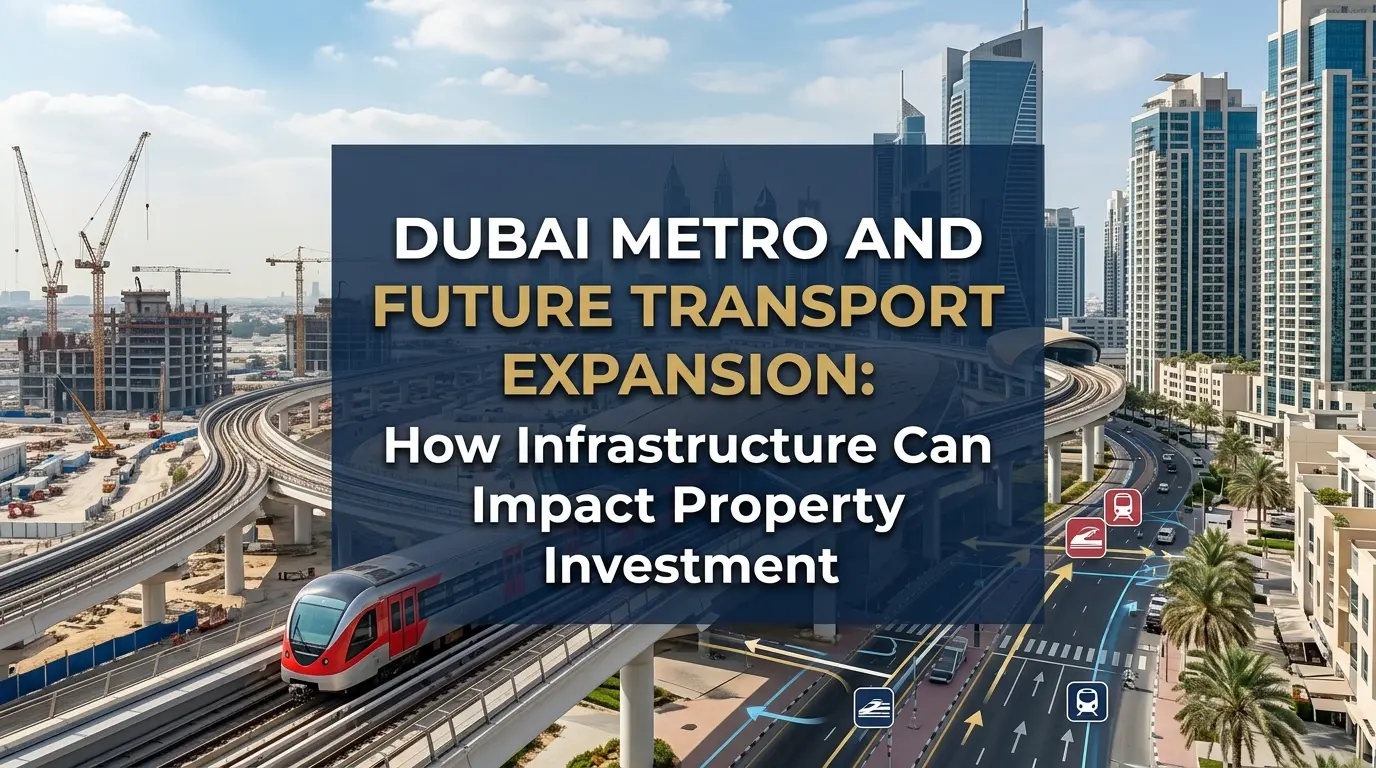
Dubai Metro expansion is becoming an important factor for investors researching Dubai real estate. New Metro projects, improved connectivity and future transport infrastructure can influence how investors evaluate property location, rental demand, accessibility and long-term investment potential.
Dubai’s transport network is continuing to expand, with the Dubai Metro Blue Line targeted for completion in 2029 and the planned Gold Line expected in 2032. For investors considering a 1 BHK, 2 BHK, apartment or other property buy in Dubai, understanding current and future connectivity can be an important part of property research.
Dubai has always treated transportation as more than a way to move people from one location to another. Metro stations, highways, airports, bridges and new mobility systems have become important parts of the city’s long-term urban development strategy.
For property investors, this makes Dubai Metro and Future Transport Expansion an important subject to understand before buying a home or investment property.
Dubai’s existing Metro network already connects major residential, commercial and tourism districts. But the next phase is even more significant. The Dubai Metro Blue Line is under construction, while the Dubai Metro Gold Line has also been approved. Together, these projects are expected to significantly expand rail connectivity across Dubai.
For an investor considering a 1 BHK, 2 BHK, apartment, townhouse or other Dubai real estate, transport connectivity can influence accessibility, tenant demand, convenience and the long-term development potential of an area.
However, a metro announcement should not automatically be treated as a guarantee of property appreciation. Investors should evaluate the complete picture, including location, developer, supply, service charges, rental demand, project quality and purchase price.
This guide explains how Dubai Metro and Future Transport Expansion may affect Dubai real estate and what Indian investors should consider.
Dubai Metro and Future Transport Expansion: Why It Matters for Property
The relationship between transport infrastructure and real estate is straightforward.
When an area becomes easier to reach, it can become more attractive to residents, employees, businesses and visitors. Better connectivity can reduce dependence on private vehicles and improve access to employment centres, schools, retail destinations and entertainment districts.
This is one reason Dubai Metro and Future Transport Expansion deserves attention from property investors.
Dubai’s existing Metro system has already demonstrated significant usage. According to Dubai’s Roads and Transport Authority, the Metro carried approximately 295 million passengers in 2025, with average daily ridership around one million. Since its launch in 2009, Dubai Metro has served more than 2.8 billion passengers through the end of 2025.
During the first half of 2026, Dubai Metro’s Red and Green Lines carried approximately 136.5 million riders.
These numbers demonstrate that rail connectivity is already an important part of Dubai’s mobility system.
For investors, the question is therefore not simply:
“Is there a Metro station?”
The better questions are:
- How close is the property to the station?
- What type of transport connection will be available?
- Which employment and lifestyle destinations can residents reach?
- Is there sufficient rental demand?
- How much new property supply is coming into the area?
- Does the purchase price already reflect expected infrastructure benefits?
These questions are especially important when comparing Dubai property investment opportunities.
Dubai Metro Blue Line: The Major Upcoming Expansion
The biggest near-term development in Dubai Metro and Future Transport Expansion is the Blue Line.
The Blue Line is a 30-kilometre route with 14 stations. It will connect with the existing Red and Green Lines and serve several important growth areas. RTA currently targets opening on 9 September 2029.
The Blue Line will connect areas including:
- Dubai Creek Harbour
- Dubai Festival City
- Ras Al Khor
- International City
- Dubai Silicon Oasis
- Dubai Academic City
- Mirdif
- Al Warqa
It will also provide interchange connections with existing Metro infrastructure.
RTA estimates that the Blue Line will serve areas expected to have a population of more than one million people by 2040. Daily ridership is projected at approximately 200,000 passengers in 2030, rising to around 320,000 by 2040.
This is important for investors because the Blue Line does not simply extend transportation into an established area. It connects several locations that are themselves part of Dubai’s broader urban expansion.
Dubai Creek Harbour and the Blue Line
Dubai Creek Harbour is one of the most visible locations associated with the Blue Line.
The project will include an iconic station at Dubai Creek Harbour, and the Blue Line will cross Dubai Creek using a new approximately 1,300-metre bridge.
For property investors, this creates an interesting infrastructure-development relationship.
An area can evolve through multiple stages:
Infrastructure → accessibility → business activity → residential demand → retail and lifestyle development
This does not mean that every property will appreciate at the same rate.
A buyer looking at a 1 BHK or 2 BHK in Dubai should still compare the property’s entry price, service charges, developer reputation, rental market and competing supply.
Infrastructure is one part of the investment equation, not the entire equation.
Dubai Silicon Oasis: A Significant Connectivity Story
Dubai Silicon Oasis is another area worth monitoring in the context of Dubai Metro and Future Transport Expansion.
The Blue Line will connect Dubai Silicon Oasis with other parts of the network and continue towards Dubai Academic City.
Dubai Silicon Oasis already has a significant residential and technology-oriented ecosystem. Improved public transportation can potentially make the location more accessible to residents who work or study elsewhere in Dubai.
For an investor researching:
- Dubai Silicon Oasis apartments
- 1 BHK properties
- 2 BHK properties
- rental apartments
- affordable Dubai real estate
- investment properties
transport connectivity should therefore be included in the due-diligence checklist.
An investor should not purchase simply because a future station is announced.
Instead, compare the property with existing rental demand and competing projects.
Dubai Metro Gold Line: The Next Major Phase
The Blue Line is not the only major development.
In April 2026, Dubai approved the Dubai Metro Gold Line, involving an estimated investment of approximately AED 34 billion.
The Gold Line is planned to extend approximately 42 kilometres with 18 stations and will be Dubai’s first fully underground Metro line. The planned inauguration date is 9 September 2032.
The Gold Line is expected to connect with the Red and Green Lines and integrate with Etihad Rail.
According to RTA, the expanded network including the Blue Line currently under construction is expected to grow from 120 kilometres and 67 stations to approximately 162 kilometres and 85 stations after the Gold Line is completed.
The Gold Line is also planned to serve more than 55 development projects and approximately 1.5 million people by 2040.
This makes Dubai Metro and Future Transport Expansion a long-term infrastructure story rather than a single Metro project.
How Metro Expansion Can Affect Dubai Real Estate
The property impact of transportation infrastructure can happen through several channels.
1. Better Accessibility
The most direct benefit is accessibility.
A property close to a Metro station can potentially provide residents with easier access to offices, shopping centres, universities, tourist attractions and other communities.
For tenants without cars, this can be particularly relevant.
A 1 BHK near Metro connectivity may therefore appeal to a different tenant segment than a similar apartment that requires a long car journey to reach public transport.
2. Rental Demand
Rental demand depends on several factors.
Transport accessibility is one of them.
Professionals may prefer locations that make commuting easier. Students may value access to educational districts. Tourists and short-term occupants may prefer convenient connections to attractions and business areas.
This is why investors evaluating Dubai property investment should study both the property and its transportation ecosystem.
However, investors should avoid assuming:
Metro nearby = guaranteed high rent.
Rental performance can vary significantly between buildings and communities.
3. Commercial Development
Transportation can also support commercial activity.
When more people can access an area, retail, offices, restaurants and services may become more viable.
This can gradually change the character of a neighbourhood.
For real estate investors, mixed-use communities can therefore be interesting because residents may have access to homes, offices, retail and public transportation within the same wider district.
4. Long-Term Development
Infrastructure can be particularly relevant in developing locations.
An established neighbourhood may already have transport connectivity.
A developing community may experience multiple infrastructure improvements over several years.
This creates a different investment proposition.
For investors considering property buy in Dubai, the question becomes:
What does this location look like today, and what infrastructure is planned around it over the next five to ten years?
Dubai 2040 and Transit-Oriented Development
The relationship between transportation and property is also connected to Dubai’s broader urban planning strategy.
The Dubai 2040 Urban Master Plan promotes transit-oriented development, integration between land use and transportation, and future-proof mobility systems.
The Blue Line is designed around the concept of a more connected 20-minute city, where residents can access a significant share of essential services within approximately 20 minutes.
For real estate investors, this can change how location is evaluated.
Traditionally, investors may have focused heavily on:
View + Price + Developer + Size
The future approach can add:
Connectivity + Walkability + Public Transport + Employment Access + Infrastructure
This broader framework can help investors compare different Dubai communities.
Should You Buy Property Near a Future Metro Station?
This is one of the most common questions investors ask.
The answer depends on the individual property.
A future Metro station can be a positive factor, but it should not be the only reason for buying.
Consider these factors before purchasing:
Current Distance
How far is the property from the existing or planned station?
A future station shown on a map may still be several years away.
Developer
Research the developer’s delivery history, construction quality and community performance.
Investors comparing developers such as Emaar, Sobha, DAMAC and Danube should evaluate each project individually rather than assuming that the developer’s name alone determines investment performance.
Purchase Price
If the seller has already priced the property assuming future infrastructure benefits, the potential upside may be different from buying before infrastructure expectations become widely priced into the market.
Rental Market
Check current rents and comparable properties.
Service Charges
A property with a lower purchase price but high recurring charges can produce a different investment result.
Supply
Future launches can create competition for tenants and buyers.
1 BHK vs 2 BHK Near Metro Connectivity
The right unit size depends on the target tenant.
A 1 BHK in Dubai can appeal to singles, young professionals and couples.
A 2 BHK in Dubai may appeal more to families, professionals sharing accommodation or tenants looking for additional space.
Near a Metro station, the investor should compare:
| Factor | 1 BHK | 2 BHK |
|---|---|---|
| Typical target | Singles/couples | Families/professionals |
| Entry price | Usually lower | Usually higher |
| Rental audience | Broad | Family-oriented |
| Resale audience | Investor-focused | End-user + investor |
| Metro advantage | Commuter convenience | Family mobility |
There is no universal answer regarding which unit should be purchased.
The right choice depends on the purchase price, expected rent, service charges, location, building quality and tenant profile.
Sobha, Danube, Emaar and DAMAC: Does Developer Matter?
Yes, but it should be evaluated alongside the location.
Dubai has numerous established developers, including Emaar, Sobha Realty, DAMAC and Danube Properties.
For example, the current Dubai Metro map already includes stations such as Sobha Realty and Danube, demonstrating how developer branding and transportation infrastructure can intersect in Dubai’s existing Metro network.
However, investors should not use the existence of a station name as a substitute for project-level research.
When comparing a project from Sobha, Danube, Emaar or DAMAC, evaluate:
- Location
- Metro access
- Developer track record
- Construction quality
- Handover history
- Payment plan
- Service charges
- Rental demand
- Resale liquidity
- Current competing supply
A promotional offer or attractive payment plan can improve affordability, but it does not automatically make a property a better investment.
How Indian Investors Can Evaluate Dubai Property
For Indian investors researching Dubai real estate, transportation infrastructure can be incorporated into a structured property analysis.
Step 1: Select the Location
Start with the area rather than the developer.
Step 2: Study Existing Connectivity
Check the current Metro, tram, bus and road network.
Step 3: Study Future Infrastructure
Review official RTA announcements for planned Metro stations and transport projects.
Step 4: Compare 1 BHK and 2 BHK Options
Compare purchase price, size, rent and service charges.
Step 5: Check Developer Credentials
Research delivery history and project quality.
Step 6: Calculate Rental Yield
Do not rely only on advertised rental figures.
Step 7: Review Payment Plans
Off-plan projects may provide staged payment structures, but the total purchase cost and handover timeline should be understood.
Step 8: Conduct Due Diligence
Verify project registration, developer information, escrow arrangements and transaction documentation.
This approach is more useful than simply searching for the phrase “near future Metro station”.
Does Metro Expansion Guarantee Property Appreciation?
No.
This is an important distinction.
Dubai Metro and Future Transport Expansion can improve connectivity and potentially increase the attractiveness of certain locations, but infrastructure alone cannot guarantee property appreciation.
Property performance is influenced by many variables:
- Supply and demand
- Economic conditions
- Interest rates and financing
- Population growth
- Rental demand
- Developer quality
- Property type
- Purchase price
- Service charges
- New project launches
- Local amenities
- Employment centres
- Tourism
- Infrastructure
The RTA itself has reported that the Blue Line supports Transit-Oriented Development and has stated that land and property values around stations could increase by up to 25%. This is an official project-related estimate, not a guarantee of appreciation for every property.
Investors should therefore treat infrastructure data as one input into their decision-making process.
Dubai Real Estate Market and Infrastructure
Dubai’s property market entered 2026 with substantial transaction activity.
Dubai Land Department reported AED 252 billion in real estate transactions in Q1 2026, representing a 31% year-on-year increase in transaction value. Real estate investments reached AED 173 billion across 57,744 investments during the quarter.
The data shows why infrastructure should be studied alongside the broader real estate market.
A strong market can contain both attractive and unattractive properties.
Similarly, a major infrastructure project can create opportunities while also attracting new development and competition.
Therefore, Dubai Metro and Future Transport Expansion should be viewed as part of a larger investment framework.
Future Transport Beyond the Metro
Dubai’s transport strategy extends beyond traditional Metro lines.
RTA is also developing autonomous mobility, air taxi initiatives, electric buses and soft-mobility infrastructure.
In 2026, RTA reported plans involving driverless taxis, commercial air-taxi operations and continued development of the Dubai Loop project.
A separate five-year soft-mobility plan approved in July 2026 covers 25 residential areas and infrastructure around 63 public transport stations through 2030, with a focus on first- and last-mile connectivity.
This is important because a Metro station is only one part of the transportation journey.
The real estate value proposition can depend on:
Home → Walkability → Bus/Taxi → Metro → Business District
Better first- and last-mile connectivity can therefore make public transport more practical.
What Property Investors Should Watch Until 2032
The next several years could be particularly important for Dubai’s infrastructure landscape.
Investors should monitor:
2026
Blue Line construction progress and Gold Line tender developments.
2029
Target opening of the Blue Line.
2030
Further development of soft mobility and supporting infrastructure.
2032
Target inauguration of the Gold Line.
2040
Long-term Dubai Urban Master Plan objectives and population/infrastructure development.
This long-term timeline is especially relevant for investors who are considering Dubai property investment as a multi-year strategy rather than a short-term speculation.
Final Thoughts: Infrastructure Should Be Part of Your Property Research
The future of Dubai real estate will not be determined by one factor.
Dubai Metro and Future Transport Expansion is important because transportation influences accessibility, mobility, urban development and potentially rental demand.
The Blue Line is expected to connect Dubai Creek Harbour, Dubai Silicon Oasis, International City, Academic City and other growing districts by 2029.
The Gold Line is planned to further expand the Metro network by 2032.
At the same time, Dubai is developing autonomous taxis, air taxis, electric buses and first- and last-mile mobility infrastructure.
For investors looking for a 1 BHK, 2 BHK, luxury apartment, off-plan property or ready property in Dubai, these developments can provide useful context.
But the smartest property research should go beyond:
“How close is the Metro?”
It should examine:
Location + Connectivity + Developer + Price + Rental Demand + Supply + Payment Plan + Service Charges + Future Infrastructure.
At Skyline Infrastructure Investments, our approach is to help Indian investors understand Dubai real estate through research, market information and project-level due diligence rather than relying only on promotional offers.
If you are exploring a property buy in Dubai, compare the complete investment picture before making a commitment.
Frequently Asked Questions
Is Dubai Metro expansion good for property investors?
Metro expansion can improve accessibility and connectivity in areas served by new infrastructure. However, it does not guarantee property appreciation or rental returns. Investors should evaluate the specific property, purchase price, supply and rental demand.
Which areas will benefit from the Dubai Metro Blue Line?
The Blue Line will connect areas including Dubai Creek Harbour, Dubai Festival City, Ras Al Khor, International City, Dubai Silicon Oasis, Academic City, Mirdif and Al Warqa.
When will the Dubai Metro Blue Line open?
RTA’s current target is 9 September 2029.
What is the Dubai Metro Gold Line?
The Gold Line is a planned 42-kilometre, 18-station underground Metro line with an estimated investment of AED 34 billion. Its planned inauguration is 9 September 2032.
Should I buy a 1 BHK or 2 BHK near Metro?
The answer depends on your budget, target tenant, expected rent, service charges, property price and location. A 1 BHK may appeal strongly to singles and professionals, while a 2 BHK can target families and larger households.
Is buying near a future Metro station guaranteed to give high ROI?
No. Future infrastructure can be an important factor, but ROI depends on several variables including purchase price, rental income, supply, service charges, market conditions and property quality.
Which developers should investors research?
Investors can research established names such as Emaar, Sobha Realty, DAMAC and Danube, but every project should be evaluated independently based on location, pricing, quality, payment plan and market demand.
Useful Official Resources
For the latest transportation information, investors should refer to the Dubai Roads and Transport Authority (RTA) and official Dubai planning resources.
For real estate transaction information, refer to the Dubai Land Department (DLD).
Skyline Infrastructure Investments can also help Indian investors understand available Dubai property opportunities, including apartments, 1 BHK, 2 BHK and other investment options.
Skyline Infrastructure Investments
Dubai Office: 1404, Le Solarium Tower, Dubai Silicon Oasis, Dubai, UAE
India Office: D-901-D, Urbtech Trade Center, Sector-132, Noida-201304, Uttar Pradesh, India
Phone: +91 9871 0134 45
Email: skylineinfrainv@gmail.com
Website: skylineinfrainv.com
Disclaimer: This article is for educational and informational purposes only. Infrastructure timelines, property prices, rental values and project availability can change. Investors should independently verify project, legal, financial and transaction information before making an investment decision.













Join The Discussion