

Dubai 2040 Urban Master Plan: Why Investors Should Pay Attention
The Dubai 2040 Urban Master Plan is more than a long-term city-planning document. For property investors, it provides an important framework for understanding where Dubai is expected to grow, how infrastructure will expand, where population density may increase and which types of communities the government wants to develop.
Launched in March 2021, the plan provides a 20-year framework for Dubai’s urban development, with a strong focus on quality of life, sustainable mobility, economic growth, environmental protection and integrated communities.
The numbers behind the plan are significant.
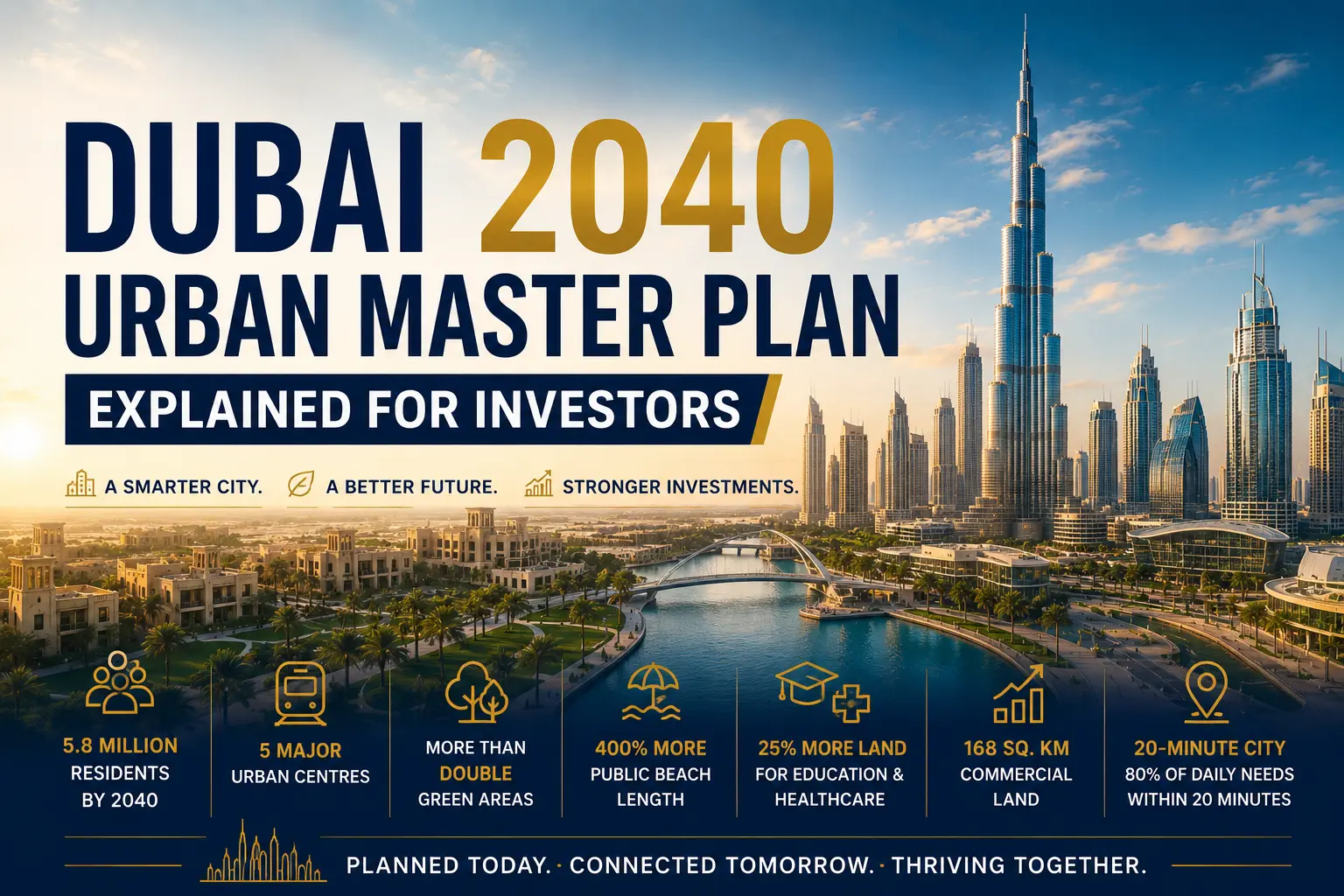
Dubai’s resident population was approximately 3.3 million in 2020, when the plan was launched. The 2040 framework anticipates a resident population of approximately 5.8 million, while the daytime population is expected to reach 7.8 million.
For investors, this raises an important question:
Where will these additional residents live, work, travel and spend their money?
Understanding the answer can help investors evaluate Dubai property beyond today’s rental yield or launch price.
Dubai 2040 Urban Master Plan at a Glance
| Target | Dubai 2040 Plan |
|---|---|
| Resident population target | 5.8 million |
| Daytime population target | 7.8 million |
| Main urban centres | 5 |
| Green & recreational areas | More than double |
| Nature reserves & rural natural areas | 60% of emirate |
| Hotel & tourism land | +134% |
| Commercial land | 168 sq. km |
| Education & healthcare land | +25% |
| Public beach length | +400% |
| 20-minute city target | 80% of daily needs within 20 minutes |
These are official targets rather than guarantees of future property performance.
1. What Is the Dubai 2040 Urban Master Plan?
The Dubai 2040 Urban Master Plan is Dubai’s long-term spatial and urban development framework.
Its objective is not simply to build more residential towers. The plan aims to coordinate:
- Residential communities
- Commercial districts
- Tourism
- Transportation
- Healthcare
- Education
- Green spaces
- Public beaches
- Economic centres
- Infrastructure
- Sustainable mobility
- Urban heritage
The official plan describes five major urban centres that will support economic activity, employment and lifestyle facilities.
This is particularly important for real estate investors because property values are influenced by more than the building itself.
A property can become more attractive when the surrounding area gains:
Transport + employment + schools + retail + healthcare + recreation + population.
That is why master planning matters.
2. Dubai’s Population Is the Biggest Long-Term Driver
One of the most important statistics in the entire plan is population growth.
Dubai’s population was around 3.3 million in 2020. The 2040 plan anticipates approximately 5.8 million residents and a daytime population of 7.8 million.
The growth is already visible.
According to Dubai Government data, Dubai’s population reached approximately 4.58 million by the end of 2025, an increase of about 332,000 people or 7.5% compared with 2024.
Population trajectory
| Year | Population |
|---|---|
| 2020 | ~3.3 million |
| 2025 | ~4.58 million |
| 2040 target | ~5.8 million |
The 2025 figure is an actual population figure, while 2040 is a planning target.
For investors, the difference is important.
Population growth creates potential demand for:
- Apartments
- Villas
- Townhouses
- Rental housing
- Retail
- Offices
- Schools
- Healthcare
- Hospitality
- Leisure facilities
However, population growth alone does not guarantee price appreciation. Investors still need to analyse supply, pricing, service charges, developer quality and rental demand.
3. The Five Urban Centres: Where Dubai Wants to Concentrate Growth
The Dubai 2040 framework focuses development around five major urban centres.
The existing centres include:
- Deira and Bur Dubai
- Downtown Dubai and Business Bay
- Dubai Marina and JBR
The plan also identifies two newer centres:
- Expo 2020 Centre
- Dubai Silicon Oasis Centre
The purpose is to create a more balanced urban structure rather than concentrating every major activity in one part of Dubai.
Why this matters to property investors
Investors should not only ask:
“Is this property in Dubai?”
A better question is:
“How does this location fit into Dubai’s future urban structure?”
A community connected to employment, transportation and services may have stronger long-term fundamentals than a similarly priced property without those connections.
4. The 20-Minute City Could Change How Investors Choose Locations
One of the most interesting elements of Phase II of the Dubai 2040 plan is the development of the 20-minute city concept.
The objective is for residents to be able to reach 80% of their daily needs and destinations within 20 minutes, using walking or cycling where practical, supported by integrated service centres and mass transit.
This changes the traditional approach to Dubai property.
Historically, investors often focused heavily on:
- Distance from Downtown
- Distance from the beach
- Metro proximity
- View
- Building amenities
In the future, the broader concept becomes:
Can residents access most of their daily requirements without travelling across the entire city?
This could increase the importance of communities that combine residential, retail, education, healthcare and recreation.
5. Infrastructure Is One of the Biggest Investment Signals
Infrastructure is one of the strongest reasons investors pay attention to master plans.
Dubai has consistently used infrastructure investment to connect emerging communities with established business and residential districts.
A major example today is the Dubai Metro Blue Line.
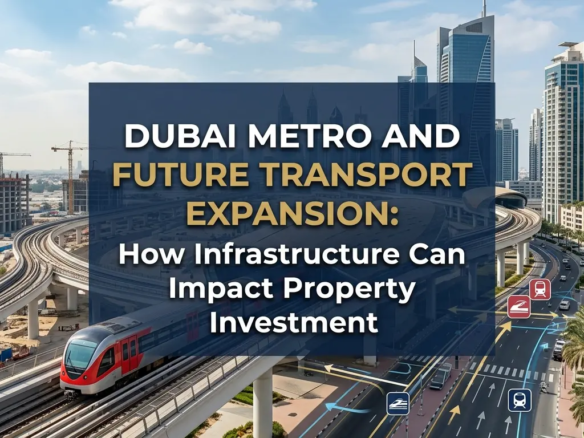
The Blue Line is a 30-kilometre metro project with 14 stations and an investment value of approximately AED 20.5 billion. It connects areas including Dubai Creek Harbour, Ras Al Khor, International City, Dubai Silicon Oasis, Academic City, Mirdif and Al Warqa.
The project is scheduled for completion in 2029.
6. Dubai Metro Blue Line: Why Property Investors Are Watching It
The Blue Line is particularly relevant because it directly connects with the Dubai 2040 strategy.
The route will serve nine major areas expected to have a combined population of around 1 million by 2040.
According to RTA, the line is expected to:
- Connect the Red and Green Metro Lines
- Serve approximately 1 million residents by 2040
- Reach around 200,000 passengers per day by 2030
- Reach approximately 320,000 passengers per day by 2040
- Connect directly with Dubai International Airport
- Support the 20-minute-city concept
The line is also expected to reduce traffic congestion on served routes by approximately 20%.
Areas connected by the Blue Line
| Area | Why investors may watch it |
|---|---|
| Dubai Creek Harbour | Major waterfront development |
| Ras Al Khor | Strategic location between established districts |
| International City | Large residential population |
| Dubai Silicon Oasis | Planned urban and technology centre |
| Academic City | Education and student population |
| Mirdif | Established residential community |
| Al Warqa | Growing residential area |
| Dubai Festival City | Residential, retail and hospitality |
| Al Rashidiya | Established transport-connected area |
This does not mean every property near a future station will automatically outperform.
But infrastructure can change accessibility, commute times and the attractiveness of surrounding communities.
7. Dubai 2040 and Transit-Oriented Development
The plan increasingly promotes development around mass-transit infrastructure.
This concept is often described as Transit-Oriented Development (TOD).
The basic idea is simple:
Higher accessibility → stronger connectivity → more convenient communities.
For property investors, this creates several questions.
Before buying, ask:
- How close is the property to existing public transport?
- Is a future metro station planned nearby?
- Is the location connected to employment centres?
- What new roads are planned?
- Is population density expected to increase?
- What competing supply will enter the area?
Infrastructure should therefore be treated as one part of an investment analysis, not as a guarantee of appreciation.
8. Green Space Is Becoming a Real Estate Factor
The Dubai 2040 plan is not only about construction.
The government intends to more than double green and recreational spaces, while nature reserves and rural natural areas are targeted to account for 60% of the emirate’s total area.
The plan also includes green corridors connecting residential areas, workplaces and service areas.
For investors, this could influence future buyer preferences.
Modern buyers increasingly look for:
- Parks
- Walking areas
- Cycling infrastructure
- Outdoor recreation
- Waterfront access
- Community spaces
- Healthy lifestyles
This means that a project’s surroundings may become increasingly important alongside the apartment itself.
9. Tourism and Hospitality Are Also Part of the Plan
Dubai’s property market is closely connected to tourism.
The 2040 framework targets a 134% increase in land allocated to hotels and tourism activities.
This can support demand for:
- Hotels
- Serviced apartments
- Holiday homes
- Waterfront residences
- Branded residences
- Short-term rental properties
- Retail and entertainment
But investors should distinguish between residential investment and hospitality investment.
A property located in a tourism-heavy area may have attractive short-term rental potential, but it can also involve different operating costs, regulations and management requirements.
10. Commercial Real Estate Is Also Expanding
Dubai 2040 is not purely a residential strategy.
The plan identifies 168 square kilometres of land for commercial activities.
This is important because residential demand often follows employment.
When businesses establish offices in a location, employees need:
- Housing
- Restaurants
- Retail
- Schools
- Healthcare
- Transportation
- Entertainment
For investors, this creates an important principle:
Follow employment and infrastructure, not just property launches.
11. Education and Healthcare Will Expand
The plan also targets a 25% increase in land allocated to education and health facilities.
This matters particularly for family-oriented communities.
Families typically evaluate property based on more than rental yield.
They consider:
- Schools
- Hospitals
- Clinics
- Parks
- Retail
- Transportation
- Community facilities
As Dubai’s population expands, access to these services becomes increasingly important.
Therefore, investors targeting long-term family tenants may want to examine the quality and future availability of these facilities before purchasing.
12. Public Beaches Could Expand Significantly
Dubai’s 2040 plan also targets a 400% increase in the length of public beaches.
This supports the city’s broader quality-of-life strategy.
Waterfront locations have traditionally commanded strong interest in Dubai.
But future investors should distinguish between:
Private waterfront + public beach access + marina access + general coastal proximity.
These are not the same thing.
The 2040 plan’s emphasis on public beaches also shows that Dubai’s future urban strategy is focused not only on premium developments but on improving overall quality of life.
13. Dubai 2040 Phase II Includes a Real Estate Strategy
Phase II of the Dubai 2040 plan includes a specific Dubai Real Estate Strategy designed to align the property sector with the wider master plan.
The government stated that the strategy is intended to balance supply and demand, proactively manage market opportunities and changes, support sustainable urban development and strengthen investor confidence.
This is important because rapid development can create both opportunity and risk.
If too many similar units are delivered in one location at the same time, rental yields and resale competition can be affected.
Therefore, investors should analyse:
Demand growth vs. future supply.
This is one of the most important principles when evaluating Dubai off-plan property.
14. Dubai 2040 and Dubai Economic Agenda D33
Dubai 2040 should also be viewed alongside the Dubai Economic Agenda D33.
D33 aims to double the size of Dubai’s economy over the decade and strengthen the city’s position among the world’s top global cities.
Its targets include:
| D33 Target | Goal |
|---|---|
| Foreign direct investment | AED 650 billion |
| Private-sector investment | AED 1 trillion |
| Government expenditure | AED 700 billion |
| Domestic demand | AED 3 trillion |
| Foreign trade | AED 25.6 trillion |
These economic targets matter for real estate because a growing economy can support business formation, employment, migration and housing demand.
15. What Does Dubai 2040 Mean for Property Investors?
The plan creates several potential investment themes.
1. Infrastructure-led locations
Areas gaining major transportation infrastructure may become more accessible.
2. Population-led housing demand
Dubai expects significant population growth by 2040.
3. Mixed-use communities
Communities combining residential, commercial and lifestyle facilities align closely with the plan.
4. Family-oriented locations
Education, healthcare, parks and daily services may become increasingly important.
5. Transit-oriented properties
Properties connected to metro and public transport could benefit from improved accessibility.
6. Future growth corridors
Investors may look beyond established prime locations toward areas receiving infrastructure and employment investment.
16. A Simple Investor Framework
Before buying a Dubai property based on the 2040 vision, use this checklist.
| Factor | Question to Ask |
|---|---|
| Location | Is this area part of a long-term growth corridor? |
| Infrastructure | What transport projects are planned? |
| Metro | Is there existing or future metro connectivity? |
| Population | Is the surrounding population increasing? |
| Employment | Are businesses and employment centres nearby? |
| Supply | How many competing units are under construction? |
| Developer | What is the developer’s delivery record? |
| Rental demand | Who is the likely tenant? |
| Service charges | How much will annual ownership cost? |
| Payment plan | Does the payment schedule suit your cash flow? |
| Exit strategy | Who will buy this property from you later? |
This approach is more useful than buying simply because someone says:
“This area is going to be the next big thing.”
17. Which Investors Should Pay Attention to Dubai 2040?
The plan may be particularly relevant to investors with a 5–15 year investment horizon.
Long-term investors can potentially benefit from understanding how today’s infrastructure decisions may shape tomorrow’s communities.
For example, a buyer considering a property near a planned infrastructure project may evaluate:
Current price → construction period → infrastructure delivery → population growth → rental demand → resale market.
However, timing matters.
A future infrastructure announcement does not mean that the benefit will immediately appear in property prices.
Markets can price expectations early.
Therefore, investors should compare the property’s current valuation with:
- Existing rental income
- Future supply
- Developer pricing
- Comparable transactions
- Infrastructure timeline
- Service charges
- Financing costs
- Expected holding period
18. What Dubai 2040 Does NOT Guarantee
This is an important point.
The Dubai 2040 Urban Master Plan is a strategic government planning framework.
It does not guarantee:
- Property price appreciation
- Rental yield
- Capital gains
- Occupancy
- Resale profits
- Developer performance
A property can be located inside a major growth corridor and still underperform if it is overpriced, poorly managed or exposed to excessive competing supply.
The plan should therefore be used as a strategic research tool, not as an investment guarantee.
19. Why 2026 Is an Important Year for Investors
Dubai enters 2026 with a significantly larger population than the 2020 baseline used when the 2040 plan was launched.
The population reached approximately 4.58 million at the end of 2025, meaning Dubai has already moved substantially toward the 2040 population target.
At the same time, major infrastructure projects are moving from planning into construction.
The Dubai Metro Blue Line, for example, has already entered construction and is scheduled for completion in 2029. RTA reported that construction progress was expected to reach approximately 30% by the end of 2026.
This creates an important transition:
Dubai 2040 is moving from a planning document toward physical implementation.
For investors, that makes location analysis increasingly important.
20. Dubai 2040 Urban Master Plan: Final Investment Takeaway
The Dubai 2040 Urban Master Plan provides investors with a useful window into how Dubai intends to develop over the next two decades.
The numbers are substantial:
- 5.8 million targeted residents
- 7.8 million targeted daytime population
- 5 major urban centres
- 60% of the emirate targeted as nature reserves and rural natural areas
- Green and recreational spaces targeted to more than double
- 134% increase targeted for hotel and tourism land
- 25% increase targeted for education and healthcare land
- 400% increase targeted for public beach length
- 80% of daily needs targeted to be accessible within 20 minutes under the 20-minute-city concept
- 30 km Dubai Metro Blue Line
- 14 stations on the Blue Line
- Around 1 million people expected to live in areas served by the Blue Line by 2040
The biggest investment lesson is simple:
Don’t only look at where Dubai is today. Study where Dubai is being planned to go.
A property investment should be evaluated through today’s fundamentals and tomorrow’s infrastructure, population, employment, connectivity and community development.
Dubai’s 2040 vision suggests that the next generation of real estate opportunities may increasingly come from integrated communities, infrastructure-connected locations, mixed-use districts, sustainable development and population-growth corridors.
But smart investing still requires property-level due diligence.
The master plan tells you where the city wants to go. Your investment analysis must determine whether the specific property can benefit from that direction.
Frequently Asked Questions
What is the Dubai 2040 Urban Master Plan?
The Dubai 2040 Urban Master Plan is a long-term framework launched in 2021 to guide Dubai’s urban development, infrastructure, sustainability, mobility, communities and economic growth through 2040.
What is Dubai’s population target for 2040?
The plan anticipates approximately 5.8 million residents and a daytime population of approximately 7.8 million by 2040.
What are the five urban centres in Dubai 2040?
The five centres include Deira and Bur Dubai, Downtown Dubai and Business Bay, Dubai Marina and JBR, Expo 2020 Centre and Dubai Silicon Oasis Centre.
What is the Dubai Metro Blue Line?
The Dubai Metro Blue Line is a 30-kilometre metro project with 14 stations connecting areas including Dubai Creek Harbour, Ras Al Khor, International City, Dubai Silicon Oasis, Academic City, Mirdif and Al Warqa. It is scheduled for completion in 2029.
What is the 20-minute city in Dubai?
Dubai’s 20-minute-city initiative aims to allow residents to access approximately 80% of their daily needs and destinations within 20 minutes, supported by integrated service centres, walking, cycling and mass transit.
Does Dubai 2040 guarantee property price growth?
No. The plan is a long-term urban-development framework, not a guarantee of investment returns. Property performance still depends on location, supply, pricing, developer quality, rental demand, operating costs and market conditions.
Should investors buy property only because of Dubai 2040?
No. Dubai 2040 should be one part of a broader investment analysis. Investors should also examine the developer, current price, rental yield, future supply, service charges, payment plan, infrastructure timeline and exit strategy.
Final Word
Dubai has already demonstrated that long-term urban planning can fundamentally change the investment landscape.
The next 14 years will be particularly important.
With a current population of approximately 4.58 million, a 2040 resident target of 5.8 million, major infrastructure projects under construction and a strategy focused on connected, sustainable and integrated communities, Dubai’s urban map is continuing to evolve.
For investors, the opportunity is not simply to predict the next popular area.
It is to understand how infrastructure, population, employment and urban planning interact—and then identify properties that are reasonably priced relative to those fundamentals.
Dubai 2040 is not just a vision for a future city. For property investors, it is a framework for understanding the direction of Dubai’s next real estate cycle.










Join The Discussion