


Over the past decade, Dubai has become one of the most preferredinternational real estate hotspots for Indian investors. What was once seen as a luxury real estate market for ultra-high-net-worth individuals has now become a strategic investment choice for middle-and upper-middle-class Indians, entrepreneurs, and NRIs alike.
There are many positive factors, such as tax efficiency, currency political stability, strong rental yields, and investor-friendly ownership laws, that have made Dubai real estate particularly attractive. Below, we explore the key reasons driving this growing trend.
1. Tax-Free Income, TCS and LRS
One of the strongest motivators for Indians investing in Dubai real estate is the absence of tax on Dubai property. Unlike India, where investors must factor in capital gains tax, stamp duty, inheritance tax, and rental income tax, Dubai offers a far more tax-efficient environment.
In Dubai:
• There is no capital gains tax on property sales
• Rental income is tax-free
• There is no property tax or wealth tax
For Indian investors, this translates into significantly higher net returns. Even after accounting for maintenance charges and service fees, investors often find that their post-tax income from Dubai properties is substantially higher than comparable investments in Indian metro cities. If you are considering buying property in Dubai as an Indian investor, there is one important factor you must account for: Tax Collected at Source (TCS) on foreign remittances.
Under India’s Liberalised Remittance Scheme (LRS), any time an Indian resident sends money abroad—whether for education, medical expenses, travel, or property investment in the UAE—banks are required to deduct a certain percentage as TCS before the funds are remitted. This means that if you are planning to transfer money overseas to purchase property in Dubai, you need to factor in TCS from the very beginning of your investment planning.
However, investors should note that TCS is not an additional or permanent tax burden. It is simply a tax collected in advance. The deducted amount is adjusted against your total income tax liability when you file your income tax return in India. If your overall tax liability is lower, you may also claim a refund.In short, TCS affects your cash flow at the time of remittance—but not your
final tax outgo.
2. Stable Currency and Strong Rental Yields
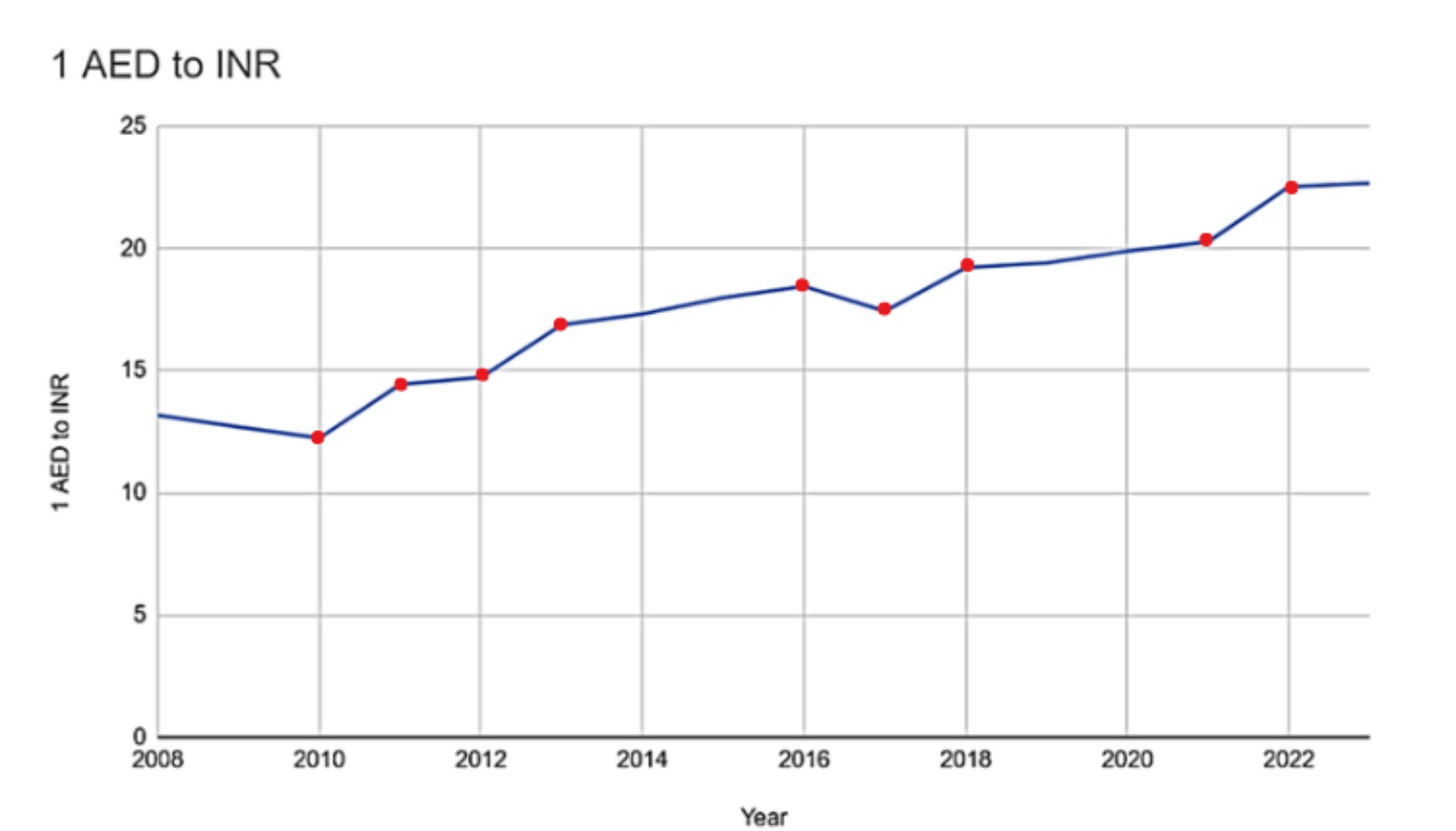
Another major reason behind the surge in Indian investment is Dubai’s currency stability. The UAE Dirham is pegged to the US Dollar, at the exchange rate of 1 USD = 3.6725 AED, providing a level of predictability and protection against volatility that many emerging market currencies do not offer. For Indian real estate investors, this acts as a hedge against rupee depreciation, helping preserve the real value of their overseas assets. As the
UAE Dirham appreciates against the Indian Rupee; the value of your Dubai property in the Indian Rupee currency increases, improving your overall investment returns.
Duis mollis et sem sed sollicitudin. Donec non odio neque. Aliquam hendrerit sollicitudin purus, quis rutrum mi accumsan nec.
In addition to currency stability, Dubai real estate is known for its attractive rental yields, which typically range between 8% and 12% annually, depending on the location and property type. In comparison, rental yields in Indian cities often hover between 2% and 4%.
Several factors support these strong returns:
• High demand from expatriates and professionals
• A growing tourism and short-term rental market
• Continuous infrastructure development
• A transparent and regulated rental ecosystem. Popular areas, such as Dubai Marina, Downtown Dubai, Business Bay, Jumeirah Village Circle, along with the fast-emerging Dubai South, have consistently delivered competitive yields, making them especially appealing
to Indian investors seeking regular rental income.
3. Ease of Ownership for Indians and NRIs
Dubai’s real estate framework is designed to encourage foreign investment, and this is another key reason why there is an increasing interest in investing in Dubai property from India. Property ownership in Dubai is straightforward and secure, thanks to the well-organised and highly regulated structure of
its real estate market. Investors benefit from a transparent system overseen by government authorities, where every transaction is registered with the Dubai Land Department (DLD), developers are regulated by RERA, and buyer funds for off-plan projects are protected through escrow accounts.
This structured, technology-driven process offers investors clarity, legal protection, and peace of mind—something that many buyers find far more streamlined compared to the procedural delays, documentation complexities, and project uncertainties often experienced in parts of the
Indian real estate market.
The buying process itself is relatively straightforward:
• No requirement for local sponsorship
• Transparent land registry and digital title deeds
• Clear legal protections for foreign buyers
In recent years, the UAE government has further strengthened investor confidence by introducing long-term residency visas, such as Golden Visa linked to real estate investment. Indians buying property in Dubai, above certain value thresholds, may qualify for renewable long-term visas. This makes Dubai not just an investment destination but also a lifestyle and business hub.
Additionally, Dubai banks and lenders now offer financing solutions for overseas property buyers up to 50% of the value of the property on easy interest rates, making it easier for buyers to enter the Dubai property market without deploying full capital upfront
4. Strong Infrastructure and Long-Term Growth Outlook
Dubai’s reputation as a global city continues to grow, supported by world- class infrastructure, business-friendly policies, and a diversified economy. It is considered as one of the safest cities, with CCTV cameras at almost every
corner.
Dubai’s real estate market is increasingly seen as a mature and regulated investment destination, rather than a speculative one. For Indian investors,the long-term growth outlook adds a layer of security. Government-backed regulatory authorities and transparent transaction processes further reduce risk. For Indian buyers, there is absolutely no need to physically visit government offices as everything is regulated and the required services are available online.
5. Geographic Proximity and Cultural Familiarity
Dubai’s geographic closeness to India, combined with excellent air connectivity, makes it an easy market for Indian investors to monitor. Cultural familiarity, a large Indian diaspora, and strong bilateral ties between India and the UAE further enhance comfort and trust. Indians are the largest expatriate community in the UAE, as they comprise about 35% to 40% of the total population. Many Indian investors also view Dubai as a gateway to global markets, allowing them to diversify their portfolios beyond domestic assets while staying connected to a familiar ecosystem.
Conclusion
The growing interest of Indians in Dubai real estate is driven by a compelling combination of tax-free returns, currency stability, high rental yields, and ease of ownership. Beyond financial advantages, Dubai offers exceptional safety standards and a secure living environment, consistently ranking among the safest cities globally. For many Indian investors and families,
Dubai also feels like a “mini India” — with a strong Indian community, Indian schools, restaurants, cultural familiarity, and seamless connectivity to major Indian cities.
As global investors increasingly prioritise diversification and long-term value preservation, Dubai stands out as a destination that balances growth, lifestyle comfort, and regulatory clarity. For Indians looking to expand their horizons beyond domestic markets, Dubai real estate offers not just financial returns, but also global exposure, stability, and strategic advantages that are hard to ignore..
















Join The Discussion