

Introduction: Why Consider Investment in Palm Jumeirah?
Investment in Palm Jumeirah attracts property buyers from India and around the world who want exposure to Dubai’s premium waterfront real estate market. Famous for its palm-shaped design, beachfront residences, luxury apartments and exclusive villas, Palm Jumeirah has become one of Dubai’s most recognisable residential destinations.
However, investing in a prestigious location requires more than choosing a property with an impressive sea view. Buyers must evaluate the purchase price, rental demand, ownership expenses, resale potential and the long-term financial objectives of the investment.
For Indian investors exploring international property ownership, investment in Palm Jumeirah may offer an opportunity to diversify their real estate holdings beyond the domestic market. The right property can potentially generate rental income and benefit from changes in market value, although neither rental performance nor capital appreciation is guaranteed.
At Skyline Infrastructure Investments, our research-driven approach helps investors understand Dubai real estate opportunities, compare property options and assess the financial considerations before making a decision.
In this guide, we explain seven important factors to evaluate before investing in Palm Jumeirah.
1. Understand What Makes Palm Jumeirah a Premium Investment Location
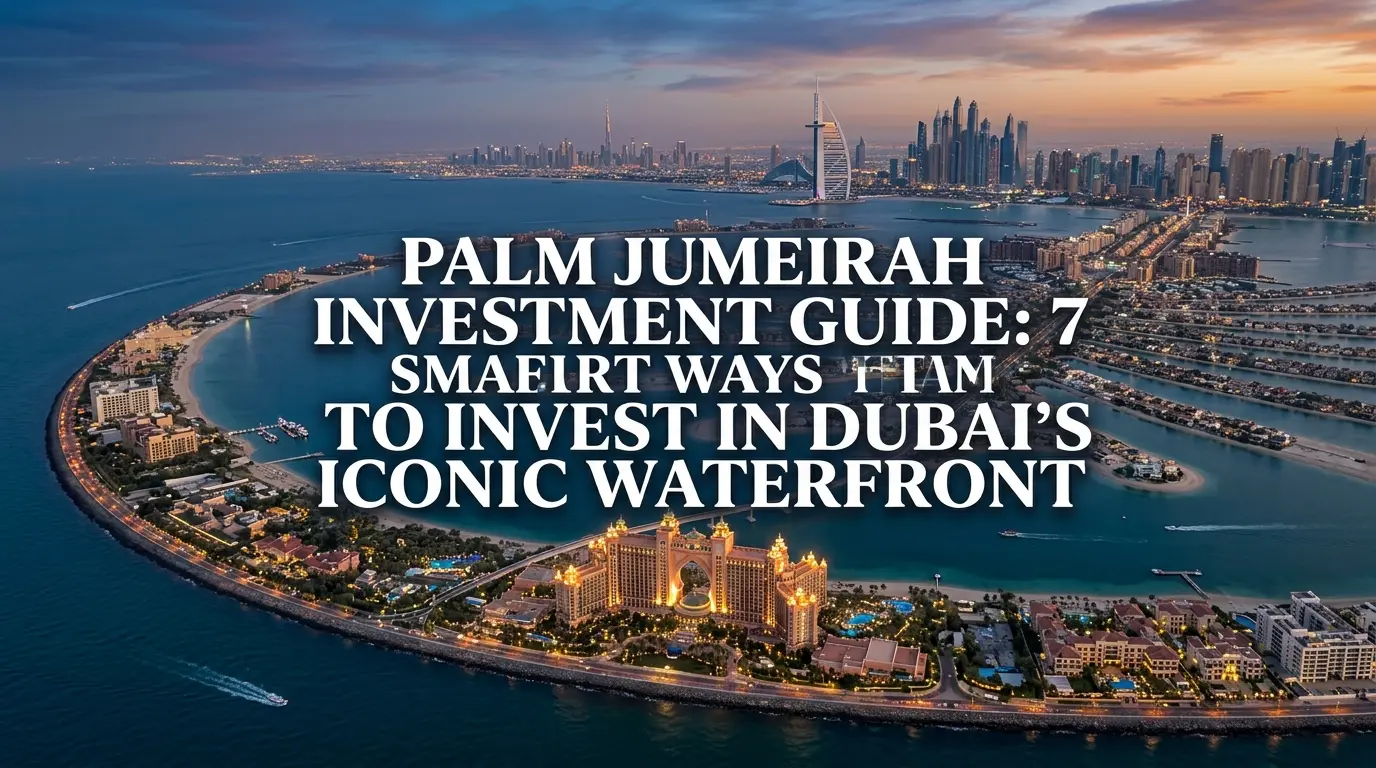
Palm Jumeirah is an artificial island developed as a distinctive waterfront community in Dubai. It features luxury apartments, beachfront villas, hotels, restaurants, leisure destinations and residential developments with views of the Arabian Gulf and Dubai skyline.
Its international recognition and limited waterfront setting contribute to its premium positioning within Dubai’s property market.
Key attractions for property investors
- Waterfront living: Selected properties offer private beach access, sea views or waterfront surroundings.
- Luxury lifestyle: Residents can access high-end hospitality, dining, shopping and leisure facilities.
- International recognition: Palm Jumeirah is a familiar destination for global property buyers and luxury travellers.
- Premium tenant segment: Certain apartments and villas appeal to executives, affluent families and tenants seeking luxury accommodation.
- Distinctive property types: Investors can compare apartments, penthouses, beachfront villas and other premium residences.
Investment in Palm Jumeirah is generally more suitable for buyers who understand the costs of luxury property ownership and are comfortable evaluating higher-value assets.
A prestigious address alone does not guarantee strong returns. Building quality, purchase price, layout, condition and achievable rent can be just as important as the location.
2. Evaluate Property Prices Before You Invest
Property prices in Palm Jumeirah vary considerably depending on the building, size, floor, view, furnishing, beach access and whether the property is ready or under construction.
A smaller apartment in an established building may have a different investment profile from a large penthouse or a signature beachfront villa. Therefore, buyers should compare similar properties rather than relying on a single average price for the entire island.
What should investors compare?
| Factor | Why it matters |
|---|---|
| Price per square foot | Helps compare similarly sized properties |
| Recent completed-property transactions | Provides evidence of actual market prices |
| Annual achievable rent | Helps estimate potential rental income |
| Service charges | Affects the net rental return |
| Property condition | Influences maintenance and refurbishment costs |
| Resale demand | Helps assess the potential exit strategy |
| Payment terms | Determines cash-flow requirements |
Before proceeding, review recent transaction records through the Dubai Land Department’s official real estate data portal.
Compare recent transactions in the same building or a closely comparable development whenever possible. Asking prices advertised online may differ from the final prices recorded in completed transactions.
For buyers considering investment in Palm Jumeirah, this research can help identify whether a particular property is reasonably priced relative to comparable options.
3. Calculate Rental Yield Instead of Focusing Only on Rent
Rental income is one of the key reasons investors consider Palm Jumeirah. Yet a property generating a high annual rent is not necessarily a high-return investment if its purchase price and operating expenses are also high.
Investors should calculate both gross rental yield and net rental yield before making a purchase decision.
How to calculate gross rental yield
The formula is:
Gross Rental Yield = (Annual Rental Income ÷ Total Property Purchase Price) × 100
For example, assume an apartment costs AED 3,000,000 and generates AED 180,000 in annual rent.
Gross rental yield = (AED 180,000 ÷ AED 3,000,000) × 100
Illustrative gross rental yield = 6% per year.
This is a hypothetical calculation, not a forecast or a claim about the current average yield across Palm Jumeirah.
How to calculate net rental yield
Net rental yield accounts for relevant property expenses, such as service charges, maintenance, management fees and vacancy-related losses.
Net Rental Yield = (Annual Rental Income − Annual Operating Expenses) ÷ Total Investment Cost × 100
Suppose the same property earns AED 180,000 annually and has AED 45,000 in annual operating expenses.
| Calculation | Amount |
|---|---|
| Property purchase price | AED 3,000,000 |
| Annual rental income | AED 180,000 |
| Illustrative annual operating expenses | AED 45,000 |
| Annual income after these expenses | AED 135,000 |
| Net yield on purchase price | 4.5% |
The example excludes acquisition costs, financing expenses and taxes or other charges that may apply to the investor. Including these items where relevant provides a more complete picture of the investment.
When assessing investment in Palm Jumeirah, use verified rents for comparable properties rather than assuming that every luxury apartment can command the same rental rate.
4. Choose Between Long-Term Rentals and Holiday Homes
Palm Jumeirah attracts both permanent residents and visitors seeking premium accommodation. Depending on the property and applicable regulations, investors may consider different rental strategies.
Long-term rentals
A long-term lease may suit investors who prioritise relatively predictable rental arrangements and fewer tenant turnovers.
Potential advantages include:
- A defined rental agreement.
- Less frequent tenant changeover.
- Lower day-to-day involvement than some holiday-home arrangements.
- The possibility of more consistent occupancy during the agreed lease period.
However, achievable rent depends on market conditions, property specifications and tenant demand.
Short-term and holiday rentals
Short-term rentals may appeal to visitors seeking beachfront accommodation, leisure facilities and convenient access to Dubai attractions.
Potential advantages include flexible pricing and the possibility of charging higher nightly rates during periods of strong demand.
However, owners must account for seasonal occupancy, furnishing, cleaning, utilities, guest management, platform charges and professional management fees. Appropriate permits and approvals are also essential.
| Consideration | Long-term rental | Short-term rental |
|---|---|---|
| Income pattern | Usually based on a lease | Can vary by season and occupancy |
| Management | Often less intensive | Usually more intensive |
| Furnishing | Depends on the tenancy | Commonly requires full furnishing |
| Operating expenses | Depends on the lease and property | Can be higher due to guest turnover |
| Main risk | Vacancy and tenant-related issues | Seasonal demand and operating costs |
There is no universally superior option. Investors should compare the expected net income of both strategies for the specific property.
5. Understand Ownership Costs and Transaction Expenses
One of the most important parts of investment in Palm Jumeirah is understanding the complete cost of ownership.
A property’s advertised price is only one part of the total amount required. Acquisition expenses and recurring charges can materially affect the return.
Costs to include in your investment budget
Property registration and transfer costs: Verify applicable Dubai Land Department fees and any other transaction-related charges before signing.
Real estate agency fees: If an agent is involved, confirm the agreed commission, applicable taxes and payment terms in writing.
Service charges: Apartment buildings and residential communities may charge owners for common-area maintenance, shared facilities and building services.
Maintenance and repairs: Budget for air-conditioning servicing, appliances, plumbing, interior upkeep and other property-specific requirements.
Property management: Professional management may be useful for overseas owners, particularly those who cannot manage tenants or guest operations directly.
Vacancy and leasing expenses: Allow for periods without rental income, tenant changeover and relevant leasing costs.
Financing costs: If the property is purchased using a mortgage, account for interest, lender fees and other financing expenses.
For example, an apartment with attractive gross rental income may produce a substantially lower net return after service charges, management and maintenance.
Before investing, request a property-specific breakdown of one-time and recurring costs. Confirm which charges apply to the owner and which may be payable by the tenant under the relevant agreement.
6. Assess Capital Appreciation and Resale Potential
Capital appreciation refers to an increase in a property’s market value over time. Some investors consider investment in Palm Jumeirah because of its established international profile and premium waterfront positioning.
However, property prices can rise or fall. Past performance does not guarantee future growth, and a luxury property may not always be easy to sell quickly at the desired price.
Factors that may influence future resale value
- Property scarcity: Unique beachfront positions or distinctive layouts may appeal to a specific buyer segment.
- Building reputation: Maintenance standards and the quality of shared facilities can influence buyer interest.
- Property condition: Well-maintained interiors and functional layouts may support marketability.
- Market liquidity: The number of active buyers at a given price affects how quickly a property may sell.
- Purchase price: Overpaying at acquisition can reduce the potential return even if market prices subsequently increase.
- Broader economic conditions: Interest rates, international investment flows, employment trends and supply can affect property demand.
Investors should evaluate several possible outcomes: prices increasing, remaining broadly unchanged or declining.
A sensible investment decision should not depend entirely on the assumption that the property will appreciate. Rental performance, ownership costs and a realistic exit strategy should also support the decision.
7. Understand Legal Requirements for Indian Investors
Indian residents considering investment in Palm Jumeirah should assess both Dubai property ownership requirements and Indian foreign-exchange rules before transferring funds.
Dubai property checks
Before committing to a purchase, investors should verify:
- The seller’s legal ownership and authority to sell.
- The property’s registration and title documentation.
- Any outstanding mortgage, service-charge liability or other encumbrance.
- The agreed purchase price and payment schedule.
- The developer’s registration and project status for off-plan properties.
- The contractual completion date and remedies for delays, where applicable.
For off-plan purchases, verify the project and escrow arrangements through the relevant Dubai authorities. Do not rely solely on marketing material or verbal assurances.
Important considerations for Indian residents
Indian residents must review the applicable Reserve Bank of India regulations, the Liberalised Remittance Scheme (LRS), tax reporting requirements and any restrictions relevant to their individual circumstances.
The permissible remittance route and treatment may depend on the investor’s residential status, funding structure, transaction type and current regulations. Do not assume that an overseas property purchase is automatically permitted through every remittance route.
Consult an authorised dealer bank and a qualified Indian tax professional before transferring funds. Also seek appropriate Dubai legal and tax guidance regarding ownership, rental operations, inheritance planning and eventual sale.
For official information, consult the Reserve Bank of India and the Dubai Land Department.
Is Investment in Palm Jumeirah Right for You?
Palm Jumeirah may suit investors looking for premium waterfront property, international real estate exposure or a residence that can also be rented out.
It may be less suitable for buyers whose main objective is to maximise rental yield at the lowest possible acquisition cost. Premium purchase prices and property-specific service charges can reduce income returns compared with less expensive markets.
Before proceeding, ask yourself:
- Can I comfortably afford the full acquisition and ownership costs?
- Is my main objective rental income, long-term value growth or personal use?
- Have I verified actual rental transactions for comparable properties?
- Does the expected net return justify the investment amount?
- Can I hold the property if market prices decline or selling takes longer than expected?
- Have I checked the legal and financial implications in both India and Dubai?
Answering these questions can help you decide whether a particular property fits your financial objectives and risk tolerance.
How Skyline Infrastructure Investments Can Help
Skyline Infrastructure Investments is a Noida-based Dubai real estate consultancy helping Indian investors research and evaluate property opportunities in Dubai.
Our advisory-led approach focuses on helping buyers understand location fundamentals, property comparisons, rental-income assumptions, ownership costs and due-diligence considerations.
For clients exploring investment in Palm Jumeirah, we encourage a research-first process that examines the property itself, the financial calculations and the investor’s long-term objectives rather than relying on luxury branding alone.
Whether you are comparing a waterfront apartment with a villa or evaluating Dubai property as part of a wider international portfolio, informed decision-making begins with reliable information and realistic assumptions.
Contact Skyline Infrastructure Investments to discuss your Dubai property investment requirements.
Website: https://skylineinfrainv.com/
Email: skylineinfrainv@gmail.com
Phone: +91 9871 013445
India Office: D-901-D, Urbtech Trade Center, Sector-132, Noida–201304, Uttar Pradesh, India.
Dubai Office: 1404, Le Solarium Tower, Dubai Silicon Oasis, Dubai, UAE.
Frequently Asked Questions (FAQs)
1. Is Palm Jumeirah a good place to invest in Dubai property?
Palm Jumeirah may suit buyers seeking premium waterfront property, potential rental income and long-term international real estate exposure. Whether it is a good investment depends on the individual property’s price, rental demand, service charges, condition and resale prospects.
2. What is the minimum investment required for Palm Jumeirah?
There is no single minimum price for all Palm Jumeirah properties. Prices vary by property type, size, building, view, condition and payment terms. Buyers should check current listings and recent registered transactions before setting a budget.
3. Can Indian citizens buy property in Palm Jumeirah?
Foreign nationals can generally purchase eligible freehold properties in designated Dubai areas, subject to applicable requirements. Indian residents should separately verify the permitted funding route, remittance regulations and tax obligations before making a purchase.
4. Can investors earn rental income from Palm Jumeirah apartments?
Yes. Owners can rent eligible properties subject to applicable tenancy rules, approvals and contractual conditions. Actual income depends on the property’s location, condition, rent achieved, occupancy and operating costs.
5. Is a Palm Jumeirah apartment or villa better for investment?
An apartment may offer a different balance of purchase cost, tenant demand and operating expenses compared with a villa. Villas may appeal to a narrower premium tenant or buyer segment. Compare the net yield, total capital required and exit options before choosing.
6. What costs should I check before buying property in Palm Jumeirah?
Review the purchase price, registration and transfer fees, agency commission where applicable, service charges, maintenance, management fees, vacancy allowance and financing expenses. The exact costs depend on the transaction and property.
7. Does investment in Palm Jumeirah guarantee capital appreciation?
No. Real estate values can increase or decrease, and resale timelines are uncertain. Investors should assess market evidence, affordability, rental fundamentals and downside scenarios rather than relying on guaranteed growth claims.
Conclusion
Investment in Palm Jumeirah can be an option for buyers interested in Dubai’s premium waterfront real estate market, but a prestigious location does not automatically translate into a strong financial return.
The most important steps are to compare recent transactions, calculate realistic net rental yields, understand the full cost of ownership, verify legal documentation and plan an achievable exit strategy.
For Indian investors, the decision should also include careful review of cross-border funding and tax requirements.
Skyline Infrastructure Investments encourages buyers to approach Dubai real estate with research, due diligence and a clear financial plan. The goal is not simply to purchase a luxury property, but to understand whether the opportunity fits your investment objectives and risk tolerance.















Join The Discussion