

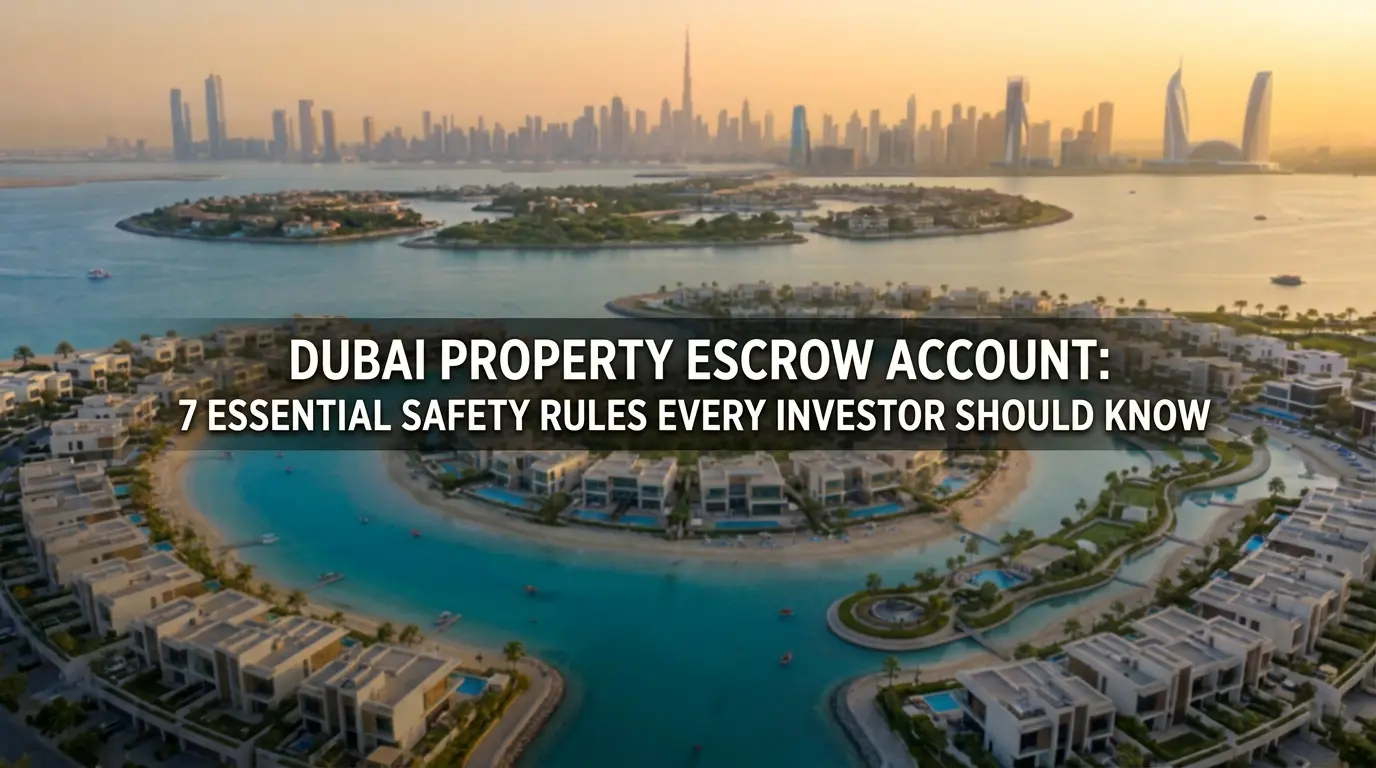
Investing in Dubai real estate has become an attractive option for Indian and international investors. With a wide range of off-plan developments, flexible payment plans and a regulated property market, Dubai offers multiple opportunities for people looking to build an international real estate portfolio.
However, one important question every investor should ask before purchasing an off-plan property is:
Where does your money go after you pay the developer?
This is where the Dubai property escrow account system becomes essential.
Dubai has introduced a dedicated regulatory framework to ensure that funds collected from off-plan property buyers are deposited into project-specific escrow accounts and managed under regulatory supervision.
Under Dubai Law No. 8 of 2007, escrow accounts play a significant role in protecting investors, regulating project finances and ensuring that funds are used for their designated development purposes.
For Indian investors considering Dubai property investment, understanding these regulations is an important part of making an informed purchase decision.
In this guide, Skyline Infrastructure Investments explains Dubai property escrow account rules, RERA regulations, fund management procedures and practical checks investors should complete before making a payment.
What Is a Dubai Property Escrow Account?
A Dubai property escrow account is a dedicated bank account established for a particular real estate development project.
When buyers purchase off-plan properties, their payments are deposited into the project’s designated escrow account rather than being treated as unrestricted funds in the developer’s general business account.
The account is managed by an approved financial institution or bank acting as an escrow trustee, under the regulatory framework overseen by the Dubai Land Department (DLD) and Real Estate Regulatory Agency (RERA).
The primary objective is to ensure that money collected from property buyers is used for the development of the relevant project in accordance with applicable regulations.
For example:
Suppose an investor purchases an apartment worth AED 1,000,000 in a Dubai off-plan development.
If the contractual payment schedule requires an initial payment of AED 200,000, the applicable buyer payment must be deposited into the project’s designated escrow account.
The funds are then managed according to the applicable escrow rules and project requirements.
This creates a financial monitoring mechanism between the buyer, developer, escrow trustee and regulatory authorities.
Understanding Dubai Escrow Account Law No. 8 of 2007
Dubai’s escrow account framework is primarily governed by Law No. 8 of 2007 Concerning Escrow Accounts for Real Estate Development in the Emirate of Dubai.
The legislation establishes requirements for developers selling off-plan properties and receiving payments from buyers or project financiers.
Some important provisions include:
| Legal provision | Investor protection |
|---|---|
| Article 3 | Applies to developers selling off-plan units and receiving buyer or financier payments |
| Article 4 | Requires developers to be registered and appropriately licensed |
| Article 6 | Establishes documentation requirements for opening an escrow account |
| Article 7 | Requires a written agreement with the escrow agent |
| Article 9 | Requires project-specific accounts dedicated to project development |
| Article 11 | Provides for regular financial reporting and regulatory oversight |
| Article 12 | Allows depositors or their representatives access to their accounting records |
| Article 14 | Requires a 5% retention after project completion certification |
| Article 15 | Provides measures to protect depositors if a development is not completed |
These provisions create a structured framework for managing funds collected through off-plan property sales.
Investors can read the original legislation through the official Dubai government legal portal:
https://dlp.dubai.gov.ae/Legislation%20Reference/2007/Law%20No.%20(8)%20of%202007.html
7 Essential Ways Dubai Escrow Rules Protect Property Investors
1. Project-Specific Escrow Accounts
One of the most important safeguards is that each real estate development must maintain its own dedicated escrow account.
According to Article 9 of Law No. 8 of 2007, the account must be opened in the name of the relevant project and dedicated exclusively to its development.
If a developer undertakes multiple projects, each project must have a separate escrow account.
Why does this matter?
It helps prevent the funds collected from buyers of one development from being freely diverted to finance an unrelated project.
For investors, this creates greater transparency regarding the financial structure of the property they are purchasing.
2. Approved Banks and Escrow Trustees
Dubai’s regulatory framework requires escrow accounts to be managed by qualified and approved financial institutions.
The Dubai Land Department’s guidance explains that an escrow trustee must be a bank or financial institution licensed to receive third-party deposits and approved by RERA.
The escrow trustee is responsible for administering the account according to the applicable agreement and regulations.
This provides an additional layer of financial oversight beyond the developer’s internal accounting system.
Investors should verify the project’s escrow arrangements and the relevant trustee rather than relying solely on verbal assurances from sales representatives.
3. Buyer Payments Must Be Deposited Into the Project Escrow Account
Under Dubai’s escrow framework, payments collected from purchasers of off-plan units must be deposited into the relevant project escrow account.
The same principle applies to qualifying project financing.
This is important because it establishes a clear financial route for funds collected from investors.
Before making a payment, buyers should verify:
- The official project name.
- The project’s registration details.
- The designated escrow account information.
- The account trustee’s details.
- The payment instructions stated in the official sale documentation.
Important: Never transfer money to an unrelated personal account or an unverified third-party account based only on a WhatsApp message or informal payment instruction.
4. Escrow Funds Are Restricted to Approved Project Purposes
Article 9 establishes that the escrow account is dedicated exclusively to the construction of the relevant development.
The account is also protected against attachment for the benefit of the developer’s creditors.
This distinction is important.
A developer’s general business expenses and the financial requirements of a specific real estate project are not the same thing.
The escrow framework is designed to ensure that project funds are administered according to the applicable legal and regulatory requirements.
This helps create financial discipline and reduces the risk of unrestricted use of buyer payments.
5. Financial Reporting and Regulatory Supervision
Escrow trustees are required to provide regular statements of account revenue and expenditure to the Dubai Land Department.
Under Article 11, the Department can request additional financial information and arrange audits when necessary.
This allows the regulatory authority to monitor the financial activity of project escrow accounts.
For investors, this is an important protection because the escrow mechanism is not simply a bank account opened in the developer’s name.
It operates within a regulatory framework that includes financial reporting and oversight.
6. Five Percent Retention After Project Completion
Another important provision is Article 14 of Law No. 8 of 2007.
It requires the escrow agent to retain 5% of the total value of the escrow account once the developer obtains the completion certificate.
The retained amount is released to the developer one year after the registration of units in the purchasers’ names.
This provision provides an additional post-completion safeguard within the statutory framework.
It is important to understand that this is a specific statutory retention requirement, not a promise that every buyer will automatically receive a 5% refund.
7. Protection Measures in Case a Project Is Not Completed
What happens if a real estate project cannot be completed?
Article 15 addresses emergency situations where a development project is not completed.
The escrow agent, after consulting the Dubai Land Department, must take the required measures to preserve depositors’ rights.
These measures may include:
- Taking steps to ensure completion of the development.
- Implementing appropriate measures to protect deposited funds.
- Arranging refunds to depositors where applicable.
The exact outcome depends on the project’s circumstances, regulatory decisions and available funds.
The important point is that Dubai’s escrow legislation provides a legal mechanism to address project non-completion.
How Does the Dubai Property Escrow System Work?
Understanding the payment process helps investors know where their money goes.
The typical process involves the following stages:
Step 1: Project Registration
The developer completes the applicable registration and approval procedures with the relevant Dubai authorities.
Step 2: Escrow Account Opening
A dedicated escrow account is opened in the project’s name through an approved escrow trustee.
Step 3: Off-Plan Property Purchase
The investor selects a unit and signs the relevant sale and purchase agreement (SPA).
Step 4: Buyer Payment
The investor makes payments according to the agreed contractual payment schedule and verified project payment instructions.
Step 5: Fund Administration
The escrow trustee administers project funds under the applicable legal requirements and account agreement.
Step 6: Construction and Monitoring
Project development and related financial activities are subject to applicable reporting, technical and regulatory oversight.
Step 7: Completion and Handover
Once the development reaches completion and the relevant requirements are fulfilled, the handover and registration procedures are undertaken.
Dubai Escrow Account vs Developer’s General Bank Account
Investors should understand the difference between a project escrow account and an ordinary corporate bank account.
| Comparison | Project escrow account | General developer account |
|---|---|---|
| Account purpose | Dedicated to the specific project | General business operations |
| Account structure | Project-specific | Corporate account |
| Fund management | Approved escrow trustee | Developer’s banking arrangements |
| Regulatory framework | Dubai escrow regulations | General banking and corporate regulations |
| Use of funds | Subject to applicable project restrictions | General permitted business purposes |
| Financial oversight | Escrow reporting and regulatory supervision | General financial and banking oversight |
The key distinction is that money deposited into a regulated project escrow account is subject to specific legal restrictions.
How Can Indian Investors Verify a Dubai Project’s Escrow Account?
Indian investors should conduct independent checks before transferring money for an off-plan property.
Here are seven practical due diligence steps.
1. Verify the Developer
Check the developer’s registration and licensing status through the Dubai Land Department.
Do not rely exclusively on advertisements, social media campaigns or sales brochures.
2. Verify the Project Registration
Confirm that the project is officially registered and authorised for the relevant off-plan sales activity.
3. Confirm the Escrow Account Details
Ask for the project’s official escrow account payment instructions and verify the account information with the authorised parties.
4. Check the Escrow Trustee
Confirm that the bank or financial institution managing the escrow account is approved under the applicable regulatory framework.
5. Check the Project’s Construction Status
Use the Dubai Land Department’s official project status service to review available project information and completion progress.
Official resource:
https://dubailand.gov.ae/en/eservices/real-estate-project-status-landing/real-estate-project-status
6. Review the Sale and Purchase Agreement
Read the SPA carefully, especially:
- Payment milestones.
- Construction-linked payment conditions.
- Expected completion and handover dates.
- Delay and termination clauses.
- Cancellation and refund provisions.
- Dispute resolution arrangements.
7. Maintain Payment Records
Keep copies of bank transfers, receipts, payment confirmations, the SPA and all official correspondence.
For Indian investors, maintaining proper records is also important for banking, foreign exchange compliance and future repatriation documentation.
Can a Developer Withdraw Money From a Dubai Escrow Account?
Yes, but escrow funds are not unrestricted corporate money.
Withdrawals and payments must comply with the applicable legal requirements, the escrow account agreement and relevant regulatory procedures.
The Dubai Land Department also provides a formal service for developers to request the withdrawal of project profits.
For projects under construction, the DLD’s published conditions include:
- The project must have active status.
- The developer must comply with applicable financial risk and solvency standards.
- A recent technical report is required.
- The available main escrow balance must cover the remaining construction costs.
- A developer undertaking and an approved project timeline are required.
- Applicable completion escrow retention conditions must be satisfied.
The withdrawal request is reviewed through the escrow trustee and the relevant DLD department.
This means the developer cannot simply treat all buyer deposits as freely withdrawable profits.
Official reference:
https://dubailand.gov.ae/en/eservices/request-for-withdrawal-of-a-projects-profits
What Happens If a Dubai Off-Plan Project Is Cancelled?
This is one of the most important questions for property investors.
Dubai’s escrow regulations include mechanisms for handling projects that are not completed.
Article 15 of Law No. 8 of 2007 provides for measures to protect depositors, including completion of the development or refunds where applicable.
The Dubai Land Department also explains its procedures for cancelled projects.
According to its published FAQs, where a project is formally cancelled, the account is transferred to the project liquidation process. The developer may be required to return investor payments within 60 days of the cancellation decision, subject to the applicable procedures and any approved extension.
If the developer does not comply, the matter may be referred to the court.
However, investors should not assume that every delayed project is automatically cancelled or that every refund is immediate or guaranteed.
The project’s formal regulatory status, available funds and legal circumstances matter.
Official information:
https://dubailand.gov.ae/en/frequently-asked-questions
Is Dubai Off-Plan Property Investment Completely Risk-Free Because of Escrow?
No.
This is an important distinction that every investor should understand.
Dubai’s escrow account system provides significant financial safeguards, but it does not eliminate every investment risk.
Escrow protection does not guarantee:
- Guaranteed rental income.
- Guaranteed capital appreciation.
- Guaranteed investment returns.
- Completion on the originally expected date.
- Immediate refunds in every dispute.
- Protection against every market fluctuation.
Investors should also consider the developer’s track record, project location, supply and demand, construction progress, payment structure, property pricing and exit strategy.
A legally compliant escrow account is an important starting point, not a substitute for comprehensive property due diligence.
Dubai Property Escrow Account Checklist for Investors
Before making your next off-plan property payment, use this checklist:
| Due diligence point | What to verify |
|---|---|
| Developer | Registration and licensing |
| Project | Official project approval and registration |
| Escrow account | Dedicated project account |
| Trustee | Approved financial institution |
| Payment details | Verified official bank instructions |
| SPA | Payment schedule and legal clauses |
| Construction | Latest available project progress |
| Receipts | Proper payment documentation |
| Cancellation | Applicable refund and dispute provisions |
For investors based in India, it is also advisable to consult qualified professionals regarding applicable RBI, FEMA and Liberalised Remittance Scheme (LRS) requirements before remitting funds overseas.
Why Escrow Regulations Matter for Indian Investors Buying Dubai Property
Dubai attracts Indian investors because of its international business environment, established real estate infrastructure and diverse residential investment opportunities.
However, investing in an overseas property market requires more than selecting an attractive apartment or comparing payment plans.
Investors must understand how their money is handled, which regulatory authorities supervise the development and what contractual protections are available.
Dubai’s escrow account framework adds an important layer of financial discipline to off-plan property transactions.
For Indian buyers, a well-informed investment decision should combine:
- Developer due diligence.
- Project registration verification.
- Escrow account verification.
- Legal review of the SPA.
- Location and market analysis.
- Payment planning.
- FEMA and remittance compliance.
At Skyline Infrastructure Investments, we believe that informed property decisions begin with research, transparency and an understanding of the regulations governing the investment.
Final Thoughts: Protect Your Investment Before You Pay
Dubai’s property escrow account regulations represent an important part of the emirate’s framework for protecting off-plan property buyers.
Law No. 8 of 2007 establishes project-specific accounts, approved escrow trustees, financial reporting requirements, statutory retention provisions and measures for situations where developments cannot be completed.
For investors, these safeguards provide a more structured and transparent environment for purchasing off-plan real estate.
However, the most effective protection begins before the first payment.
Verify the developer, confirm the project’s registration, check the escrow account, examine the SPA and understand the risks associated with the investment.
At Skyline Infrastructure Investments, our approach is research-driven and investor-focused. We help Indian investors understand Dubai property opportunities through informed real estate research and advisory support.
Assets appreciate. Excuses depreciate. Make informed investment decisions.
Frequently Asked Questions (FAQs)
1. Is an escrow account mandatory for Dubai off-plan properties?
Dubai Law No. 8 of 2007 requires developers selling off-plan units and receiving buyer or financier payments to comply with the escrow account framework, subject to applicable legal provisions and regulatory exceptions.
2. Who regulates property escrow accounts in Dubai?
The Dubai Land Department (DLD) and its Real Estate Regulatory Agency (RERA) oversee the applicable regulatory framework. Approved banks and financial institutions act as escrow trustees.
3. Can a Dubai developer use buyer money for another project?
Project escrow funds are dedicated to the relevant development. Article 9 requires a separate escrow account for each project undertaken by a developer.
4. What happens to escrow money if a project is cancelled?
The relevant regulatory and liquidation procedures are initiated. Depending on the circumstances and available funds, measures may include project completion or refunds to eligible investors.
5. Is the Dubai escrow account managed by the developer?
No. The account is administered by an approved bank or financial institution acting as an escrow trustee under the applicable regulatory framework.
6. Does Dubai escrow law guarantee property investment returns?
No. Escrow regulations protect the handling of project funds but do not guarantee capital appreciation, rental income or investment returns.
7. How can I check a Dubai property’s project status?
Investors can use the official Dubai Land Department Real Estate Project Status service to review available project information and construction progress.
8. What is the 5% escrow retention rule in Dubai?
Article 14 requires the escrow agent to retain 5% of the total escrow account value after the developer obtains the completion certificate. This amount is released one year after units are registered in the purchasers’ names.
9. Can Indian investors buy Dubai off-plan property?
Indian investors can purchase eligible Dubai properties, subject to applicable ownership rules, transaction requirements and Indian foreign exchange regulations. They should obtain professional advice on FEMA and LRS compliance.
10. Should I verify the escrow account before purchasing an off-plan property?
Yes. Confirm the official project details, account information and approved escrow trustee before transferring funds. Always use verified payment instructions and maintain transaction records.
About Skyline Infrastructure Investments
Skyline Infrastructure Investments is a Noida-based Dubai real estate consultancy helping Indian investors research and explore Dubai property investment opportunities.
Our investor-focused advisory approach emphasises project research, developer evaluation, location analysis, payment structures and regulatory awareness.
Contact Us
Website: https://www.skylineinfrainv.com/
Email: skylineinfrainv@gmail.com
Phone: +91 9871 0134 45
India Office: D-901-D, Urbtech Trade Center, Sector-132, Noida-201304, Uttar Pradesh, India.
Dubai Office: 1404, Le Solarium Tower, Dubai Silicon Oasis, Dubai, UAE.
Explore Dubai property opportunities with informed research and professional advisory support.















Join The Discussion