

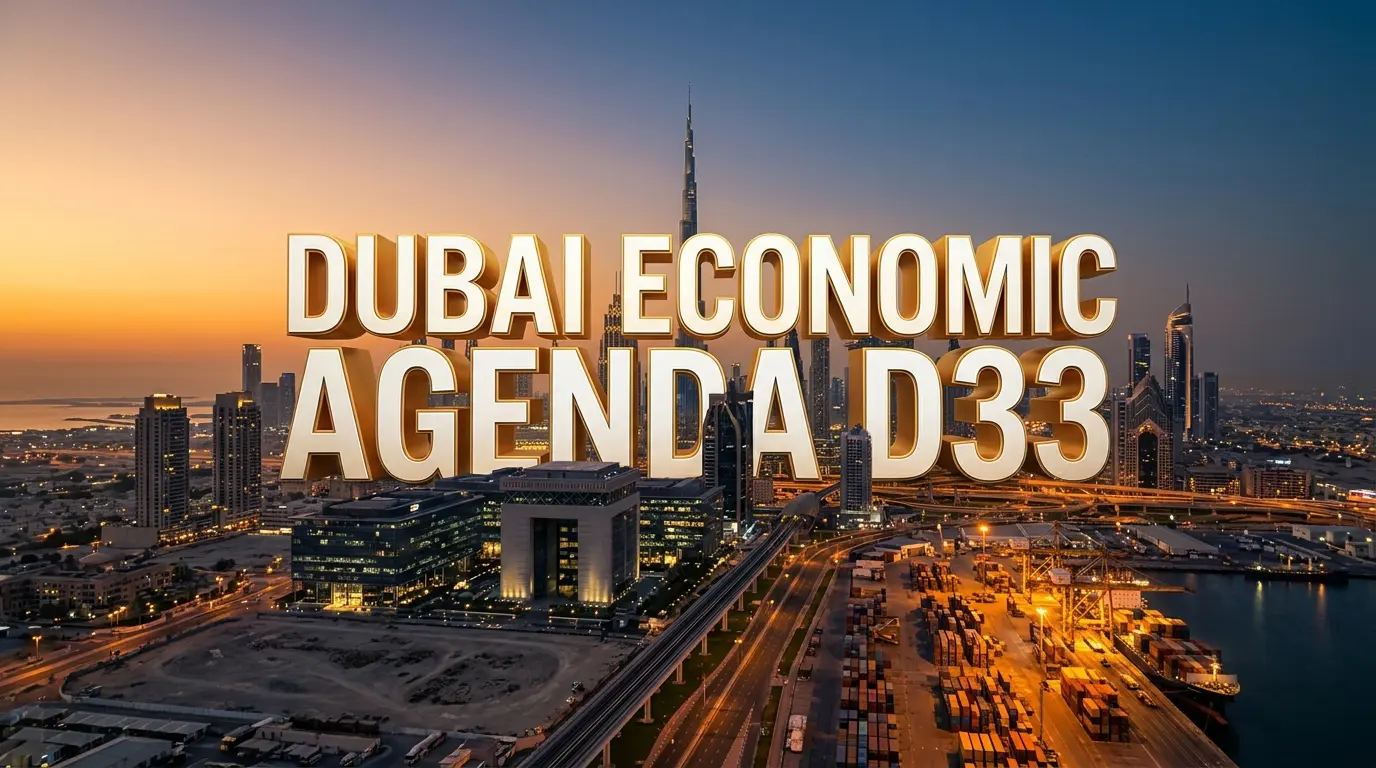
Dubai is preparing for a new era of economic growth through the Dubai Economic Agenda D33, an ambitious strategy designed to double the size of its economy by 2033. The initiative aims to strengthen Dubai’s position as a global destination for business, tourism, technology, international trade and foreign investment.
For Indian investors exploring international real estate opportunities, understanding Dubai Economic Agenda D33 is important. Its focus on infrastructure, business expansion, international connectivity and economic diversification could influence future residential and commercial property demand.
In this article, we explore the major objectives of D33, its connection with Dubai’s real estate market, emerging investment locations and important considerations for Indian property buyers.
1. What Is Dubai Economic Agenda D33?
Launched on 4 January 2023, the Dubai Economic Agenda D33 is a 10-year economic roadmap designed to double Dubai’s economy by 2033.
The strategy focuses on developing new economic sectors, attracting international investment, expanding global trade and strengthening Dubai’s position among the world’s leading business cities.
Some of its major targets include:
| Economic Objective | Target by 2033 |
|---|---|
| Foreign trade in goods and services | AED 25.6 trillion |
| Foreign direct investment | AED 650 billion |
| Government expenditure | AED 700 billion |
| Private-sector investment | AED 1 trillion |
| Domestic demand for goods and services | AED 3 trillion |
| Annual contribution from digital transformation | AED 100 billion |
These objectives highlight Dubai’s ambition to develop a diversified, internationally connected and investment-friendly economy.
2. How D33 Could Influence Dubai’s Real Estate Market
Economic expansion and real estate demand are closely connected. When businesses expand, employment opportunities increase and international professionals relocate, the requirement for residential and commercial spaces can also grow.
Dubai Economic Agenda D33 focuses on several sectors that could influence property demand.
Business Expansion: Attracting multinational corporations, entrepreneurs and international companies could increase demand for residential apartments, offices and commercial properties.
Foreign Investment: The strategy’s foreign investment targets reflect Dubai’s ambition to attract international capital and strengthen its business environment.
Tourism Development: Increasing tourism activity could support demand for hotels, holiday homes, serviced apartments and hospitality-related properties.
Infrastructure Development: Better transport connectivity and urban infrastructure can improve accessibility and make selected residential communities more attractive.
Technology and Innovation: Growth in technology, fintech and digital businesses could attract skilled professionals and support demand for modern residential developments.
However, economic expansion does not guarantee property appreciation or rental returns. Individual locations and projects require independent market research.
3. Five Major D33 Priorities That Investors Should Understand
A. International Trade and Global Connectivity
Dubai aims to increase foreign trade in goods and services to AED 25.6 trillion by 2033.
The strategy also aims to expand Dubai’s international trade network by connecting with 400 additional cities.
As Dubai strengthens its position as a global trading hub, demand for logistics facilities, warehouses, commercial offices and nearby residential accommodation could receive additional support.
Dubai South is one of the locations investors can monitor because of its relationship with aviation, logistics and emerging business infrastructure.
B. Strengthening Dubai as a Global Financial Centre
Dubai continues to attract financial institutions, investment firms, fintech businesses and international corporations.
The expansion of financial services can create employment opportunities and increase demand for premium residential properties.
Locations such as Business Bay and Downtown Dubai are relevant to investors researching properties connected to established commercial districts.
C. Digital Transformation and Technology
Digital transformation is another important pillar of D33.
Dubai aims to generate AED 100 billion annually through digital transformation initiatives.
The development of technology businesses, startups and innovation-focused companies could attract international talent and create demand for modern residential communities.
For property investors, proximity to business districts, transport networks and lifestyle infrastructure can be important selection factors.
D. Tourism and Hospitality Growth
Tourism remains an important part of Dubai’s economic development strategy.
The growth of international tourism can support demand for hospitality assets, holiday homes and serviced residences.
Some established destinations worth researching include Dubai Marina, Palm Jumeirah, Downtown Dubai and Dubai Creek Harbour.
Investors considering tourism-oriented properties should carefully evaluate occupancy, operating expenses, management fees and competition.
E. Private-Sector Investment and Entrepreneurship
D33 aims to increase private-sector investment to AED 1 trillion by 2033.
Encouraging entrepreneurship and business expansion can strengthen Dubai’s employment ecosystem and create additional demand for commercial and residential real estate.
For investors, this makes it important to understand the relationship between business activity, population growth, housing supply and rental demand.
4. Infrastructure Development: A Major Driver of Future Property Demand
Infrastructure development plays an important role in shaping real estate markets.
Dubai continues to invest in aviation, transport connectivity, logistics and urban development.
Al Maktoum International Airport
The planned expansion of Al Maktoum International Airport is expected to strengthen Dubai’s aviation and logistics ecosystem.
Dubai South is an important area to monitor because of its connection with the airport, logistics infrastructure and emerging residential developments.
Dubai Metro and Connectivity
Transport connectivity can improve accessibility to business districts, residential communities and commercial destinations.
Properties located near established transport infrastructure may appeal to residents and tenants seeking convenient daily travel.
New Residential Communities
Dubai’s expanding urban landscape includes several master-planned communities offering residential, retail, hospitality and recreational facilities.
Investors should evaluate the actual development progress, connectivity and expected completion timelines before making decisions.
5. Dubai Economic Agenda D33 and Dubai 2040 Urban Master Plan
The Dubai Economic Agenda D33 and Dubai 2040 Urban Master Plan are two important long-term initiatives shaping Dubai’s future.
While D33 focuses on economic growth, the Dubai 2040 Urban Master Plan focuses on the city’s physical development, urban planning and quality of life.
Its priorities include:
- Improving public transport connectivity.
- Developing sustainable residential communities.
- Expanding green and recreational spaces.
- Enhancing public facilities.
- Supporting balanced urban development.
- Improving the overall quality of life.
For property investors, understanding both initiatives can provide a broader perspective on Dubai’s future development.
D33 explains the economic direction, while the 2040 Urban Master Plan provides insight into the city’s physical transformation.
6. Best Dubai Locations to Research Under the D33 Vision
Not every location will benefit equally from economic expansion. Investors should compare existing infrastructure, upcoming supply, rental demand, connectivity and purchase prices.
Here are some locations worth researching:
| Location | Investment Consideration |
|---|---|
| Dubai South | Aviation, logistics and emerging residential ecosystem |
| Business Bay | Established commercial and residential district |
| Dubai Marina | Waterfront lifestyle and established rental market |
| Downtown Dubai | Premium residential and tourism destination |
| Dubai Creek Harbour | Master-planned waterfront community |
| Dubai Hills Estate | Family-oriented residential environment |
| Dubai Maritime City | Waterfront residential and commercial development |
Investors should evaluate each location based on their financial objectives rather than assuming that every emerging area will deliver similar returns.
7. Off-Plan vs Ready Properties: Which Investment Strategy Is Better?
Dubai’s economic development creates opportunities for different types of property investors. Choosing between off-plan and ready properties depends on investment objectives, financial capacity and risk tolerance.
Off-Plan Properties
Off-plan properties are purchased before construction is completed.
Potential advantages include:
- Flexible construction-linked payment plans.
- Access to newly launched developments.
- Different apartment configurations and layouts.
- Opportunities to purchase at launch-stage prices.
However, investors should examine developer credibility, construction progress, payment obligations, handover timelines and market competition.
Explore our guide: 1 BHK Flats in Dubai.
Ready Properties
Ready properties allow buyers to inspect completed units and evaluate the actual surrounding community.
Potential advantages include:
- Immediate possession after transaction completion.
- Existing rental income potential.
- Better visibility of building quality.
- More reliable assessment of actual neighbourhood conditions.
Investors should also consider service charges, maintenance expenses, vacancy risk and resale demand.
Explore our guides:
8. Important Considerations for Indian Investors
Dubai attracts Indian property investors because of its international business environment, connectivity and established real estate market.
However, overseas property investment requires proper financial and regulatory planning.
FEMA and LRS Regulations
Indian residents must evaluate overseas property remittances under applicable FEMA regulations and RBI’s Liberalised Remittance Scheme.
Investors should understand applicable remittance limits, permitted transactions, documentation and tax requirements before transferring funds.
Official website: https://www.rbi.org.in/
Dubai Land Department Registration
Property transactions must follow applicable Dubai Land Department registration procedures.
Buyers should understand ownership documentation, registration charges and title deed requirements.
Official website: https://dubailand.gov.ae/
Property Acquisition Costs
The total investment amount may include:
- Dubai Land Department registration fees.
- Agency fees, where applicable.
- Trustee and administrative charges.
- Service charges.
- Property management expenses.
- Mortgage-related costs, if applicable.
Currency Exchange Risk
Indian investors should consider fluctuations between the Indian rupee and UAE dirham because currency movements can affect the actual investment cost and repatriated proceeds.
Tax and Repatriation Planning
Indian tax residents should evaluate applicable Indian income-tax rules, foreign asset reporting requirements and repatriation regulations with qualified professionals.
9. How to Identify Property Opportunities Connected to D33
Investors should connect Dubai’s economic development plans with project-level research.
A practical investment evaluation framework includes:
| Research Parameter | What to Evaluate |
|---|---|
| Economic activity | Nearby business and employment growth |
| Infrastructure | Existing and approved connectivity |
| Population demand | Residential and workforce requirements |
| Rental market | Actual rental rates and occupancy |
| Property supply | Existing and upcoming inventory |
| Developer reputation | Track record and delivery performance |
| Financial structure | Payment schedule and total acquisition cost |
| Exit strategy | Resale demand and market liquidity |
The Dubai Economic Agenda D33 provides a long-term economic direction, but investment decisions should always be supported by independent property research.
10. Dubai Real Estate Market: Understanding the Investment Environment
Dubai’s property market has become an important part of the emirate’s broader economic ecosystem.
According to the Dubai Land Department’s 2024 annual report, real estate transactions reached AED 761 billion in 2024, including AED 522 billion in real estate investments.
These figures highlight the scale of real estate investment activity in Dubai.
For investors, historical transaction volumes can provide useful market context. However, they should not be treated as guarantees of future property appreciation or rental income.
A detailed evaluation should include current transaction prices, rental performance, upcoming property supply and the financial fundamentals of individual developments.
11. Why Research-Driven Advisory Matters for Indian Property Buyers
Investing in an international property market requires more than selecting an attractive apartment or payment plan.
Indian buyers should understand the developer, project location, ownership structure, payment obligations, registration process and ongoing expenses.
Skyline Infrastructure Investments is a Noida-based Dubai real estate consultancy helping Indian investors research and evaluate property investment opportunities in Dubai.
Our advisory approach focuses on:
- Understanding individual investment objectives.
- Researching suitable Dubai locations.
- Comparing developers and property projects.
- Evaluating off-plan and ready-property options.
- Explaining payment structures and associated costs.
- Supporting informed property investment decisions.
Our objective is to help investors make research-driven decisions with a clear understanding of opportunities and associated risks.
Conclusion: D33 and Dubai’s Long-Term Economic Vision
The Dubai Economic Agenda D33 represents an ambitious vision for the emirate’s future.
Its focus on international trade, foreign investment, digital transformation, tourism, infrastructure and entrepreneurship could strengthen Dubai’s position as a global business and investment destination.
For Indian investors, understanding D33 can provide useful context when researching Dubai’s residential and commercial real estate market.
However, successful property investment depends on selecting the right location, evaluating the developer, understanding the financial structure and conducting proper due diligence.
At Skyline Infrastructure Investments, we believe informed decisions begin with research, transparency and a clear understanding of the market.
Assets appreciate. Excuses depreciate.
Frequently Asked Questions (FAQs)
1. What is Dubai Economic Agenda D33?
Dubai Economic Agenda D33 is a 10-year economic strategy launched in January 2023 to double Dubai’s economy by 2033 and strengthen its position as a leading global business and investment destination.
2. What are the main targets of D33?
Major targets include AED 25.6 trillion in foreign trade, AED 650 billion in foreign direct investment, AED 1 trillion in private-sector investment and AED 100 billion in annual digital transformation contributions by 2033.
3. How could D33 affect Dubai’s property market?
D33 could support real estate demand through business expansion, employment growth, tourism, international investment and infrastructure development. Actual property performance will depend on location, supply and demand.
4. Which Dubai areas should property investors monitor?
Dubai South, Business Bay, Dubai Marina, Downtown Dubai, Dubai Creek Harbour, Dubai Hills Estate and Dubai Maritime City are among the locations investors can research.
5. Is Dubai a suitable destination for Indian property investors?
Dubai offers an established international real estate market and a wide range of residential and commercial properties. Indian investors should evaluate property fundamentals, FEMA regulations, tax implications and currency risks before investing.
6. What is the difference between D33 and Dubai 2040 Urban Master Plan?
D33 focuses on economic development and business growth, whereas the Dubai 2040 Urban Master Plan focuses on urban development, infrastructure, residential communities and quality of life.
7. Does D33 guarantee higher property prices in Dubai?
No. D33 is an economic development strategy, not a guarantee of property appreciation or rental returns. Investors should conduct project-specific due diligence.
8. Can Indians purchase property in Dubai?
Indian citizens can purchase eligible properties in designated freehold areas, subject to applicable Dubai property ownership regulations and Indian foreign exchange requirements.
Official External References
- Dubai Economic Agenda D33: https://www.d33.ae/
- Dubai Land Department: https://dubailand.gov.ae/
- Invest in Dubai: https://www.investindubai.gov.ae/
- UAE Government Portal: https://u.ae/
- Reserve Bank of India: https://www.rbi.org.in/
About Skyline Infrastructure Investments
Skyline Infrastructure Investments is a Noida-based Dubai real estate consultancy helping Indian investors research Dubai property opportunities through an advisory-led and research-driven approach.
Website: https://skylineinfrainv.com/
Email: skylineinfrainv@gmail.com
Phone: +91 9871 0134 45













Join The Discussion