

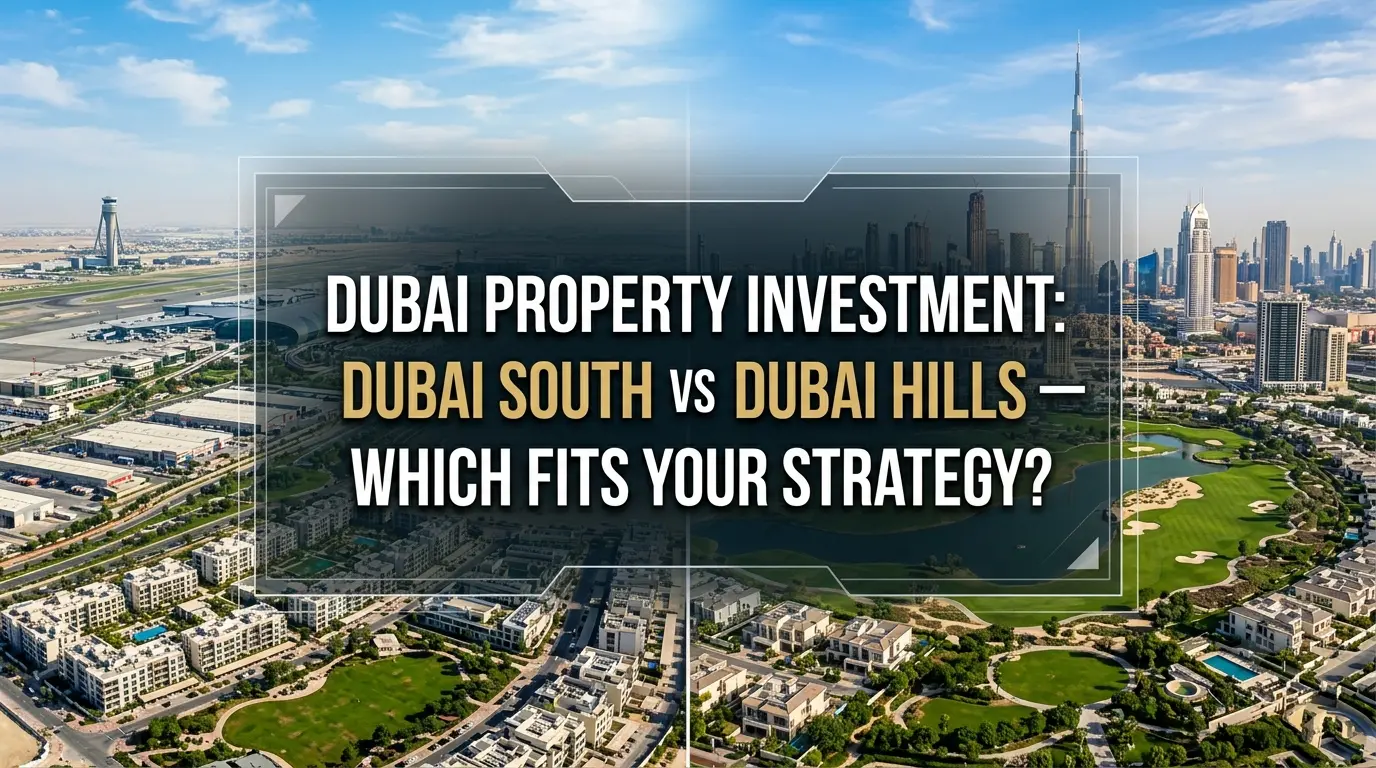
Dubai South vs Dubai Hills is a comparison that matters for investors looking beyond Dubai’s most established central locations. Both communities offer strong long-term investment narratives, but they are built around very different demand drivers.
Dubai South is closely connected with aviation, logistics, business, mobility and the long-term expansion of Al Maktoum International Airport. Dubai Hills Estate, on the other hand, is an established master-planned residential community positioned between Downtown Dubai and Dubai Marina, known for its green spaces, golf course, schools, healthcare facilities and family-oriented lifestyle.
For Indian investors considering property in Dubai, the decision between Dubai South vs Dubai Hills should not be based only on today’s property prices. Location, infrastructure, tenant demand, entry price, property type, holding period, liquidity and future development all need to be considered.
This guide compares Dubai South vs Dubai Hills across seven important investment factors so that investors can determine which community better matches their strategy.
Dubai South vs Dubai Hills: Quick Comparison
Before going deeper, here is a high-level comparison.
| Factor | Dubai South | Dubai Hills Estate |
|---|---|---|
| Community profile | Emerging mixed-use district | Established master-planned community |
| Major demand driver | Airport, logistics, aviation and business | Residential lifestyle, accessibility and amenities |
| Al Maktoum Airport proximity | Major strategic advantage | Further from airport |
| Downtown Dubai proximity | Farther | Relatively closer |
| Community maturity | Developing | More established |
| Property options | Apartments, townhouses, villas and other developments | Apartments, villas, townhouses and branded residences |
| Investor profile | Growth-oriented and long-term investors | Income, lifestyle and established-community investors |
| Infrastructure story | Strong future-development narrative | Mature existing infrastructure |
| Risk profile | Higher development/area-maturity risk | Relatively lower area-development risk |
| Investment approach | Growth + infrastructure-led | Income + established-demand + capital preservation |
The comparison shows why there is no universal winner in the Dubai South vs Dubai Hills debate.
The better choice depends on what the investor wants from the property.
1. Dubai South vs Dubai Hills: Location and Connectivity
Location remains one of the most important variables in Dubai real estate investment.
However, location should not simply mean “how close is the property to Downtown Dubai?”
For long-term investors, the more useful question is:
What economic activity will create demand around this location in the future?
Dubai South
Dubai South is positioned around Dubai’s southern growth corridor and is closely connected with the aviation, logistics and transportation ecosystem.
One of its biggest strategic advantages is its relationship with Al Maktoum International Airport, which is planned for significant expansion.
The airport expansion is expected to support the wider economic development of the surrounding area, alongside logistics, aviation, commercial and residential activity.
Dubai South also benefits from its connectivity to major road networks serving Dubai and the wider UAE.
This makes the community particularly interesting for investors who believe infrastructure-led growth will influence future property demand.
Dubai Hills Estate
Dubai Hills Estate has a very different location proposition.
It sits in a central part of Dubai between major destinations including Downtown Dubai and Dubai Marina, giving residents access to established employment, retail, education, healthcare and leisure hubs.
The community is designed around a golf course, parks, residential neighborhoods and supporting amenities.
This creates a more mature residential ecosystem than many emerging communities.
Which wins on location?
In the Dubai South vs Dubai Hills comparison, the answer depends on the investor.
Dubai Hills has an advantage for investors prioritizing established connectivity and access to central Dubai.
Dubai South has an advantage for investors looking at the long-term economic development of Dubai’s southern corridor.
2. Dubai South vs Dubai Hills: Infrastructure and Future Growth
Infrastructure is one of the strongest reasons investors consider Dubai South.
Dubai has historically used large-scale infrastructure investment to support the development of new economic and residential corridors.
The most significant infrastructure story around Dubai South is Al Maktoum International Airport.
Dubai has announced a major expansion of the airport, with the long-term plan targeting capacity of up to 260 million passengers annually.
The first phase is planned around 150 million passengers, with the wider project expected to include five parallel runways and hundreds of aircraft stands.
The airport’s development is therefore much more than an aviation project.
Large airport infrastructure can support:
- Employment
- Logistics
- Hospitality
- Retail
- Commercial offices
- Transportation
- Residential demand
- Business formation
- International connectivity
This creates a potentially powerful long-term demand ecosystem around Dubai South.
Dubai Hills infrastructure
Dubai Hills already has many of the characteristics investors look for in an established community.
The area includes:
- Dubai Hills Park
- Dubai Hills Mall
- Golf facilities
- Schools
- Healthcare access
- Residential neighborhoods
- Retail and dining
- Major road connectivity
The investment story is therefore different.
Dubai South is more closely associated with future infrastructure-led expansion, while Dubai Hills benefits from existing community infrastructure and established demand.
Investment implication
When comparing Dubai South vs Dubai Hills, investors should understand the difference between:
Buying into an emerging growth corridor
and
Buying into an established residential ecosystem.
Neither approach is automatically better.
The appropriate choice depends on risk tolerance and investment horizon.
3. Dubai South vs Dubai Hills: Property Types and Entry Strategy
Another important difference between Dubai South vs Dubai Hills is the property mix.
Dubai South has seen considerable residential development as the wider district continues to mature.
Depending on the project and developer, investors can find:
- Studios
- 1-bedroom apartments
- 2-bedroom apartments
- 3-bedroom apartments
- Townhouses
- Villas
The community can therefore appeal to investors who want exposure to a developing location at different price points.
Dubai Hills also offers a broad range of residential products.
These include:
- Apartments
- Townhouses
- Villas
- Luxury residences
- Branded residential developments
The community’s established reputation has also supported demand for higher-quality residential products.
Why entry price matters
Indian investors should avoid selecting a community simply because the headline price appears lower.
A cheaper property is not necessarily a better investment.
Instead, compare:
Purchase price + service charges + financing cost + expected rent + vacancy risk + resale liquidity + future supply.
For example, an apartment with a lower purchase price may have weaker rental demand than a more expensive apartment in a mature community.
Likewise, a property in an emerging area may have greater long-term upside potential but require a longer holding period.
This is why the Dubai South vs Dubai Hills decision should be made at the individual property level rather than only at the community level.
4. Dubai South vs Dubai Hills: Rental Income Potential
Rental income is one of the biggest reasons Indian investors consider Dubai real estate.
However, rental performance depends on the actual property rather than simply the community name.
Factors include:
- Unit size
- Floor
- View
- Building quality
- Developer reputation
- Furnishing
- Service charges
- Amenities
- Access to transport
- Tenant profile
- Nearby employment centers
- Competing supply
Dubai South rental strategy
Dubai South’s rental demand can benefit from employees and professionals connected with aviation, logistics, business and surrounding employment hubs.
As the wider district develops, the potential tenant pool may also evolve.
Investors considering Dubai South should therefore examine:
Who will rent this particular property?
For example, a compact apartment may target professionals, while a townhouse could appeal more to families.
Dubai Hills rental strategy
Dubai Hills benefits from a more established residential tenant profile.
The community attracts families and professionals looking for:
- Green spaces
- Quality housing
- Schools
- Healthcare access
- Retail
- Recreation
- Connectivity to major Dubai destinations
This can make certain properties particularly attractive to longer-term residential tenants.
Which is better for rental income?
There is no universal answer.
In the Dubai South vs Dubai Hills comparison:
Dubai South may appeal to investors seeking rental exposure to an emerging employment and infrastructure corridor.
Dubai Hills may appeal to investors who prioritize established residential demand and community amenities.
The correct approach is to calculate the property’s net rental yield, not just the advertised gross yield.
5. Dubai South vs Dubai Hills: Capital Growth Potential
Capital appreciation is another major consideration.
But investors should be careful with claims about future returns.
No community can guarantee a specific appreciation rate.
Instead, investors should identify the factors that can influence future value.
Dubai South growth factors
Potential growth drivers include:
- Al Maktoum International Airport expansion
- Aviation-related activity
- Logistics growth
- Business expansion
- Infrastructure development
- Population growth
- New residential communities
- Improved connectivity
The thesis is essentially:
Infrastructure → economic activity → employment → population → housing demand.
If this chain develops successfully over the long term, residential demand in the surrounding corridor could benefit.
Dubai Hills growth factors
Dubai Hills has a different growth thesis.
Its strengths include:
- Established community positioning
- Premium residential environment
- Strong amenities
- Golf-course lifestyle
- Retail infrastructure
- Family demand
- Proximity to major Dubai destinations
Because the community is more mature, investors may be buying into an already established location rather than waiting for an entire ecosystem to form.
Growth vs maturity
This is one of the most important differences in Dubai South vs Dubai Hills.
Dubai South can be viewed through an emerging-growth lens.
Dubai Hills can be viewed through an established-premium-community lens.
Investors should decide which type of opportunity better matches their risk profile.
6. Dubai South vs Dubai Hills: Risk, Liquidity and Holding Period
Investment risk is often overlooked when comparing Dubai communities.
Two properties can have similar prices and rental yields but very different risk profiles.
Dubai South
The main consideration is development-stage risk.
Investors should assess:
- Project completion
- Developer track record
- Construction progress
- Future competing supply
- Infrastructure timelines
- Actual tenant demand
- Service charges
- Resale activity
An emerging community may require patience.
If your investment horizon is five to ten years, the development story may be more relevant.
If you need a quick exit, an established location may be more suitable.
Dubai Hills
Dubai Hills benefits from an established community ecosystem.
Investors can assess existing:
- Rental transactions
- Comparable sales
- Tenant demand
- Amenities
- Resale listings
- Community infrastructure
This provides more historical information for decision-making.
However, established premium communities can also come with higher acquisition prices.
Holding period matters
A simple framework is:
Shorter holding period → prioritize liquidity and established demand.
Longer holding period → infrastructure and future growth may become more important.
This does not mean Dubai South is only for long-term investors or Dubai Hills is only for short-term investors.
It means the investment thesis should match the expected holding period.
7. Dubai South vs Dubai Hills: Which Investor Should Choose Which?
After comparing location, infrastructure, property types, rental demand, growth potential and risk, the decision becomes easier.
Choose Dubai South if you are:
- Comfortable with an emerging community
- Looking for infrastructure-led growth potential
- Interested in Dubai’s southern economic corridor
- Comfortable with a longer investment horizon
- Interested in aviation and logistics-driven demand
- Comparing relatively newer residential developments
- Willing to conduct deeper project-level due diligence
Dubai South can make sense for investors who want to participate in a developing part of Dubai rather than simply buying into an established premium community.
Choose Dubai Hills if you are:
- Looking for an established master-planned community
- Prioritizing existing amenities
- Targeting family-oriented rental demand
- Interested in a premium residential environment
- Prefer more mature infrastructure
- Want stronger visibility into existing community demand
- Prefer proximity to established Dubai destinations
Dubai Hills can be attractive to investors who place greater value on an established residential ecosystem.
Dubai South vs Dubai Hills: The Right Question Is Not “Which Is Better?”
One of the biggest mistakes investors make is asking:
“Which community is better?”
The better question is:
“Which community is better for my investment strategy?”
An investor seeking long-term infrastructure-led growth may arrive at a different conclusion from an investor seeking established rental demand.
Similarly, a family-focused investor may prioritize Dubai Hills, while an investor with a longer horizon may be more interested in Dubai South.
This is why community-level comparisons should always be followed by property-level due diligence.
Dubai South vs Dubai Hills: A Practical Investor Scorecard
Before making a decision, score each community against your own priorities.
| Investment Factor | Dubai South | Dubai Hills |
|---|---|---|
| Future infrastructure story | High | High |
| Established community | Developing | Strong |
| Airport-related growth story | Very Strong | Moderate |
| Family lifestyle ecosystem | Growing | Strong |
| Existing amenities | Growing | Strong |
| Long-term infrastructure potential | Strong | Strong |
| Development-stage considerations | Higher | Lower |
| Established rental demand | Growing | Strong |
| Premium community positioning | Developing | Strong |
| Suitable for long-term investors | Yes | Yes |
This table should be treated as a strategic framework rather than a guarantee of investment performance.
Actual results depend on the specific project, developer, purchase price, financing, tenant demand and market conditions.
What Indian Investors Should Check Before Buying
For Indian investors researching Dubai South vs Dubai Hills, comparing the communities is only the first step.
Before making a purchase decision, review the following.
1. Developer track record
Research:
- Previous projects
- Delivery history
- Construction quality
- Customer feedback
- Post-handover service
- Project completion history
2. Project location
Do not stop at the community name.
Check:
- Exact building location
- Road access
- Public transport
- Nearby schools
- Retail
- Employment centers
- Future infrastructure
- Construction activity around the property
3. Service charges
A property with attractive gross rental income can produce a very different net return after service charges and other costs.
4. Payment plan
For off-plan property, examine:
- Booking amount
- Construction-linked installments
- Post-handover payments
- Handover date
- Registration-related costs
- Financing requirements
5. Rental comparables
Look at comparable units rather than relying only on projected rental figures.
Compare:
- Same community
- Similar size
- Similar building
- Similar furnishing
- Similar floor
- Similar view
6. Exit strategy
Before purchasing, ask:
Who will buy this property from me later?
Potential buyers may include:
- End users
- Investors
- Overseas buyers
- Dubai residents
- Families
- Professionals
A clear exit strategy can be as important as the entry price.
Dubai South vs Dubai Hills for Indian Property Investors
For Indian investors, Dubai property can provide geographic diversification outside the Indian real estate market.
However, diversification should not mean buying blindly.
Investors should consider:
- AED-INR exchange-rate movement
- Dubai property prices
- Rental income
- Service charges
- Financing costs
- Transaction costs
- Property management
- Tax implications in India
- Repatriation rules
- Exit strategy
Indian investors should also obtain independent legal, tax and financial advice where appropriate, particularly because the tax treatment of overseas property and rental income depends on the investor’s individual circumstances and applicable regulations.
How Skyline Infrastructure Investments Can Help
At Skyline Infrastructure Investments, our approach is focused on helping Indian investors research and evaluate Dubai property opportunities with greater clarity.
We are a Noida-based Dubai real estate consultancy focused on investor education, research and property evaluation.
Our role is to help investors understand the factors behind a property decision rather than simply focusing on a property’s headline price or projected return.
For a Dubai South vs Dubai Hills comparison, our research process can include reviewing:
- Community fundamentals
- Project location
- Developer profile
- Property type
- Payment plan
- Rental considerations
- Infrastructure
- Investment horizon
- Potential exit strategy
- Overall suitability for the investor
The objective is simple:
Understand the asset before making the investment decision.
Final Verdict: Dubai South vs Dubai Hills
So, Dubai South vs Dubai Hills — which is better?
There is no single answer.
Dubai South is compelling for investors who are comfortable with an emerging corridor and want exposure to Dubai’s long-term aviation, logistics and infrastructure expansion.
Dubai Hills is compelling for investors who prioritize an established master-planned community, strong amenities, family-oriented demand and a premium residential environment.
The decision ultimately comes down to your investment strategy.
If your priority is future infrastructure and long-term growth potential, Dubai South deserves serious consideration.
If your priority is established community infrastructure, lifestyle and residential demand, Dubai Hills may fit better.
The smartest approach is not to choose a community based solely on marketing claims.
Instead, compare the specific property, developer, purchase price, payment plan, rental evidence, service charges, location, supply and exit strategy.
That is the difference between simply buying property in Dubai and making a properly researched Dubai property investment decision.
Dubai South vs Dubai Hills is therefore not a question of one community being universally better. It is a question of which investment thesis fits your capital, risk tolerance, time horizon and objectives.















Join The Discussion