

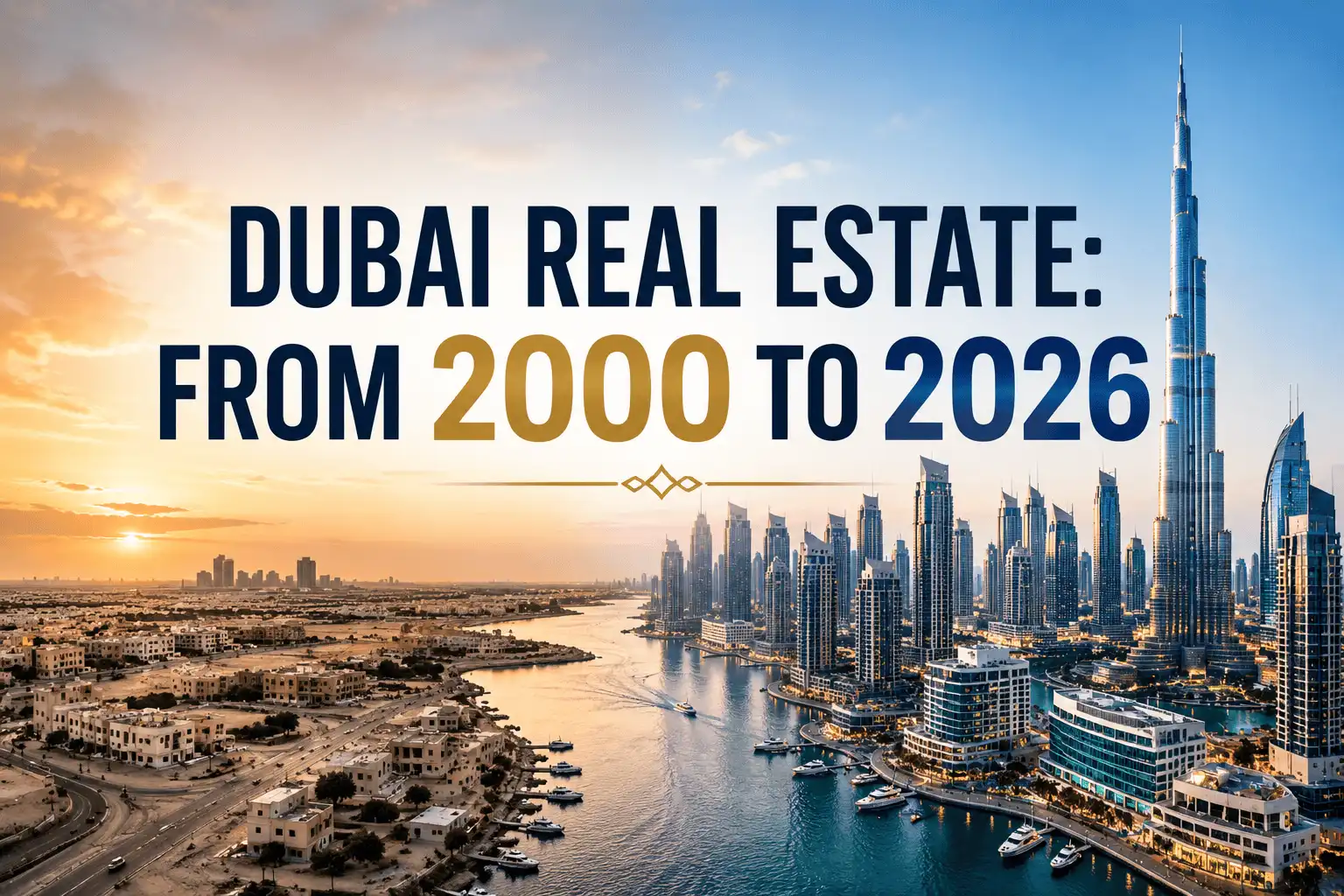
Dubai’s real estate market in 2026 looks almost unrecognisable compared with the market of 2000.
In 2000, Dubai had a population of approximately 862,387. Today, the emirate has grown into a global business, tourism and investment hub, with its population reaching approximately 4.58 million by the end of 2025.
That demographic transformation has gone hand in hand with a dramatic evolution in real estate.
Over the past 26 years, Dubai property has experienced:
• The opening of designated freehold ownership to international buyers
• A massive construction and development boom
• The global financial crisis of 2008
• A severe property correction
• Regulatory reforms
• Recovery and renewed international investment
• The Expo 2020 growth cycle
• The COVID-19 shock and rapid recovery
• The Golden Visa era
• Record-breaking transactions in 2022, 2023, 2024 and 2025
• A new phase of digitalisation and smart real estate in 2026
The story is therefore not simply about rising property prices. It is a story about population growth, infrastructure, regulation, economic diversification, international investment and repeated market cycles.
Dubai Real Estate in 2000: The Market Before the Freehold Era
To understand modern Dubai real estate, we need to go back to the beginning of the 21st century.
In 2000, Dubai’s population was approximately 862,387, according to Dubai’s official census data. The emirate had around 55,659 buildings and 145,363 housing units.
The market was very different from today’s international investment environment.
Foreign ownership was not yet as broadly established as it is today. Dubai’s modern international property market was still developing, while the emirate was simultaneously investing heavily in infrastructure, tourism, aviation, trade and new communities.
This was the foundation for what would happen next.
2002: The Turning Point for Dubai Property
One of the most important years in Dubai’s modern real estate history was 2002.
Dubai began allowing foreign nationals to acquire freehold property in designated areas, creating a major shift in the city’s property market. This opened Dubai’s residential market to a much wider international investor base.
The decision was transformational.
International buyers could now consider Dubai not only as a place to work or visit, but also as a place to own property.
This helped create demand for major developments such as Palm Jumeirah, Dubai Marina, Emirates Hills, Arabian Ranches and Downtown Dubai.
Under Law No. 7 of 2006, non-UAE nationals could, in designated areas, acquire freehold ownership without time restrictions or usufruct/leasehold rights for up to 99 years.
Why 2002 matters: the introduction of freehold ownership fundamentally changed the economics of Dubai real estate. Dubai started becoming a destination for international capital, international residents and international property investors.
2003–2008: Dubai’s First Major Property Boom
Following the introduction of freehold ownership, developers accelerated the launch of large-scale projects.
Dubai’s development model was different from many traditional cities. Instead of simply expanding existing neighbourhoods, developers created entirely new destinations.
Examples included Palm Jumeirah, Dubai Marina, Downtown Dubai, Arabian Ranches, Jumeirah Islands and Emirates Hills.
Population growth supported the expansion.
Dubai’s population increased from 862,387 in 2000 to 1.32 million in 2005, according to Dubai Statistics Center census data. By 2010, the population had reached approximately 1.91 million.
This rapid population growth created demand for housing, offices, retail and hospitality.
But the market also became increasingly speculative. Property prices rose rapidly during the boom.
By 2008, some segments were recording extraordinary price increases. Contemporary market reporting showed villa prices rising by around 50% over two years in certain segments.
The market was moving extremely quickly. Then came the global financial crisis.
2008–2011: The Dubai Property Crash
The global financial crisis dramatically changed Dubai’s real estate market.
The correction began in the second half of 2008 and intensified during 2009.
According to the International Monetary Fund (IMF), Dubai’s residential property prices fell by more than 50% between September 2008 and September 2009.
Another IMF assessment noted that by early 2009, the number of transactions had fallen to around one-quarter of the summer 2008 peak, while prices had fallen by approximately 50%.
By 2012, the IMF reported that real estate prices had fallen by more than 60% from their mid-2008 levels.
The impact was significant. Projects were delayed or cancelled, speculative investors exited the market, financing became more difficult and developers faced serious liquidity pressure.
The lesson was important: Dubai real estate was not immune to global economic cycles.
But the crisis also became a catalyst for regulatory reform.
2010–2012: Regulation, Restructuring and Recovery
After the crisis, Dubai’s property market entered a period of consolidation.
The market became more regulated, and investor protection became increasingly important.
The regulatory framework around developers, escrow accounts, brokers and property registration developed significantly.
At the same time, Dubai continued investing in infrastructure and economic diversification.
The emirate’s economy was no longer dependent on real estate alone. Tourism, aviation, logistics, trade, financial services and business activity all supported property demand.
By 2012, signs of recovery were becoming visible.
Dubai’s reputation as a relatively safe and globally connected business destination also helped attract new capital.
2013–2014: Expo 2020 and the Second Growth Cycle
Another major turning point came in 2013, when Dubai won the right to host Expo 2020.
The event strengthened expectations for infrastructure investment, tourism, business activity and population growth.
DLD data later showed that the market’s quarterly sales activity reached a new post-crisis peak in Q4 2013, with 20,935 sales transactions.
Dubai entered another period of strong property demand.
Communities expanded, infrastructure improved and international investors returned.
However, the market again began experiencing price pressure and oversupply concerns.
2015–2019: Market Correction and Maturation
The period after 2014 was not another straight-line boom.
Dubai experienced a multi-year correction influenced by increased housing supply, lower oil prices, regional economic conditions, changing investor sentiment and global interest-rate conditions.
This period was important because it forced the market to become more mature.
Developers became more focused on project quality, payment plans, end-user demand, community infrastructure and product differentiation.
Meanwhile, Dubai continued strengthening its position as an international city.
The market was becoming less dependent on short-term speculation and increasingly connected to the emirate’s broader economic growth.
2019: Golden Visa Changes the Investment Equation
The introduction of long-term residency programmes added another dimension to Dubai’s property market.
The UAE’s Golden Visa programme created a pathway for qualifying investors to obtain long-term residence.
For real estate investors, the current federal framework provides a 5-year Golden Visa for qualifying real estate investment of at least AED 2 million, subject to applicable requirements.
This changed the way some international buyers viewed Dubai property.
A property purchase could potentially serve multiple purposes: Investment + lifestyle + residency + wealth diversification.
That combination became particularly important for high-net-worth individuals and international entrepreneurs.
2020: COVID-19 Creates Another Shock
The COVID-19 pandemic created an unprecedented global economic shock.
Dubai’s property market initially experienced pressure as lockdowns and travel restrictions affected transactions.
DLD data shows that Dubai recorded 35,400 real estate transactions worth AED72.47 billion in 2020. Of these, 14,356 were off-plan transactions worth AED19.81 billion, while 21,044 were secondary-market transactions worth AED52.66 billion.
April and May were among the most affected months during the lockdown period.
But Dubai’s recovery was remarkably fast.
Government measures, economic reopening, business continuity and international migration helped the market regain momentum.
2021: The Beginning of the Current Dubai Property Cycle
By 2021, Dubai real estate was entering a completely different phase.
DLD recorded 84,772 real estate transactions worth AED300 billion during the year, representing approximately 65% growth in transaction numbers and 71% growth in value compared with 2020.
The market was being supported by Expo 2020, international migration, business relocation, remote-work trends, strong luxury demand, government reforms, long-term residency programmes and international investor confidence.
In 2021, 40.4% of transactions were off-plan, while 59.6% were secondary/ready properties according to DLD.
2022: Dubai Crosses AED500 Billion
In 2022, Dubai real estate reached another major milestone.
Total real estate transactions crossed AED500 billion for the first time, reaching approximately AED528 billion—a 76.5% increase from 2021.
This was significant because it demonstrated that the post-pandemic recovery was not simply a temporary rebound.
Dubai had entered a powerful new growth cycle.
2023: AED634 Billion and a New Record
The momentum continued into 2023.
According to DLD, Dubai recorded more than 166,400 real estate transactions worth AED634 billion in 2023.
The total number of real estate-related transactions across different activities reached approximately 1.6 million, up 16.9% from around 1.368 million in 2022.
The market was becoming significantly larger than it had been during the previous cycle.
2024: AED761 Billion Real Estate Market
Dubai’s real estate sector reached another record in 2024.
According to DLD’s annual report, total real estate transactions reached approximately AED761 billion across approximately 226,000 transactions.
The market recorded around AED522 billion in real estate investments.
That represented approximately 20% growth in transaction value and 36% growth in transaction volume compared with 2023.
According to market data cited in Emaar’s 2024 integrated report, Dubai apartment prices increased approximately 19% during 2024, while villa prices increased approximately 23%.
This was no longer simply a luxury-market story. Demand was spreading across multiple price segments and communities.
2025: Dubai Real Estate Breaks the AED900 Billion Barrier
In 2025, Dubai’s real estate sector recorded more than AED917 billion in transactions across more than 270,000 transactions. The value increased approximately 20% year on year.
The scale of investment was also remarkable.
DLD reported that real estate investments exceeded AED680 billion across approximately 258,600 deals.
The number of investors reached approximately 193,100, an increase of 24%, while the number of new investors reached approximately 129,600, up 23%.
This is an important statistic because it shows that Dubai’s growth is not being driven solely by a small group of existing investors. The investor base itself is expanding.
2026: Dubai Enters a New Phase
By 2026, Dubai’s real estate market had moved beyond simply recovering from previous cycles.
The market was becoming increasingly institutionalised, digital and globally connected.
In Q1 2026, DLD reported:
Total real estate transactions: AED252 billion
Real estate transactions: 60,303
Real estate procedures: 718,160
Transaction value growth YoY: 31%
Transaction volume growth YoY: 6%
Real estate investments: AED173 billion
Investment transactions: 57,744
The first quarter alone generated AED252 billion in total real estate transaction value.
That is a remarkable figure when compared with the entire AED72.47 billion recorded in 2020.
Dubai Real Estate: 2000 vs 2026
The transformation becomes clearer when we compare the beginning and the current market.
Indicator | Around 2000 | 2025/2026
Dubai population | 862,387 | 4.58 million
Foreign freehold market | Not yet established in today’s form | Established in designated areas
Major master communities | Limited | Extensive citywide network
Digital property services | Minimal | DLD digital ecosystem
International investor base | Emerging | ~193,100 investors in 2025
Annual transaction value | Early-stage market | AED917B in 2025
Real estate strategy | Development-led | Strategy 2033 + D33
Market position | Emerging regional market | Global investment destination
The Numbers Tell the Bigger Story
Year | Major Market Milestone
2000 | Population reaches 862,387
2002 | Foreign freehold ownership becomes a major market catalyst
2006 | Dubai formalises key property registration and foreign ownership legislation
2008 | Global financial crisis hits Dubai property
2009 | Residential prices fall more than 50% from September 2008 to September 2009
2010 | Population reaches 1.91 million
2012 | Recovery becomes increasingly visible
2013 | Expo 2020 win strengthens growth expectations
2019 | Long-term residency reforms strengthen investor appeal
2020 | COVID-19 shock; AED72.47B in real estate transactions
2021 | AED300B real estate transactions
2022 | AED528B transactions
2023 | AED634B transactions
2024 | AED761B transactions
2025 | AED917B transactions
Q1 2026 | AED252B transactions
The figures demonstrate something important: Dubai’s real estate story has not been a straight line. It has been a series of cycles.
What Has Driven Dubai Real Estate Growth?
Several structural factors have remained important across different cycles.
1. Population Growth
Dubai’s population increased from 862,387 in 2000 to approximately 4.58 million by the end of 2025. That is more than a fivefold increase.
More residents mean more demand for apartments, villas, offices, retail, schools, healthcare and community infrastructure.
2. International Ownership
The introduction and expansion of designated freehold areas allowed Dubai to attract international property capital. This remains one of the fundamental differences between Dubai and many emerging markets.
3. Infrastructure
Dubai did not build property in isolation. The city simultaneously invested in roads, metro, airports, tourism infrastructure, business districts, logistics, schools, healthcare and entertainment.
4. Economic Diversification
Real estate is only one component of Dubai’s economy. In 2024, real estate activities contributed 8.0% of Dubai’s constant-price GDP, equivalent to approximately AED35.33 billion in value added.
At the same time, Dubai’s economy includes major contributions from wholesale and retail, transport and storage, financial services, manufacturing, construction, tourism and hospitality, and information and communication.
Dubai Real Estate Strategy 2033
Dubai is now looking beyond 2026.
The Dubai Real Estate Sector Strategy 2033 aims to increase the value of real estate transactions by 70% to AED1 trillion, double the sector’s contribution to GDP to approximately AED73 billion, and increase home ownership to 33%.
This is significant.
Dubai is no longer simply asking, “How do we build more property?”
The question has become, “How do we build a more sustainable, transparent, technology-driven and globally competitive real estate ecosystem?”
From Property Sales to Digital Real Estate
Another major difference between 2000 and 2026 is technology.
Today’s Dubai property ecosystem includes digital transaction records, Dubai REST, real-time transaction data, digital property services, AI applications, blockchain initiatives, property tokenisation experiments and digital investment platforms.
In 2025, DLD also entered initiatives exploring blockchain and digital assets in real estate, reflecting Dubai’s broader push toward technology-driven investment infrastructure.
This could become one of the biggest changes in the next phase of Dubai real estate.
What Can Investors Learn From 26 Years of Dubai Real Estate?
Lesson 1: Property Markets Move in Cycles
Dubai experienced a major boom, a severe correction, recovery, another correction, COVID-19 and then an unprecedented growth cycle. Investors should therefore avoid assuming that property prices will only move upward.
Lesson 2: Location Matters
Infrastructure and population growth can dramatically change the performance of individual communities. A location that looks peripheral today may become strategically important as Dubai expands.
Lesson 3: Regulation Matters
The post-2008 market demonstrated the importance of stronger regulation, transparent registration, escrow systems and professional market participants.
Lesson 4: Population Growth Creates Structural Demand
Dubai’s population increase from 862,387 in 2000 to 4.58 million in 2025 is one of the most important statistics in understanding the city’s real estate story.
Lesson 5: Infrastructure and Economy Matter More Than Short-Term Headlines
The strongest property opportunities are generally connected to broader economic and infrastructure development rather than simply short-term speculation.
Dubai Real Estate in 2026: Where Does the Market Go From Here?
Dubai enters the second half of the 2020s from a position of considerable strength.
The market has moved from:
Emerging Market → Freehold Boom → Global Financial Crisis → Regulatory Reform → Recovery → Expo Cycle → COVID Shock → International Investment Boom → Global Real Estate Hub
The next phase will likely be defined less by simply building more towers and more by sustainable urban development, technology, smart property services, population growth, international wealth migration, institutional investment, new communities, infrastructure expansion, regulation and quality of life.
The first quarter of 2026 already shows that demand remains strong, with AED252 billion in real estate transaction value recorded in just three months.
At the same time, investors should remember that record transaction values do not automatically mean every property is a good investment.
Dubai contains hundreds of communities, thousands of projects and very different property segments.
The right questions are:
Which location?
Which developer?
Which property type?
What entry price?
What rental demand?
What payment plan?
What supply is coming?
What is the long-term exit strategy?
Frequently Asked Questions
When did Dubai’s modern real estate market begin?
Dubai’s modern international property market began taking shape around 2002, when designated freehold ownership became available to foreign buyers. The legal framework was subsequently formalised through property registration legislation, including Law No. 7 of 2006.
What happened to Dubai real estate in 2008?
The global financial crisis caused a severe correction. IMF data shows Dubai residential property prices fell by more than 50% between September 2008 and September 2009.
How much was Dubai’s real estate market worth in 2024?
Dubai recorded approximately AED761 billion in real estate transaction value in 2024, across approximately 226,000 transactions.
How much was Dubai real estate worth in 2025?
Dubai’s real estate sector recorded more than AED917 billion in transactions in 2025, across more than 270,000 transactions.
How did Dubai real estate perform in Q1 2026?
DLD reported AED252 billion in real estate transaction value in Q1 2026, up 31% year on year, with 60,303 real estate transactions.
Can foreigners own property in Dubai?
Yes. Foreign nationals can acquire freehold property in designated areas of Dubai, subject to applicable laws and regulations.
Final Takeaway: 26 Years That Changed Dubai
The Dubai real estate story from 2000 to 2026 is much more than a story about rising property prices.
It is a story about transformation.
In 2000, Dubai had fewer than 900,000 residents.
By the end of 2025, its population had reached approximately 4.58 million.
In 2002, international freehold ownership helped open the market to global investors.
In 2008–09, the market experienced one of its deepest corrections.
By 2021, annual real estate transaction value had reached approximately AED300 billion.
In 2022, it crossed AED528 billion.
In 2023, it reached AED634 billion.
In 2024, it reached AED761 billion.
And in 2025, Dubai surpassed AED917 billion.
Then, in just the first quarter of 2026, another AED252 billion in transactions was recorded.
The numbers tell the story of a market that has evolved through multiple cycles and shocks while becoming increasingly global, regulated and technologically advanced.
For investors, however, history should not be used to assume guaranteed future returns.
Instead, it should be used to understand why Dubai has grown, how its cycles work, and which structural factors may continue to influence real estate demand.
Dubai’s first 26 years of modern real estate were about building the city.
The next chapter may be about making that city smarter, more sustainable and even more globally connected.
About Skyline Infrastructure Investments
Skyline Infrastructure Investments provides Dubai real estate advisory and investment guidance for investors looking to understand the market before making property decisions.
Our approach focuses on:
• Dubai market research
• Off-plan and ready property analysis
• Developer comparison
• Location and community analysis
• ROI and rental-yield evaluation
• Payment-plan analysis
• Investment strategy
• Buyer education
India Office
A-708, Urbtech Trade Center, Sector-132, Noida – 201304, Uttar Pradesh, India
Dubai Office
1404, Le Solarium Tower, Dubai Silicon Oasis, Dubai, UAE
+91 79009 80070
skylineinfrainv@gmail.com
skylineinfrainv.com
Disclaimer: This article is for educational and informational purposes only. Historical performance and transaction values do not guarantee future property prices, rental income or investment returns. Buyers should conduct independent due diligence and obtain appropriate professional advice before making an investment decision.
Key Sources for Verification
- Dubai Statistics Center — Dubai population and statistical reports.
- Dubai Land Department — annual real estate reports and 2026 market updates.
- Dubai Media Office — official real estate transaction announcements.
- International Monetary Fund — Dubai/UAE real estate market assessments.
- Dubai Legislation Portal — Law No. 7 of 2006 and related property regulations.
- UAE Government — Golden Visa and property ownership information.













Join The Discussion